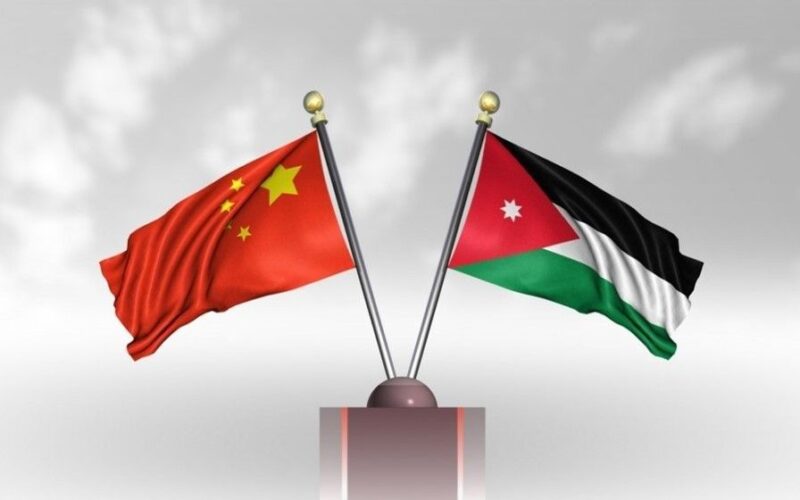
Chinese exports to Jordan reached $6.29 billion compared to under $500 million in Jordanian exports to China in 2025.
Total Chinese investments in Jordan amounted to $3.6 billion between 2010 and 2025.
The energy sector accounted for roughly 89% of total executed Chinese investments in Jordan (2010–2025).
Jordan holds an estimated $400 million in unexploited export potential to the Chinese market.
Expanding Chinese investments and technology transfer strengthens a sustainable economic partnership with China.
The Jordan Strategy Forum calls for establishing a permanent economic cooperation mechanism with China to follow up on agreed projects and convert them into actionable investment opportunities.
AMMAN — Ahead of His Majesty King Abdullah II’s upcoming visit to the People’s Republic of China, and highlighting its importance in advancing bilateral relations and enhancing economic and investment cooperation, the Jordan Strategy Forum (JSF) released a “Knowledge is Power” report titled “Jordanian-Chinese Economic Prospects: Between Trade and Foreign Direct Investment.” The paper examines China’s expanding economic role in the Middle East, current trade and investment dynamics between Jordan and China, and Jordan’s priorities regarding productive investment attraction, technology transfer, and export enhancement to cement its status as a trusted regional production hub.
The JSF paper highlights that technological shifts and power competition are reshaping the global economy, turning trade, investment, and supply chains into direct instruments of economic security. China has emerged as a major industrial, investment, and technological power, while the United States and other advanced economies increasingly prioritize supply chain resilience, export controls, and economic security.
For Jordan, the paper notes that the Kingdom maintains strong strategic ties with numerous regional and international partners to attract productive investments, enhance manufacturing capabilities, and diversify its export base geographically and sectorally to raise economic growth rates and generate sustainable employment.
Against this backdrop, the upcoming Royal visit to China presents a key opportunity to deepen bilateral economic ties, particularly as trade remains heavily imbalanced and Chinese investments are currently concentrated in a relatively narrow range of economic activities in Jordan.
At the regional level, China has established itself as a major economic partner across the Middle East. While its regional engagement initially focused on securing energy supplies, cooperation expanded under the Belt and Road Initiative to cover trade, investment, infrastructure, manufacturing, logistics, and technology.
In trade, Chinese exports to Arab economies reached approximately $293.5 billion in 2025, against imports of around $201 billion, bringing total trade volume to nearly $495 billion. The JSF noted variations in trade dynamics across the region: China’s imports center heavily on energy resources from oil-exporting nations, while it runs significant trade surpluses with non-oil economies.
Chinese outward foreign direct investment (FDI) also represents a key pillar of its international relations. Globally, Chinese FDI grew from $45.8 billion in 2010 to a peak of $215.0 billion in 2017, before declining during 2018–2023 and rebounding to $88.2 billion in 2025. This trajectory indicates that while Chinese overseas investment remains substantial, it has become more selective compared to earlier phases of rapid expansion.
Furthermore, the structure of Chinese overseas investments is undergoing a major shift. Earlier phases focused primarily on infrastructure and traditional energy under the Belt and Road Initiative, whereas investments are increasingly shifting toward renewable energy, electric vehicles (EVs) and batteries, digital infrastructure, artificial intelligence, and advanced manufacturing.
This shift is expected to gain momentum under China’s new overseas investment regulations that took effect on July 1, 2026. These regulations place greater emphasis on compliance, governance, sustainability, and supply chain security—offering Jordan an opportunity to attract responsible, high-value-added investments that facilitate technology transfer, expand exports, and integrate the Kingdom into reliable global value chains.
Regarding bilateral relations, the report emphasizes that Jordanian-Chinese economic ties remain focused primarily on trade rather than investment, manufacturing, or technological cooperation. In 2025, Chinese exports to Jordan stood at approximately $6.29 billion, compared to just $0.43 billion in imports from Jordan, creating a bilateral trade deficit of around $5.86 billion. Jordanian exports remain concentrated in a narrow commodity range, including phosphates, potash, fertilizers, chemicals, and copper.
On the investment front, cumulative Chinese FDI in Jordan totaled nearly $3.56 billion between 2010 and 2025. While lower than figures in Iraq ($12.19B), the UAE ($9.72B), Egypt ($8.29B), Saudi Arabia ($7.02B), and Morocco ($3.93B), it still reflects a significant Chinese investment presence.
China executed 71 investment projects in Jordan from 2010 to 2025, compared to 1,227 in the UAE, 540 in Saudi Arabia, 375 in Egypt, 377 in Morocco, and 30 in Iraq. However, Chinese investment in Jordan was heavily concentrated in a single sector: out of $3.56 billion, the energy sector absorbed roughly $3.17 billion—nearly 89%. Other sectors received limited allocations, including $360 million in consumer products, $19.7 million in automotive, $6.4 million in financial and business services, and just $4.27 million in ICT.
The JSF notes that Jordan’s primary challenge is not merely attracting more Chinese FDI, but diversifying and directing it toward activities that build productive capacity, transfer technical knowledge, develop local suppliers, create high-skilled jobs, and transition Jordan toward higher-value export sectors.
To maximize the outcomes of the Royal visit, the Forum identified five core pillars:
Positioning Jordan as an Export-Oriented Base: Presenting Jordan to Chinese investors as a stable, globally connected base for export production by leveraging its strategic location, skilled workforce, industrial zones, and preferential trade access. This approach pairs Chinese capital, technology, and manufacturing power with Jordanian skills and market access without compromising Jordan’s strategic economic ties with the US, Europe, and other partners.
Diversifying Investments to Align with Economic Vision: Directing Chinese capital toward target sectors under Jordan’s Economic Modernization Vision, such as advanced manufacturing, renewable energy industries, mining, pharmaceuticals, logistics, ICT, agrifood, and tourism.
Focusing on Technology Transfer and Capacity Building: Moving beyond physical capital accumulation to secure partnerships in R&D, innovation centers, technical training, higher education, and commercialization of entrepreneurial ventures—especially in renewables, EVs, digital infrastructure, and AI.
Expanding Jordanian Exports to China: Tapping into Jordan’s estimated $400 million in unexploited export potential to China by streamlining compliance standards, certification procedures, logistics, e-commerce integration, and direct business-to-business links.
Translating Intergovernmental Agreements into Tangible Projects: Connecting investors directly with sectoral opportunities, strengthening ties between chambers of commerce, and building robust communication networks between Chinese and Jordanian enterprises, including SMEs.
The JSF recommended establishing a permanent joint mechanism for economic cooperation and implementation. Composed of relevant government ministries, investment authorities, and private sector bodies, this entity would follow up on commitments, resolve implementation bottlenecks, and identify new commercial opportunities.
The report concludes that the King’s visit provides a pivotal opportunity to drive this transformation forward, turning strategic dialogue into concrete results through investment diversification, export growth, technology transfer, and high-quality job creation.