
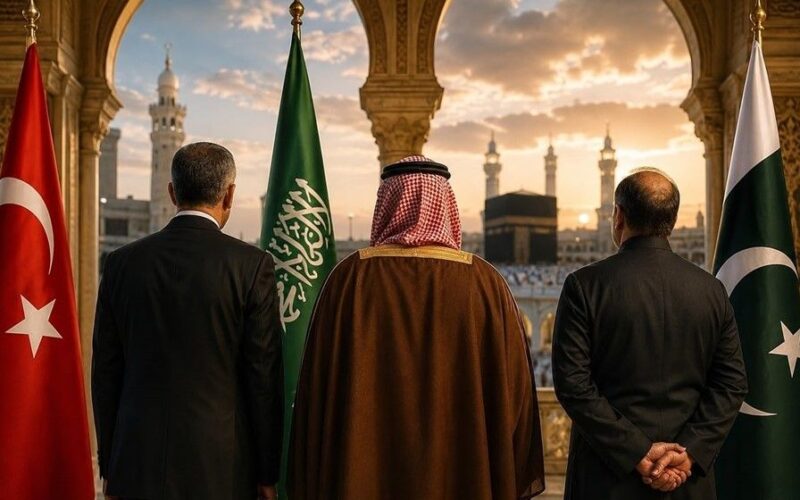
Under no circumstances can the Mecca Mutual Defense Agreement, which brings together three major regional powers Saudi Arabia, Türkiye, and Pakistan be compared to the NATO alliance.
There are enormous differences between the two agreements, leaving little room for comparison.
At its initial stage, the Mecca agreement is no more than a framework for coordination that could be built upon in the future if the three parties demonstrate the necessary political will.
Nevertheless, this unprecedented step in the history of relations between these countries confirms that the region we knew before the events of the past three years has changed dramatically and is heading toward further transformations whose scope remains uncertain.
The developments that have shaken the region since October 7, 2023, have undermined the foundations upon which relations between its states and major powers were built.
Regardless of one’s position on that extraordinary event, no observer can deny that it marked the beginning of a new historical phase in the Middle East, with profound and far-reaching consequences.
The events of these years have shaken the logic of alliances, relations, and strategic positions of numerous countries, before eventually reaching the point of open military confrontation with all possibilities on the table.
The trilateral defense agreement which could become a four-party agreement if expectations voiced by Minister Vidal regarding Egypt’s accession prove accurate is one of the political and security repercussions of the events that have swept the region.
It represents a unique convergence of interests among three capitals that found themselves at the heart of major regional developments.
Pakistan had never been this closely connected to the region’s problems and challenges.
However, the repercussions of its crisis with India and India’s alliance with Israel pushed Islamabad to become more involved in the Middle Eastern environment.
The war against Iran then provided Pakistan with an unprecedented diplomatic opportunity.
Pakistan’s exhausted economy is also a major factor in the alliance.
Türkiye, for its part, had been engaged in a battle for regional influence from the very beginning, even before the events of October 7.
Developments in Syria subsequently gave Türkiye what could be described as a permanent seat on the Middle East’s security council.
The serious deterioration in Ankara’s relations with Tel Aviv, the economic crisis resulting from the war with Iran, and the broader geopolitical transformations affecting the region’s energy and transportation sectors have strengthened Türkiye’s presence in the regional landscape and deepened its relations with Saudi Arabia and numerous Gulf Arab and regional states.
Amid all these sweeping transformations and the threats reaching its borders as a result of the war raging in the Gulf, Riyadh initially moved quickly to conclude a mutual defense agreement with Pakistan, the only nuclear power in the Muslim world.
Building on that step, it subsequently sought to bring Türkiye into the arrangement, creating what could be described according to the Turkish foreign minister as a founding team and a potential starting point for expanding the alliance at a later stage.
In practical terms, the trilateral alliance is still in its infancy, and it is impossible to predict where it will stand years from now.
It is not a substitute for the strategic alliance with the United States, but it sends Washington a message that carries a deep expression of disappointment with the way its administration has dealt with its allies in the Middle East.
It is also undoubtedly a message to Israel’s far-right government, which in turn senses the serious threat posed by what Netanyahu has called the “anti-Israel Sunni axis.”
Tehran is not excluded from the messages of the “Mecca” agreement, even if it is not the intended target of the alliance, as the Turks say. For Saudi Arabia, however, Iran is currently the primary source of threat.
In the foreseeable future, the three countries will use the agreement to expand cooperation in political, defense and security, and economic fields, as well as provide logistical support in emergencies when requested nothing more.
What remains clear for now is that the Arab and Gulf defense cooperation frameworks have receded in favor of a broader regional alliance.
Related Stories

Why Isn't the War Being Decisively Ended?
How Will Jordan Settle the Battle?