
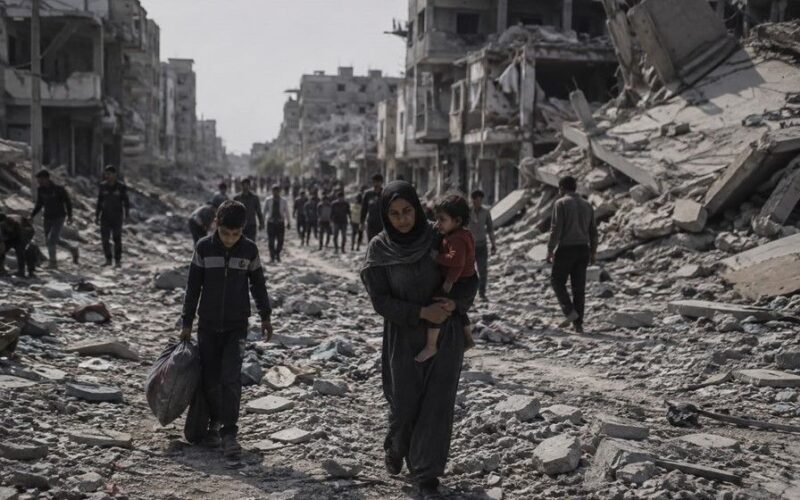
The flow of aid into the Gaza Strip has declined significantly due to Israeli restrictions, while international attention to Gaza has also waned, as if we were witnessing a forgotten war with all its humanitarian costs.
Days ago, Justin Brady, head of the United Nations Office for the Coordination of Humanitarian Affairs (OCHA) in Palestine, warned that Gaza is facing a food emergency that could reach Phase 5 of the international food security classification the stage at which famine is officially declared.
Brady said that 67% of the population in the Strip is suffering from food insecurity, while nearly 10% are approaching the brink of famine.
More than 4,000 children require urgent care, alongside breastfeeding women who need additional nutritional and health support. These figures are based on a technical assessment involving more than 60 experts from 20 different organizations, underscoring their reliability.
This is merely one example of the forgotten war whose humanitarian costs starvation, illness, the absence of education, and the lack of economic opportunities are no longer receiving sufficient attention. At present, discussions surrounding Gaza largely focus on three issues: disarmament, the administration of the Strip, and reconstruction.
The staggering numbers of those killed, missing and wounded, many of whom have suffered injuries that cannot be treated, are horrifying. Everyone follows these figures and knows the scale of the suffering.
Yet there has been a noticeable decline in the intensity of international attention to the humanitarian dimension and to the lives of Gazans after this war.
During the war, Gazans complained of being left to fend for themselves despite the efforts made by Arab, Muslim and Western countries.
Yet the reality is now far worse, particularly as the humanitarian crisis has become chronic. Meanwhile, the world is preoccupied with other conflicts involving Iran, Syria, Yemen, Iraq, Ukraine, Russia and Lebanon, pushing Gaza’s crisis into the shadows and away from the spotlight.
The impact on people’s lives caused by the absence of education and healthcare, shortages of food, medicine, water and electricity, and the lack of employment opportunities constitutes a war in itself, rather than merely the aftermath of a war.
This raises questions about the humanitarian dimension and the role of Arab countries and the international community in alleviating the human cost of a war whose consequences we witness every day.
We have seen this pattern in several crises across the region. By way of comparison, rather than equating the situations, the Syrian uprising initially attracted significant international attention to the chaos, killings and displacement taking place in Syria.
Yet the same parties that had shown concern gradually reduced their attention, until the Syrian crisis became a crisis for Syrians alone, as well as for neighboring countries dealing with its consequences.
All of this suggests that abandoning suffering populations is nothing new. In many cases, people are left to face their own fate and pay the price of the crisis.
This confirms that international moral rhetoric is often used politically for a limited period until its objectives are achieved, after which a people may be left to confront its own destiny.
The Gaza Strip needs a new Arab and international campaign to strengthen humanitarian protection for its people as they face a range of internal crises from orphanhood and poverty, through starvation and disease, to the loss of any prospects for the future.
Related Stories

Expanding Social Security Coverage

The Least Reshuffled Prime Minister in Jordan