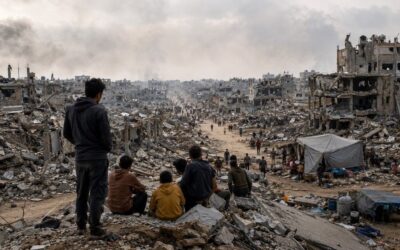
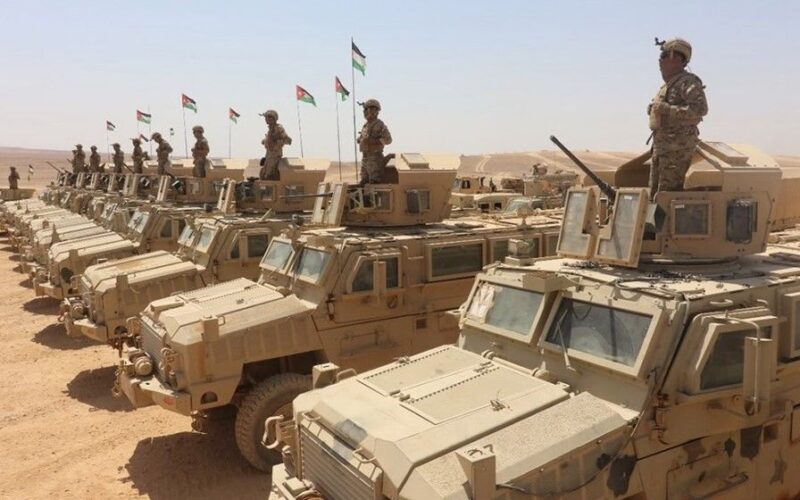
There is a fundamental difference between a state and militias, a state possesses institutions, legitimacy, the rule of law, an army, allies, and a people who understand that the survival of the state is the survival of everyone.
Militias, no matter how much weaponry, media influence, or funding they possess, thrive on chaos.
They derive their strength from instability and collapse when confronted by a state that knows exactly what it wants.
Therefore, any attempt to undermine Jordan’s security is not a balanced confrontation between two equal sides; rather, it is a clash between a state-building project that has existed for more than a century and groups that can survive only outside the authority of the law.
Let me briefly revisit history, Over the past fifteen years Jordan has existed within one of the world’s most volatile security environments.
Since the outbreak of the Syrian conflict in 2011, its northern border stretching approximately 375 kilometers has become one of the Middle East’s most sensitive frontiers.
Across that border emerged armed groups, smuggling networks, terrorist organizations, and transnational criminal gangs, creating conditions that could have plunged almost any country into chaos.
Yet Jordan remained steadfast, preserving its internal security and political stability while maps and realities shifted across the region.
This resilience was not the product of chance, It was, after God’s protection, the result of a security doctrine based on proactive action rather than reaction.
Genuine security success is measured not by the number of confrontations that occur, but by the number of threats neutralized before they ever reach the streets.
This approach has earned Jordan’s security services a strong regional and international reputation for their ability to gather intelligence, analyze information, and respond swiftly and effectively.
Jordan’s experience in combating terrorism provides perhaps the clearest example.
Following the 2005 hotel bombings in Amman, the state did not treat the attacks as a temporary crisis but as a turning point in building a comprehensive national counterterrorism framework.
Legislation was strengthened, coordination between the Armed Forces and security agencies was enhanced, and significant investments were made in intelligence and technological capabilities.
As a result, Jordan became one of the region’s most successful countries in foiling terrorist plots before they could be carried out.
When the Rukban military outpost came under terrorist attack in 2016, the response extended beyond military action, It included a comprehensive review of border security procedures, increased operational readiness, and the development of new rules of engagement suited to evolving threats.
The message was unmistakable: Jordan’s security is a red line, and sovereignty is not merely a political slogan but a decision enforced on the ground.
Another battle soon emerged one no less dangerous: the war against drug trafficking and cross-border smuggling along the northern frontier.
These operations were not simply criminal enterprises seeking financial gain. They often became intertwined with armed groups and organized networks attempting to use smuggling as a tool to undermine security and stability.
Once again, the Jordan Armed Forces demonstrated their ability to respond decisively, repeatedly announcing the thwarting of infiltration and smuggling attempts and the seizure of large quantities of narcotics and weapons, under a clear policy that Jordan’s borders are not vulnerable to violation.
Those who believe they can exhaust Jordan overlook the fact that the Jordanian state was never built under stable circumstances.
Since the establishment of the Emirate in 1921, Jordan has faced regional wars, economic crises, successive waves of refugees, and instability in neighboring countries.
Yet its institutions have continued to function, the state has endured, and it has maintained its regional and international role with confidence and efficiency.
Jordan’s strength does not stem solely from its military capabilities, despite the professionalism of its Armed Forces.
It is rooted in an integrated system that includes the security establishment, the judiciary, public administration, political leadership, and social cohesion.
States do not prevail through military force alone; they succeed through unity of purpose, citizens’ trust in their institutions, and the ability to manage crises without losing balance.
By contrast, militias regardless of the slogans they raise or the media tools and financial resources they possess consistently face the same fundamental weakness: they cannot build a state, govern a society, or produce lasting stability.
History across the region is filled with groups that appeared powerful at certain moments but ultimately declined when confronted by states with strong institutions and clear political will.
Jordan does not seek escalation, as its political doctrine is based on stability and good-neighborly relations.
At the same time, however, it will not tolerate any infringement on its sovereignty or the security of its citizens.
This balance has safeguarded the Kingdom for decades and will remain the cornerstone of its ability to confront future threats.
In conclusion, betting on destabilizing Jordan’s security is a losing proposition. History demonstrates that the Kingdom has overcome far greater dangers.
Geography places it in one of the world’s most turbulent regions, reality confirms that its military and security institutions have accumulated decades of experience, making them better prepared than ever to confront any new challenge.
Related Stories

A Skin That Cannot Be Stolen Inspired by the Scottish Legend of The Selkie

The Alternative to the Regime May Be Worse Than the Regime