
Economic growth has long been,
and continues to be, the subject of extensive debate among economists worldwide,
not only about its importance, but also its limitations as a measure of
economic performance and the success of public policies.
Despite the heavy reliance on gross domestic product
growth as a principal indicator of economic progress, GDP growth alone does not
reveal how the benefits of growth are distributed, the quality of the jobs it
creates, or its actual impact on living standards and economic and social
rights.
There is no doubt that economic
growth is necessary to expand available resources, increase productive
capacity, and create new economic opportunities.
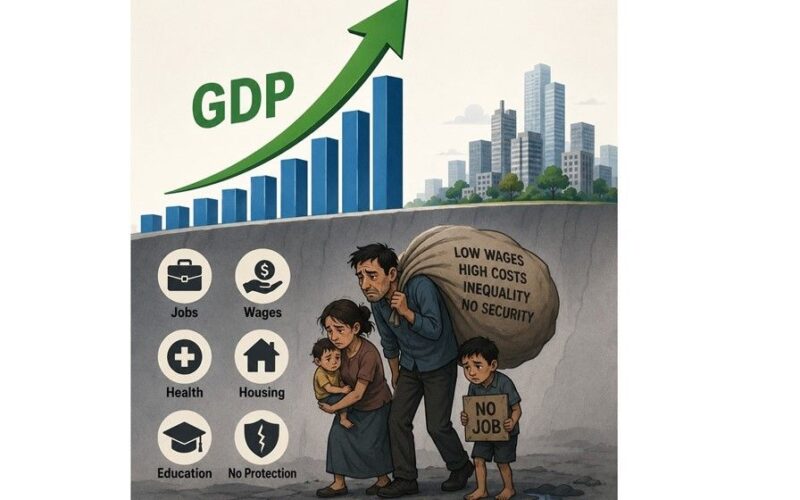
However, higher GDP does not
automatically improve the lives of most of the population, particularly in
countries facing high levels of unemployment, poverty, and inequality.
The
economy may grow while real wages decline, income gaps widen, the costs of
education, healthcare, housing, and transportation increase, and opportunities
for decent work remain limited.
In this context, the report
issued in June 2026 by the United Nations Special Rapporteur on extreme poverty
and human rights provides further evidence in support of this line of thinking.
The report makes clear that higher rates of
economic growth do not necessarily translate into poverty reduction or improved
enjoyment of rights unless they are accompanied by policies that ensure a
fairer distribution of resources, promote decent work, improve public services,
and expand social protection.
Macroeconomic figures can hide
significant disparities in the distribution of the returns generated by
economic activity, Growth may be concentrated in capital-intensive sectors or
sectors with limited employment-generating capacity and therefore may fail to
create sufficient numbers of jobs.
A large share of the returns from growth may
also accrue to a limited number of companies and social groups, while low- and
middle-income households continue to face rising prices, weak wages, and
declining public service quality.
For this reason, economic
performance cannot be assessed solely through the GDP growth rate.
A more
accurate evaluation requires a broader set of indicators, including
unemployment and poverty rates, real wage levels, the coverage and adequacy of
social protection, and the quality of education, healthcare, housing, and
transportation services. It should also measure economic and social disparities
across different groups and regions.
The quality of growth is no less
important than its rate. Growth based on low wages, informal employment, weak
social and labour protection, and the depletion of natural resources may
produce temporary gains in statistical terms, but it also accumulates economic
and social imbalances that are difficult to address over the long term.
Sustainable
and equitable growth, by contrast, should be based on developing productive,
value-added sectors, creating decent work opportunities, building a fairer tax
system, strengthening public services, and expanding social protection.
The issue, therefore, is not to
diminish the importance of economic growth or to call for abandoning it, but
rather to redefine its place within a broader framework of economic and social
objectives.
Growth should not be treated as an end, but as a means of improving
people’s lives, expanding their choices, and strengthening their economic and
social security.
Accordingly, successful economic
policy should be measured by its ability to translate growth into higher
incomes, more stable jobs, better-quality public services, broader social
protection, and lower levels of poverty and inequality.
An increase in GDP that
is not accompanied by a tangible improvement in the lives of the majority of
the population remains little more than a numerical achievement with limited
economic and social significance.
Related Stories

So the Local Administration Reform Does Not Fail

What Was Discussed Between the Deputy Prime Minister and the Syrians