
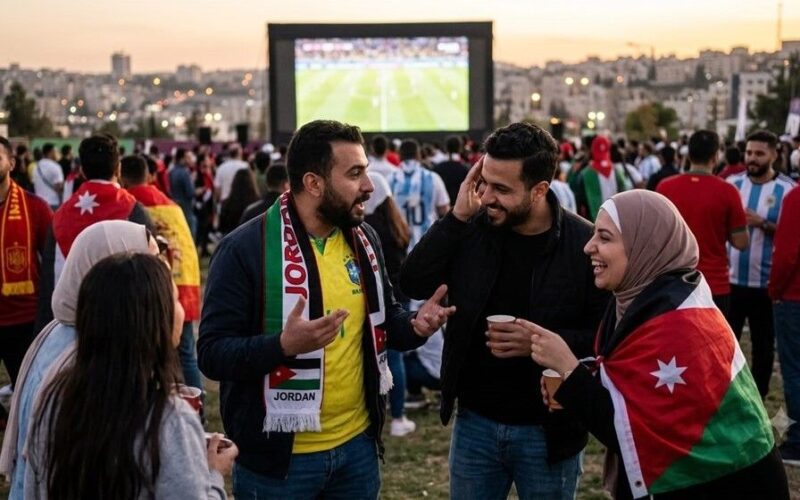
Jordan’s historic qualification for the FIFA World Cup for the first time has made the tournament far more meaningful to Jordanians.
Many people who had never paid much attention to football suddenly found themselves following the competition because the national team, the Nashama, was taking part.
It was not unusual to see people with only a basic understanding of the game heading to public fan zones across the country in the early hours of the morning to cheer on their team.
Their motivation went beyond football. It was about expressing national identity, embracing competition, and supporting what they saw as a reflection of both personal and collective aspirations.
Once Jordan was eliminated in the group stage, the atmosphere inevitably changed.
A large segment of supporters whose loyalty was exclusively to the national team gradually lost interest in the tournament. For them, the World Cup season ended the moment the Nashama’s campaign came to a close.
Others, however, quickly returned to their long-standing allegiances. Many Jordanians have spent decades supporting traditional football powers, and after Jordan’s exit as well as the elimination of fellow Arab teams, particularly Egypt and Morocco they resumed cheering for their favorite international sides.
Football possesses a unique ability to inspire multiple layers of loyalty, You begin by supporting the team closest to your heart, then gradually extend your enthusiasm to nations with which you may have no cultural, historical, or geographical connection.
Sometimes all it takes is admiring a single player to develop an emotional attachment to an entire national team, without ever fully understanding why.
People are often asked why they support Brazil, Spain, or another footballing nation. Most cannot provide a logical explanation.
The answer usually lies in childhood memories, early experiences watching football, or a spontaneous emotional connection. Supporting a team often happens instinctively much like love at first sight without conscious reasoning.
This instinct is not limited to football, even when watching two unfamiliar teams compete in any sport, people often find themselves naturally rooting for one side over the other, perhaps simply because of a jersey color or an unexplainable feeling.
Taking sides is a fundamental part of human nature, It extends far beyond sports and shapes many aspects of everyday life.
What distinguishes sport from politics, however, is that sporting loyalties rarely carry lasting consequences.
More often than not, they do not breed hostility. This is precisely why the expression “sportsmanship” has become synonymous with accepting defeat gracefully, whether in elections, competitions, or life’s many challenges.
Perhaps the most disappointing aspect of this World Cup has been seeing political rivalries spill into the world of sport. Football, one of humanity’s greatest games, should remain a celebration of athletic competition rather than becoming another arena for political divisions, polarization, or judgments based on geopolitical power.
The widespread support shown for smaller and less-favored nations that competed with remarkable courage reflected something deeper than football.
It represented a natural desire to stand with the underdog against those perceived as more powerful or dominant. In many ways, this can be seen as an expression of the human conscience a belief that determination and courage deserve recognition regardless of a nation’s wealth, influence, or military strength.
Ultimately, supporting a team in sport offers something increasingly rare in today’s world: a sense of joy, belonging, and inner peace.
At a time when many areas of public life have become dominated by anger, division, and hostility, sport remains one of the few places where passion can unite rather than divide, and where competition can still be celebrated in the true spirit of the game.
Related Stories

How will Jordan solve the bridge crisis?

A Key Opportunity to Reduce Unemployment Rates