
5 Affordable Android Phones That Have More Power Than The Google Pixel 10a
We may receive a commission on purchases made from links.
Google’s Pixel lineup of smartphones is a great way to experience Android in its purest form. Current-gen Pixel phones come with the latest version of Android out of the box, are first in line to receive new updates, and receive support for a very long time — 7 years, to be exact. This makes them a compelling alternative to the iPhone, which also has excellent software support. Of course, if you’re looking for an apples-to-apples comparison, the top-of-the-line Pixel 10 Pro is what you should be considering if you want to match the experience the latest iPhone 17 Pro offers.
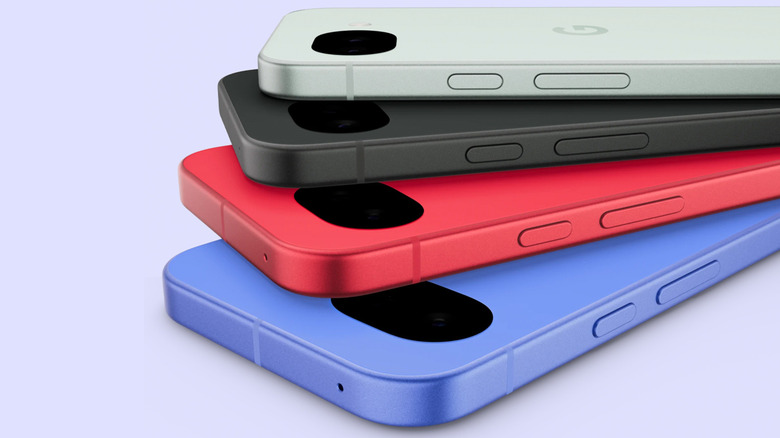
Nearly every smartphone manufacturer that markets and sells flagship phones also offers a few options in the budget segment. For Google, that phone is the Pixel 10a. Powered by last year’s Tensor G4 SoC, packed with 8GB of RAM, and featuring a great dual-camera setup on the rear as we’ve explored in our review of the Pixel 10a, it’s a solid option to consider if you’re shopping in the sub-$500 price range.
The Pixel 10a does cut a few corners to achieve its price tag
For starters, it isn’t exactly the best performer in its segment. Fortunately, there are a number of solid contenders that give the phone a run for its money, five of which we highlight below. Do note that a few of our picks aren’t officially sold in the U.S. Though you can import them from trusted channels, carrier compatibility might be a hit or a miss.
OnePlus 15R
At $700, the OnePlus 15R is costlier than the 256GB variant of the Pixel 10a, but once you peep everything it has to offer, it starts looking like a steal even at a $100 premium. For starters, it’s powered by the Snapdragon 8 Gen 5 SoC, which sits a notch below the 8 Elite Gen 5, the most powerful Android chipset at time of writing. Compared to the Pixel 10a’s dated Tensor G4, which even at launch struggled to keep up with the competition, the OnePlus 15R offers substantially better performance.
You also get 12GB of RAM, which helps keep apps in memory for longer and is equipped to handle AI workloads better in the longer run. At 6.83 inches, it’s also a much bigger phone than the Pixel 10a. It features an AMOLED panel that can refresh up to 165Hz in supported games, with a peak brightness of 3,600 nits in specific HDR scenarios. Overall, with a smaller hole-punch notch and slimmer bezels, the 15R provides for a more impressive multimedia experience.
If offering some of the best performance in the segment wasn’t enough, the OnePlus 15R also packs in one of the biggest smartphone batteries in the U.S. At 7,400 mAh, it offers roughly 50% more capacity than mainstream flagships. In our review of the OnePlus 15R, the phone offered exceptional battery life as expected, with impressive charging speeds of up to 80W with the included power adapter.
Samsung Galaxy S25 FE
Samsung is the largest Android manufacturer globally, and although its flagship Galaxy S series gets widespread attention, the company also dominates in the mid-range and budget-oriented segments. With a catalog so wide, there’s a Samsung smartphone at every price point you can buy. The Galaxy S25 FE is an upper mid-range offering that provides nearly the same experience as its costlier siblings but manages a lower price tag by trimming back a few premium extras.
The phone is powered by Samsung’s in-house Exynos 2400 SoC, which offers noticeably better performance than the Tensor G4 found inside the Pixel 10a according to NanoReview. It matches RAM capacity at 8GB and you still get a useful set of AI features. One UI, once known for being packed with bloat, has streamlined in terms of design over the years and doesn’t feel sluggish anymore. The display is a 6.7-inch LTPO AMOLED panel with a 120Hz refresh rate emitting up to 1,900 nits of peak brightness.
Like Google, Samsung promises up to 7 years of OS updates to the Galaxy S25 FE. You get a triple camera setup that includes a 50-megapixel wide, a 12-megapixel ultrawide, and an 8-megapixel 3x telephoto lens. There is support for 45W of fast wired charging, which tops up the 4,900 mAh battery relatively quickly. Though it retails at $650 for the 128GB variant, it can often be picked up for under $600 with deals on marketplaces like Amazon.
Poco X7 Pro
Xiaomi is already well regarded for manufacturing some insanely good value flagships, but its Poco sub-brand that operates in the mid-range segment addresses its competition even more aggressively. The Poco X7 Pro is a gaming-centric handset that’s powered by the MediaTek Dimensity 8400 Ultra SoC. It offers superior performance, managing to hit scores around 40% higher than the Tensor G4 in AnTuTu benchmarks.
The Poco X7 Pro features a 6
67-inch AMOLED display with a 120Hz refresh rate and a touch sampling rate of 1,920Hz. It offers a dual camera setup with a 50-megapixel wide and an 8-megapixel ultrawide sensor, which GSMArena called “mostly mediocre.” However, the review also called it the most powerful smartphone in its price range, rating the phone 4.2 stars overall. The global variant of the phone packs in a 6,000 mAh silicon carbon battery, offering up to 90W of wired charging speeds.
The phone runs a customized version of Android 15, dubbed HyperOS, and is set to receive at least three major OS updates and 4 years of security patches. The phone is priced impressively well at $410. This gets you 256GB of storage and 12GB of RAM. Although Xiaomi predominantly operates in Asian markets, the Poco X7 Pro is available in the U.S. through Amazon. There is support for select carriers, but ensure you verify network band compatibility with your provider before buying the device.
OnePlus Nord 6
Despite rumors surrounding the company’s global shutdown and market exits recently, OnePlus has been hard at work as usual, delivering value offerings. The OnePlus Nord 6 is the latest by the company’s budget-oriented sub-brand, and it is packing a lot of heat. It’s powered by the Snapdragon 8s Gen 4 SoC, which beats the Tensor G4 in every regard by a landslide. You also get up to 12GB of RAM and 256GB of fast UFS 4.1 storage.
The Nord 6 is marketed for gamers, which is made apparent by its 6.78-inch AMOLED panel that can hit refresh rates of up to 165Hz in supported titles, similar to the OnePlus 15 we’ve previously reviewed (its costlier elder sibling). The phone offers a touch sampling rate of 3840Hz, which makes on-screen input feel even more responsive. You also get a dual camera setup at the rear with a wide and an ultrawide lens, but the real star of the show is the gigantic 9,000 mAh silicon carbon battery and support for up to 80W of wired charging.
OxygenOS powers the experience, and OnePlus promises up to 4 years of OS updates for the Nord 6. Its price, after conversion, turns out to be around $415 for the 8GB RAM variant. Unfortunately, the OnePlus Nord 6 is exclusive to the Indian market; in China, it’s sold as the OnePlus Turbo 6.
RedMagic 11 Air
If you’re looking for a gaming-centric smartphone that’s also available in the U.S., RedMagic is the brand to default to. The RedMagic 11 Air is priced the same as the Pixel 10a at $500 but offers substantially more horsepower. For starters, it’s powered by the Snapdragon 8 Elite SoC, which, on paper, is more than twice as powerful as the Tensor G4 found in the Pixel 10a. Despite being a generation older, the Snapdragon 8 Elite can handle any modern mobile game you throw at it at maxed-out settings with high frame rates.
The RedMagic 11 Air sports a few unique additions, like capacitive shoulder triggers on the side that get you more control in supported games. Even the 6.8-inch 144Hz AMOLED display offers something that you won’t find on most smartphones — a notchless, continuous experience. Though this does put a dent in selfie quality, that may be a sacrifice hardcore gamers may not mind making. The phone is actively cooled by a fan and a vapor chamber.
You also get more RAM at 12GB and twice the storage that the Pixel 10a provides. The 7,000 mAh silicon carbon battery, as highlighted in TechRadar’s review, makes this a multi-day phone with moderate usage. When it’s time to top it up, there’s an 80W adapter included. You also get an inarguably more interesting design with the RedMagic 11 Air, and you can spec it up to 16GB of RAM and 512GB of storage for just $100 more.