
10 Subtle Airplane Cabin Features That Are Usually Only Noticed By Frequent Flyers
We may receive a commission on purchases made from links.
Many passengers have other things on their mind when they board a plane, like finally enjoying their long-awaited vacation or thinking about the possibilities of their next business meeting. But if you’re a frequent flyer and have been taking flights for several years, you would’ve probably noticed the subtle differences as airlines upgraded their cabins and bought newer jets, even as these jets have looked the same for more than 50 years. You might’ve even observed the various amenities that competing airlines offer — say, if you switched from a low-cost carrier (LCC) to a legacy airline — and how they affect your convenience while in the air.
So, let’s look at a few subtle airline cabin features that only frequent flyers and enthusiasts notice. We’re skipping out on crew features like crawl spaces on some long-haul flights where pilots and cabin crews sleep, as most passengers will never get to see these. Instead, we’ll list amenities that you could enjoy when you board a plane that offers them.
USB ports
As battery-powered devices that are powered through USB ports became more popular, more passengers started bringing and using power banks on flights. However, there have been multiple news stories of these gadgets bursting into flames onboard, which is why many airlines have started banning their use on flights. Still, they recognize the need for people to keep their phones, tablets, and other electronics charged, especially for airlines that do not offer any sort of in-flight entertainment and whose passengers must rely on their own gadgets to keep themselves entertained.
That’s why airlines have started adding USB ports to their seats, allowing people to top up their devices, especially on long flights. It’s also a simpler solution for many airlines, as traditional AC plugs must cater to various international standards, like plug types, voltages, and even frequencies. While some companies provided a solution that’s compatible with the majority of the world, USB ports are still far more accessible, especially as many electronic devices now support USB-C as standard and many laptops can now be recharged via USB-C. The only downside is that passengers need to bring their own USB cable, but almost everyone does this anyway, especially if they’re traveling for several days.
Still, you must know that not all planes feature a USB port, especially if you’re flying on an older model with an LCC. Based on my experience, these are often found between the seats, near the end of the armrest, or near the screen, if your plane is equipped with one. If you can’t find a USB port at your seat, it’s best to ask the cabin crew where it’s located, if the plane offers one.
A larger space over your head
One of the issues that passengers must contend with is the lack of overhead bin space, especially when traveling on a crowded flight. For example, Boeing says that the standard configuration of the Boeing 737 Max 8 can only hold 118 bags in all the overhead compartments — a major issue for a plane that holds a maximum of 189 passengers in a single-class configuration. On the other hand, the company’s Space Bins configuration holds 178 bags, providing over 50% more space for everyone. Airbus also has a comparable upgrade it calls the Airspace XL bins. While some people might still need to keep their bags under their seats, newer designs like these mean that there’s a smaller chance that you’ll have no place to put your items, forcing you to gate-check your suitcase.
Another design change I noticed as someone who’s been flying since the 1990s is the difference in how the overhead cabin compartments work. Back then, they were fixed directly on the cabin roof, with their doors opening upward to reveal the space inside. However, newer designs have the entire bin move upward to close and secure your luggage in flight. Aside from the larger baggage space that they offer, they also have the side effect of providing a larger overhead space to passengers. This makes the cabin feel more spacious and less claustrophobic, even if you’re seated in the economy section of a plane.
Adaptive ambient lighting
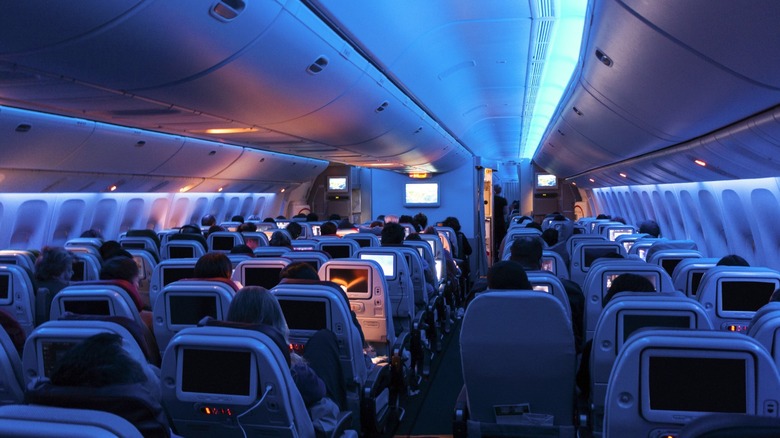
Airlines dim or turn off the cabin lights during takeoff and landing for safety, and while the lighting change happens gradually, you’ll still notice this happening over a number of seconds. But as LED technology progressed, new systems gave airlines more lighting functionality and control. These allowed them to incorporate subtle color branding while also improving the mood inside their cabins.
I experienced this when I flew for the first time on a Boeing 737 Max 8 that had the adaptive lighting feature. Since it was a red-eye flight, the cabin lights were dimmed gradually to enter night mode and let the passengers sleep. However, I only noticed that the lights went out when it was already completely dark and I could no longer see what I was reading.
However, note that the availability of this tech will again vary by airline, aircraft type, and even specific jets that haven’t been retrofitted yet. Companies with a large fleet of older jets might take their time to install this upgrade and only do it when a particular airframe undergoes a major maintenance check or modification. LCCs, especially those that often do not fly long distances, might even forgo installing this feature on their aircraft altogether to save on costs and keep fares low.
Dimmable windows on newer aircraft models
Some of the latest aircraft models, namely the Boeing 787 and the Airbus A350, already offer dimmable windows to their customers in lieu of the traditional window shades. The Airbus A330neo will also receive this feature starting in 2027. So, if you only take short-haul regional flights, there’s a lower chance that you’d experience these dimmable windows, especially as the aircraft that feature them are typically used for long-haul flights. What makes them unique from traditional windows is that they’re electronically adjusted if you want to limit the amount of light entering your window. So, if you still want to see outside but don’t want to be blinded by the sun, you can lower the opacity of the tint without totally blocking out the view.
Aside from giving passengers finer control of how much they can see outside, Gentex Aerospace, the maker of this technology, also claims that it reduces maintenance costs while offering a larger window design for a better view outside. It also allows cabin crew to centrally control the window tint, ensuring that the windows are open during critical phases of flight like takeoff and landing for safety, without having to individually check each row to see if the passengers are complying.
Wi-Fi powered BYOD onboard entertainment
In-flight entertainment (IFE) systems are quite expensive to install, and they also add weight to the aircraft, resulting in higher fuel burn for each flight. This results in higher costs for the airline, which it must then pass on to its customers. So, a few companies now offer a wireless IFE solution that lets passengers use their own devices to “stream” movies, TV shows, music, and even play games through the browser on their gadgets without needing an internet connection.
Although some airlines also offer onboard Wi-Fi to let their passengers use the internet, these often carry an additional cost that people might be unwilling to pay. Furthermore, service might be spotty, depending on the weather, location, and type of connection that the airline has, resulting in frustration over slow connections. So, this Wi-Fi-powered BYOD (bring-your-own-device) entertainment service gives passengers and airlines the best of both worlds when it comes to in-flight entertainment.
I got to accidentally try this system during my last flight, and it was so convenient to use that I didn’t even need guidance from anyone, despite it being my first time. You see, most of the airlines that I fly on usually have seatback IFE systems or don’t offer them at all. Since it was my first time flying with that particular airline after more than 20 years, I got curious if they offered in-flight Wi-Fi and noticed that there was an open Wi-Fi network onboard. All I did was connect to it and open my browser, and I was immediately greeted with the home page of the plane’s IFE system. Because of that, I spent the entirety of that four-hour flight watching a movie and playing a couple of games.
Wired in-flight entertainment screen controller
I’ve flown numerous times on legacy carriers, and some of them use older jets that do not have wireless or touchscreen IFE systems, especially in the economy section where you’ll typically find me. This means that passengers must rely on a wired controller to navigate through the system and choose what they want to watch, listen to, or play. Some airlines even offer telephony services right at the seat, and you can swipe your credit card on the controller itself to pay for it.
What’s interesting, though, is that since the IFE is designed for gaming, media consumption, and, in some cases, telephone conversations, the controllers must do a lot of things. For example, the controller on the EVA Air jet that I flew on had a remote-control layout on one side and a gaming console controller layout on the other to play the games on the plane’s IFE system. While they are not as ergonomic as your favorite DualSense or DualSense Edge PS5 controllers, they do a good enough job of keeping you entertained for the duration of your flight.
Some newer aircraft already feature touchscreen systems, meaning they no longer need to have wired controllers like these in the seats. But if you get the chance to ride an older wide-body aircraft from a legacy carrier, you might still get the chance to use these old gadgets and feel what flying was like in the 2000s.
Unique earphone jacks that do not let you connect your own earphones
Many older jets still use a dual-prong adapter that requires two 3.5 mm jacks to use, and they then lend a pair of earphones to their passengers to listen to the IFE system. Airlines primarily used these jacks, which are incompatible with most modern electronics, so that passengers would not take the earphones home with them. After all, even though these accessories might feel cheap, passengers taking them home for use with their personal devices would quickly add up in costs.
However, as earphones have become more common, some airlines are replacing these old two-prong jacks with the standard single one. After all, earphone costs have started going down, with basic wired earbuds costing under $10 on Amazon. Airlines could probably get them for much cheaper, especially if they order large quantities of even more basic models, or they’ll just sell earphones to passengers who forget to bring one onboard. Another advantage with airlines upgrading to a single jack is that you can now use your own pair of high-quality earphones if you have the proper cable, with some airlines even letting you connect your Bluetooth earbuds to IFE.
Unfortunately, this is only available on some newer jets, and many older planes still rely on the traditional two-prong jack. You can easily purchase a cheap airplane adapter online to solve this problem, allowing you to use your IEMs or wired earbuds with the plane’s IFE. But if you insist on using your AirPods, you can get a Bluetooth audio transmitter for less than $35 to pair it with the adapter.
Lower deck lavatory in the Airbus A340
The Airbus A340 stands as one of the last four‑engine airliners still in service, with Lufthansa being the single largest operator, with 15 in service. However, these jets are nearing retirement, with the airline planning to phase them out in the second half of 2026. While this big quad-jet is mostly known for its tiny engines, Lufthansa’s fleet also has one unique quirk not found in any other A340 — the lower-deck lavatory.
These are bathrooms installed in the plane’s belly and are accessible via a set of stairs, making room for six to 10 more paying passengers on the main deck and reducing aisle congestion when multiple people take bathroom breaks simultaneously, especially during a long-haul flight. However, it does reduce the number of cargo pallets that the plane can carry and makes maintenance and operations a bit harder.
Unfortunately, there have been no reports that Lufthansa (or any other airline) will implement a lavatory layout like this. So, once Lufthansa’s A340s have taken their last flight, passengers will also no longer have the chance to relieve themselves in the belly of the plane at 35,000 feet.
Hidden button to lift the aisle seat armrest
While you may not think much of an armrest, it’s quite crucial in airplane seats as it can give you a place to rest your arm and lean on during long flights. However, it can also get in the way if you want to lean on your companion or when you’re getting in or out of your seat. Many middle and window seats have their armrests that can move up and out of the way if you want the extra space, but aisle seats are typically set in the down position.
Keeping armrests upright could become an obstacle in case of an emergency, which is why they’re required to be set in the down position during takeoff and landing. But once you’re in cruise, did you know that you can actually lift the aisle seat armrest? A lever or button usually sits near the hinge of the aisle armrest that you can find by feeling around. When you find it, you can just press it, and you should be able to lift the armrest out of the way and enjoy more space in your economy seat.
Note that not all seats have this feature, though
So, if you can’t find the button or lever, it probably means that your airline didn’t install this feature, and you’ll just have to endure the limited space of your seat — at least you still get the additional legroom that an aisle seat offers over the middle and window seats.
Footrests
Even though most economy class seats are the cheapest you can buy, some airlines still go out of their way to make your flight as comfortable as possible. One way they make it easier for passengers is by adding footrests to economy seats, allowing you to stretch your legs (to some extent).
Out of all the airlines I’ve flown on, I’ve only experienced this with Singapore Airlines and Thai Airways (this again may vary, depending on the airframe you’re flying on), although Australia’s Qantas also offers them on its Premium Economy seats on the Boeing 787, as well as offering foot nets in the economy class of its Airbus A380, Boeing 787-9, and Airbus A330-300 jets.
If you plan on taking a long-haul flight and are unsure if your carrier will offer a footrest, consider getting one online instead. A pack of two usually costs less than $25, and they should be easy to hang off your tray table’s lock. Just be sure that you don’t put too much weight on it, or you might risk breaking the clip, and also keep it stowed during taxi, takeoff, and landing for safety.