
5 Of The Highest-Rated Motorola Razr Fold Alternatives You Can Buy
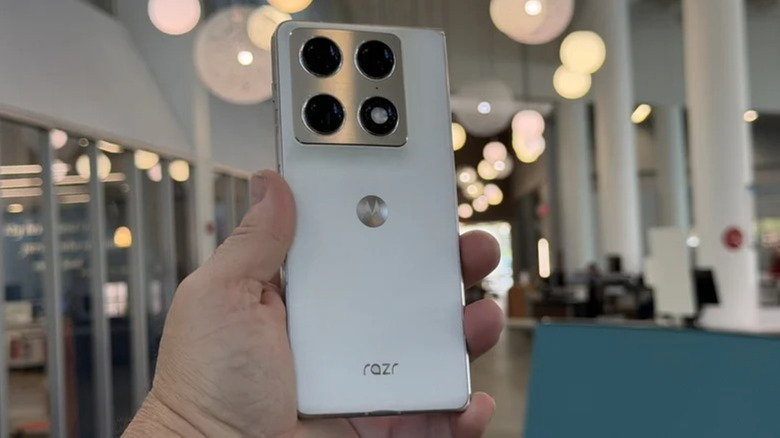
After years of shipping flip-style foldables under its revived Razr brand, Motorola has finally expanded into book-style folding phones with the brand new Motorola Razr Fold. In our Razr Fold review, we dubbed it the best book-style foldable yet, a claim based on its impressive build quality, cameras, and battery, as well as the lack of real alternatives in the United States market, due to protectionist trade policies that have squeezed many options out of the market. Although the Razr Fold might be a few steps behind the latest foldables from China, those aren’t available at your local retailer or carrier store.
Thankfully, there are other alternatives. Pickings may be slim, but the U.S. still has a number of attractive book-style foldables on offer, as well as flip-style folding phones for those who don’t need a pocket tablet. Samsung singlehandedly cemented the folding phone as a staple of the smartphone market, and Google has a powerful position as the architect of Android. While you may see media coverage of Chinese foldables packed with bleeding-edge tech, some of the coolest Android phones are difficult to import, a hassle to get working with Google services, and a headache to get working with American networks. You can read more about those in our roundup of the best phones the U.S. is missing out on.
With multiple new, notable foldables coming later in the year from Samsung and, for the first time, Apple, there’s a shadow hanging over the current crop of devices. To that end, let’s have a look at five of the most highly-rated book-style foldables you can actually buy right now that you might consider instead of a Razr Fold.
1
Samsung Galaxy Z Fold 7 Nadeem Sarwar/SlashGear Samsung is practically synonymous with foldables, having kicked the trend off in 2019 with the Galaxy Z Fold. Over seven generations, the Korean tech behemoth refined that design, and its latest Galaxy Z Fold 7 is the elephant in the room for anyone considering a Razr Fold. While the earlier models were chunky bricks that reminded you there was a doubled-over tablet in your pocket, the Z Fold 7 is thin enough to be mistaken for its cousin, the slab-style Galaxy S26 Ultra, when folded.
Our Galaxy Z Fold 7 review found pocketability to be among its core appeals, along with an improved inner display with a less noticeable crease at the center of its fold. It also has a faster processor than the Razr. The two largest downsides are the battery and price. The battery is a 4,400mAh capacity and charges at a painful 25 watts. When even the Motorola Razr Fold has embraced truly capacious silicon-carbon batteries that charge at over three times its speed, the Z Fold 7 feels a step behind the competition in that regard. As for the price, Samsung knows it can command a premium for its foldables. Starting at a penny shy of $2,000 for the lowest 256-gigabyte storage configuration, even a payment plan can’t alleviate the sting.
As of this writing, we’re heading into June, so the next generation of Samsung’s foldables is expected to debut very soon. The Z Fold 7 was launched at the end of July last year, and rumor has it that the Z Fold 8 will bow in July this time around. It is expected to bring modest improvements, including upgrades to the processor and camera, as well as getting ever so slightly thinner (via TechAdvisor).
2. Google Pixel 10 Pro Fold
The naming scheme clearly got away from Google when its Platforms and Devices team was ideating the Pixel 10 Pro Fold. Maybe they took Yoda on as a marketing consultant. But its cumbersome name belies a truly agile book-style foldable, one that any prospective Razr Fold customer would do well to consider as an alternative.
Released in October of last year, the Pixel 10 Pro Fold is now about halfway through its product cycle. Nonetheless, it remains a compelling option thanks to Google’s first-party software advantage, though our Pixel 10 Pro Fold review notes disappointingly limited multitasking functionality in Google’s Pixel skin for Android, with only two-app side-by-side capabilities. Other phones on this list, including the Razr Fold, allow at least three apps side by side, with many more in windows. On the other hand, you’ll always get the latest version of Android before other foldable phone owners do, at least until the end of Google’s promised 7-year support cycle.
What the 10 Pro Fold does have is magnets on the back, which Google calls PixelSnap, but most people will recognize as the same MagSafe feature the iPhone has been rocking for several generations now. It’s the kind of thing you think you don’t need until you buy a few magnetic accessories and realize you can’t live without it anymore. Many will also appreciate its more reasonable price at $1,800. Not cheap, certainly, but competitive with Motorola’s pricing (only a 512GB configuration of the Razr is available, and it’ll run you $1,900) and much better than Samsung’s.
3. Motorola Razr Ultra (2026)
The obvious alternative to the Motorola Razr Fold, at least for those who like what Motorola is doing but don’t want a book-style foldable clunking around in their purse or pocket, is its smaller sibling, the Motorola Razr Ultra.
Motorola has made the disappointing choice this year to ship the Razr Ultra with the same Qualcomm processor as last year’s model. As noted in our Razr Ultra (2026) review, that makes this less of an upgrade and more of a lateral progression, but it’s hard to argue that the Snapdragon 8 Elite it carries has aged poorly. It’s still an incredibly performant chip. What’s harder to swallow is a price increase despite the spec sheet remaining stagnant. Although the $200 increase over last year’s model is likely due to unavoidable supply chain issues resulting from the AI industry’s insatiable hunger for hardware, that’s Motorola’s problem to deal with. Consumers aren’t getting as much bang for their buck.
But there's still a lot to love here
Unlike Samsung and Google, which keep things simple, Motorola has gone all out with the Razr’s finishes. It’s the only brand offering luxuriously ridiculous materials like Alcantara and wood. Motorola doesn’t skimp on software, either. Despite being close to pure Android in look and feel, there are extra goodies here, such as motion gestures to activate the flashlight or camera, and a camcorder mode that lets you half-fold the phone for more ergonomic video shooting, while twisting the phone to zoom in or out. You can also use almost any app on the cover screen, which Samsung won’t let you do easily on its flip phones, but as we discovered when reviewing the Titan 2 Elite, you can’t get much done on a diminutive, square display.
4. Samsung Galaxy Z Flip 7
If a flip phone speaks to you more than a book-style foldable phone, you’ll most likely end up choosing between the Motorola Razr Ultra and Samsung Galaxy Z Flip 7 as an alternative to the Razr Fold. The Z Flip series deserves a great deal of credit for popularizing the flip-style foldable smartphone, and without it, Motorola likely wouldn’t have resurrected the Razr brand from its mid-2000s grave.
The Z Flip 7 isn’t trying to reinvent the wheel, and it’s a partial acknowledgment that the flip phone category is meant for people who want a more minimalist phone — but not too minimalist. The latest flip is powered by a Samsung Exynos processor rather than the comparatively far more powerful Qualcomm Snapdragon chip found in its bigger brother, the Galaxy Z Fold 7. And unlike the Razr Ultra, its direct competition, it does not allow a free-for-all on the outer display, instead treating that real estate more like a pocketable smartwatch. You can flip through widgets to view notifications, but if you want to run multiple apps on the cover, you’ll need to download the Good Lock app from the Galaxy Store and use the MultiStar module inside.
Samsung will be refreshing its foldables before the summer is out, so unless you need a phone yesterday, it’s worth waiting to see what the next generation brings. Plus, you’ll more than likely be able to find the Galaxy Z Flip 7 at a steep discount once its successor is out. Given that this flip phone scored well with reviewers from major outlets, including The Verge, Android Authority, and CNET, despite its somewhat lackluster processor, it’s a solid pick for any fold-curious consumers.
5
Honor Magic V6 Adam Doud/SlashGear Our last Razr Fold alternative is stretching the parameters of this article. Can you buy the Honor Magic V6, the latest book-style foldable from the Chinese vendor? Yes. But although it operates on the wireless bands required for U.S. carrier support, it is not available in the U.S. market. That means you’ll need to import this foreign foldable, which can cost a pretty penny on top of its preexisting price tag, starting at about $1,500 from popular import sites. On the other hand, that could still wind up being cheaper than some of the other options we’ve listed.
In our hands-on review of the Honor Magic V6, we used preproduction software and weren’t able to conduct rigorous benchmarking. Even so, we found it to be a very robust offering. It is running the Qualcomm Snapdragon 8 Elite, the beefiest processor you’ll find in an Android smartphone today. No other phone on this list carries that chip, and the Razr Fold uses its less powerful sibling, the Snapdragon 8 Gen 5. Honor pairs that top-shelf silicon with a 6,660mAh silicon-carbon battery, edging out the Razr Fold’s 6,000mAh cell. The coup de grace is an IP68/IP69 water and dust resistance rating, completely sealed against dust and able to survive underwater and high-pressure, high-temperature water jets. The Razr Fold only manages an IP48/IP49 rating, with far less dust protection. Like Motorola, Honor decked the Magic V6 out with unique materials on its backplate, including a vegan leather option.
Adventurous smartphone buyers should consider this a viable alternative to Motorola’s book-style foldable, but people who prefer predictability should probably stick close to home with other options on this list.
How these Razr Fold alternatives were chosen
The products discussed in this article were chosen both because they serve as substitutes for the 2026 Motorola Razr Fold, given their market positions, and because they were well received in SlashGear’s rigorous, hands-on testing and review process. This does not mean they were the most highly rated smartphones we have tested overall, but that they are the most highly rated we have tested, and they are also reasonable alternatives to the Razr Fold. For the Samsung Galaxy Z Flip 7, we cross-referenced multiple hands-on reviews from reputable external outlets.