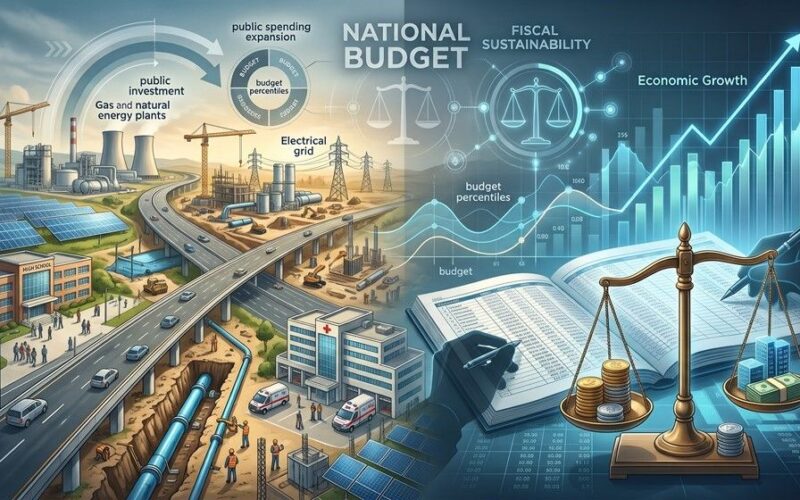
The estimates for the 2027 budget are built on raising spending on wages and services and expanding public investment. I see this as a necessary formula for stimulating the economy. Supporting purchasing power boosts demand, and projects raise the economy’s capacity to produce. But making the two work together requires revenues to grow sustainably, and spending to leave an impact beyond the budget year, in the form of better productivity, services and jobs.
Current spending is estimated to grow by about 6.4%, to reach JD12.025 billion. These estimates include a monthly increase of JD30 for anyone earning less than JD600, at an annual cost of JD260 million. The cost is split between JD50 million for civilians, JD100 million for the military and JD110 million for retirees. The increase supports household spending, and its effect passes into markets through demand for goods and services.
The calculations also include an expected saving of JD50 million, which helps absorb part of the commitments. This is where managing spending within the budget becomes important. Expanding social spending requires constant control of costs and efficient use of resources. Every sustained saving eases pressure on the treasury and gives it greater capacity to protect its priorities.
This goes hand in hand with maintaining spending on social protection. JD171 million is allocated to subsidising wheat and barley, JD80 million to gas cylinders, JD280 million to the National Aid Fund and JD124 million to cancer insurance. These items have a direct economic impact. They ease basic burdens on households and help them spread their income across multiple needs, while support for treatment protects households that face high health costs.
Alongside support for demand, capital spending estimates are set to rise by about 17.9%, to reach JD1.710 billion, compared with a revised JD1.450 billion for 2026. This increase opens the way to boosting contracting, industry and project-related services, and then to improving the economy’s productive capacity once the projects are complete. I therefore believe the quality of project selection and the speed of delivery are what give this expansion its developmental value.
The allocation of JD504 million to projects under the Economic Modernisation Vision reflects part of this direction. These include JD60 million for the national carrier, JD33 million for the Al-Reesha gas project, JD51 million to support tourism and JD22 million for public transport. These sectors are linked to water, energy, mobility and tourist activity, and investment in them can address constraints on economic expansion and improve the business environment, provided that payments are tied to progress on the work and the results achieved.
Investment also extends to ministerial capital allocations of JD671 million, including JD151 million for education, JD81 million for health and JD116 million for public works. The importance of this spending lies in combining better services with the development of human capital and infrastructure. Schools, health facilities and good roads leave economic effects that go beyond the cost of building them, provided they are chosen according to need and run efficiently.
Revenues remain the pivot of this equation. The budget targets local revenues of JD10.925 billion, compared with a revised JD9.846 billion for 2026, an increase of about 11%. Economic forecasts point to real growth of 3.1% and nominal growth of 5.5%. This makes the composition of growth, the efficiency of collection and the widening of the tax base decisive factors in reaching the target. Growth in profits and sales, better compliance and tackling tax evasion all support the revenue total.
In my view, the success of the 2027 budget will be measured by its ability to turn spending into productive activity, and to turn that activity into steady resources that fund services and maintain fiscal balance. Achieving this requires close monitoring of implementation, directing resources to their highest-return uses, and preserving the private sector’s capacity to expand. That way, the improvement in public finances rests on a broader economic base that is better able to last.
Related Stories

Egg White Transformed into an Amber-Like Material