
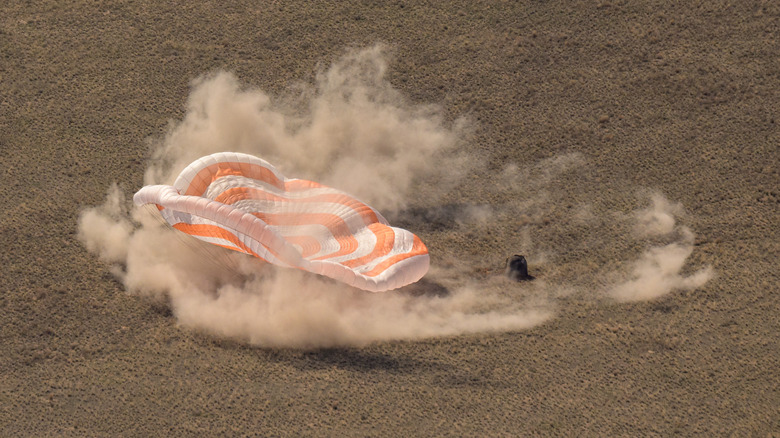
Why Russian Spacecraft Land On Solid Ground – But NASA Splashes Down In The Ocean
To say that the United States and the Soviet Union picked very different lanes during the great Space Race of the 1950s and ’60s would be an understatement — starting with the placement of their respective launch facilities. It wasn’t arbitrary. Regardless of their geopolitical ideology, the way rockets were launched (almost always to the east, mind you) and subsequently retrieved had as much to do with physics and geography as with the heroic efforts of the men and women who managed to get into space during an era when it seemed wholly impossible.
Russia is the world’s largest country, a transcontinental nation directly bordered by 14 other countries. Since its geographical coordinates place it much farther north, it’s naturally much farther from the equator. Furthermore, while a good chunk of the U.S. is surrounded by open, uninhabited water, Russia has only the Arctic Ocean to the north and the Caspian Sea to the southwest. Unfortunately, neither can be safely used because the Arctic is far too cold and riddled with ice, while the smaller Caspian “sea” is landlocked by several populated countries.
What Russia has in great abundance, though, is endless stretches of open land. As much as 65% is almost entirely devoid of humans thanks to ground that remains permanently frozen year-round (permafrost) and has been that way for thousands of years. A high-speed capsule dropping down into all that uninhabited area makes for a perfect landing zone.
Location, location, location
The equator is the best spot to send rockets up because the Earth’s speed there is 1,025 mph. Launching along that latitude (halfway between the North and South Poles) gives the craft extra momentum as it attempts to reach an orbital flight speed around 17,398 mph and break free from the planet’s gravitational pull more efficiently. This scientific principle is important because the majority of the continental United States is much closer to the equator than almost all of Russia.
Both NASA and private companies like SpaceX have launch sites that are located in southern states, putting them even closer to the equator. For instance, “America’s Spaceport” at Cape Canaveral, Florida, is only 1,960 miles north of the equator.
The Russians built the Baikonur Cosmodrome, home to one of the worst accidents in space exploration history, as far south as they possibly could — in Kazakhstan. Back in the 1950s, Kazakhstan was part of the old Soviet Union. When the communist nation collapsed in 1991, a lease agreement was established to keep the facility operational. However, it still sits about 3,150 miles from the equator at roughly the same latitude as Portland, Maine, and is still considered very far north.
Geography dictates the landing zone
American launch facilities are all located next to vast bodies of water, which provide a softer, safer landing. Until the reusable Space Shuttle came online in the early 1980s and could land like an airplane, NASA astronauts always returned home via a watery ocean splashdown. Russian cosmonauts were never so lucky. To clearly show the differences, here‘s how the first two astronauts in space returned to terra firma.
The first human in space was Soviet cosmonaut Yuri Gagarin, who accomplished the feat on April 12, 1961, aboard Vostok 1, one of the most historically significant aircraft in aviation history. Meanwhile, Astronaut Alan B. Shepard — aboard the Mercury spacecraft Freedom 7 — became the first American a few weeks later (on May 5) but was the first human to “splash down” (in the Atlantic Ocean).
Unlike Shepard’s watery return, which allowed him to remain safely seated inside Freedom 7, Gagarin had to eject from the Vostok 1 capsule while it was still over 4 miles above Earth and float back down using a parachute. Vostok 1 deployed its own set of chutes around one and a half miles above the ground. Both landed in a wide-open field 530 miles southeast of Moscow, the same return method the Russians have used ever since.