
Two years after the formation of Dr. Jafar Hassan’s government, any economic assessment of its performance should not stop at the number of decisions taken or the scale of programs launched. What matters more is its ability to manage the economy during one of the most turbulent regional periods, while preserving financial and monetary stability and keeping growth projects moving forward.
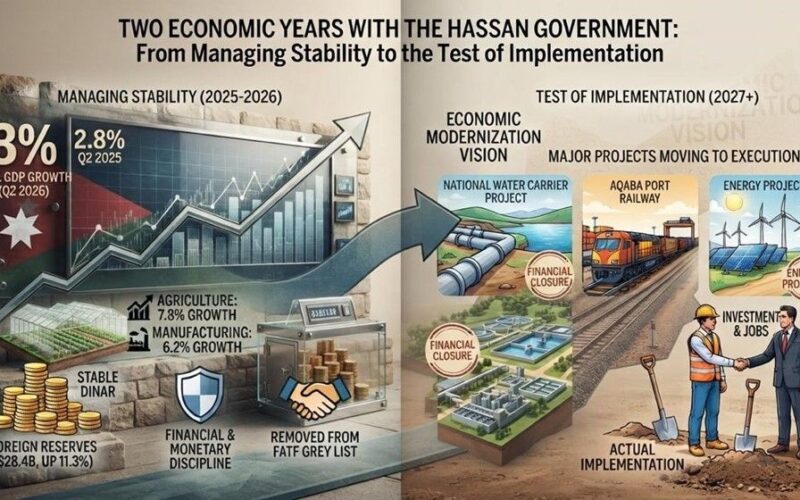
One important indicator is that the Jordanian economy has continued to improve its performance. Real GDP grew by 3% in the second quarter of 2026, compared with 2.8% in the same period last year, following growth of 2.9% in the first quarter. Agriculture grew by 7.8% and manufacturing by 6.2% in the second quarter, with industry contributing about 35% of the growth achieved. Given the repercussions of the war and regional instability, these figures reflect the economy’s ability to sustain a gradual growth path.
On public finances, the government treated the budget over the two years as a tool of discipline rather than merely a list of expenditures. It largely adhered to budget assumptions last year, and domestic revenues rose to JD5.625 billion by the end of July 2026, an increase of JD107 million, or 1.9%, compared with the same period in 2025. More importantly, the government remains committed to its declared target for the overall deficit, despite heightened risks.
At the same time, fiscal policy has shifted more toward capital spending and projects that can raise the economy’s productive capacity. The 2026 budget raised capital expenditure allocations to about JD1.6 billion, including JD396 million for Economic Modernization Vision projects, along with allocations for the National Carrier, gas exploration and other items. Actual capital spending reached about JD687 million by the end of July 2026, up JD55 million, or about 8.7%, compared with the same period in 2025.
Most importantly, the past two years saw a number of major projects move from the stage of discussion and study to executive preparation and financing. The National Water Carrier has reached decisive stages ahead of implementation, while arrangements are advancing for the Aqaba Port railway and for gas and energy projects, including the development of the Risha field and gas pipelines. These projects are not ordinary government spending; if implemented efficiently, they should form a new foundation for growth, investment and employment.
In monetary policy, Jordan has preserved one of its key economic strengths: the stability of the dinar and of foreign reserves. Gross reserves reached about $28.4 billion in August 2026, up 11.3% from the end of 2025 and covering 9.2 months of imports, while the dinar’s exchange rate against the dollar remained stable at its familiar levels.
The government is also continuing to build on the earlier achievement in addressing the money-laundering file and Jordan’s removal from the grey list, which strengthens the integration of the Jordanian financial system into the international financial system.
However, stability should not obscure the scale of the challenge ahead. Growth of 3% is good under current circumstances, but it still needs to rise before it can bring about a tangible shift in the labor market and in incomes.
The government’s greatest challenge in its third year will be to move the major projects from financial closure and procedures to actual implementation, and to turn the Economic Modernization Vision from a government program into investment, production, jobs and exports.
In short, the past two years were, to a large extent, years of stabilizing the economy and preparing the engines of growth. The coming year must be the one that tests whether these engines can run and deliver tangible economic impact.
Related Stories

When Does the Salary Arrive?

An Economic Analysis of Building Permits