In the conduct of politics, certain assets defy immediate measurement yet prove most consequential in the relations among states. They are the trust that accrues with the passage of time, the reputation that particular stances forge, and the relationships that endow a nation with the capacity to shape the calculations of others in furtherance of its own interests.
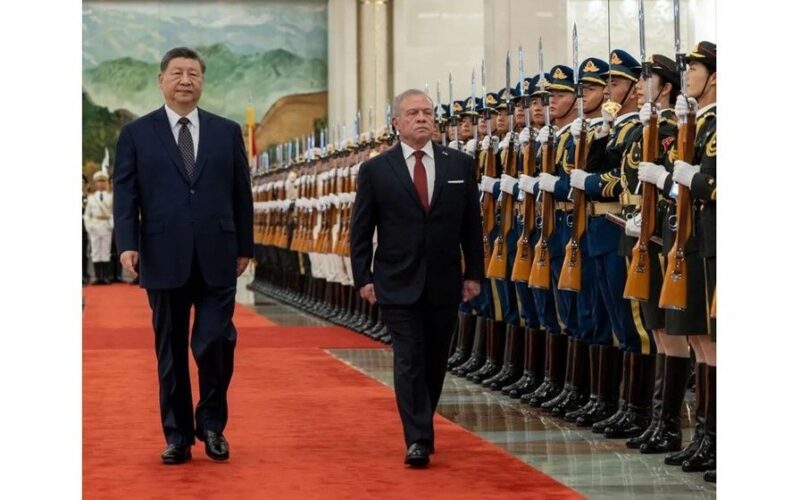
Seen from such a vantage point, the recent working visit of His Majesty King Abdullah II to China constitutes something considerably greater than a diplomatic engagement. It is not a commencement but the continuation of a long and deliberate trajectory of Jordanian–Chinese partnership across political, economic and cultural planes, built upon the mutual trust whose threads His Majesty has assiduously woven over many years.
The visit opened a multiplicity of avenues for cooperation before Jordan — economic, investment-related, technological, industrial, touristic, educational and otherwise. Such was the wellspring of its pluralism in the broadest sense, for the most propitious relations among nations are constructed around a lattice of intersecting interests that, over time, matures into an integrated fabric of genuine partnership, the fruits of which are harvested by the peoples of both countries.
Among the most salient outcomes of the royal visit is its affirmation of the equipoise that defines Jordanian political doctrine in the management of international affairs. Cooperation with China does not come at the expense of Jordan’s entrenched strategic partnerships with the United States, the European Union and other nations; rather, it adds a vital dimension to the diversification of options, particularly economic ones, enabling Jordan to construct a varied portfolio of partnerships that serves its interests in a changing, multipolar world — by granting access to new markets, expertise and opportunities, until the very possession of options becomes a strategic diplomatic asset of the state.
China, by virtue of its standing as an economic, industrial and technological colossus, offers a vast panorama of capabilities and expertise for cooperation across a wide array of sectors. The compass of Jordan’s economic approach thus evolves, in turn, from “What can we import from and export to China?” to the more consequential question: “What can we produce together?”
Perhaps within that very question resides one of the most important keys to comprehending the value of the relationship with China, a country whose political culture rests on the conviction that great partnerships are not built upon a single moment, but upon the continuity of trust in what will serve its future interests. From such a perspective, too, Jordan’s value to China cannot be reduced to the volume of goods that Beijing sends to Amman or the reverse. Jordan lies at the heart of the geopolitical equation that binds three continents — Asia, Europe and Africa — and its singular location, its stability, and its web of balanced relationships possess the capacity to render it a hub for trade corridors and global investment flows, as well as a base for a regional network of production, trade and services, in a region where security, politics and economics converge.
It is precisely here that the value of royal diplomacy becomes unmistakable: it does not content itself with gaining access to the world’s centres of decision-making, but rather builds a depth of trust that allows shared interests to burgeon into investments, projects and enduring partnerships.
True political influence begins the moment a state succeeds in cultivating an image through which others regard it as a trusted partner — one possessed of a credibility that the state can leverage to widen the circles of opportunity precisely when challenges intensify.
Such, then, is the art of crafting presence and influence — an art in which Jordanian diplomacy has proven itself a master practitioner: the capacity to translate diplomacy into an opportunity-generating space. It is precisely what the royal efforts in Beijing accomplished, leaving the responsibility thereafter upon the government to convert that royal success into tangible opportunities for our people.
Related Stories

The Yemeni Escalation That Could Be a Game-Changer

Companies are forming at an escalating pace