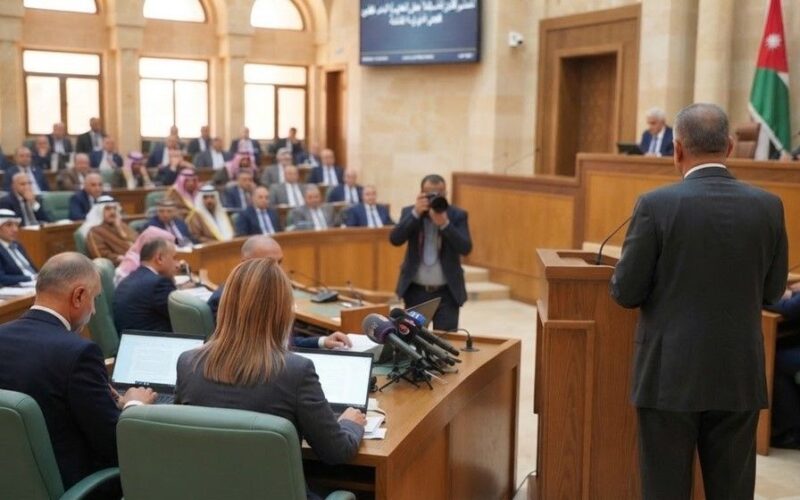
Prime Minister Jafar Hassan took the initiative, without waiting for MPs to ask, to present an account of what the government had promised a year ago, what it had actually achieved by the end of the year, and, most importantly, the projects it intends to implement in the coming year.
It was a work plan that translates the draft General Budget Law into economic, development and social objectives, rather than simply presenting dry figures that do little to capture the interest of most citizens.
The Prime Minister’s address can be described as an economic and political statement that outlines the government’s vision and provides a basis for parliamentary discussion of the draft law.
In the past, governments traditionally opened budget discussions with a statement by the Minister of Finance before MPs began reviewing the law’s articles in the Finance Committee, ahead of voting on and approving it.
This time, the Prime Minister established a new tradition by opening the first reading session of the draft law with this lengthy statement.
The move reflects Dr Jafar Hassan’s desire to lead a discussion on economic policies and practical programmes, rather than treating figures and data as mere accounting exercises.
It also demonstrates considerable respect for the role of the legislative authority and represents a serious attempt to manage parliamentary accountability in a way that serves the shared commitment of both authorities to placing the public interest above slogans and populist rhetoric.
MPs now have an opportunity to build on Hassan’s presentation and adopt a different approach from the traditional practices that have long characterised budget debates.
This is an ideal opportunity for a Parliament whose overwhelming majority consists of party-affiliated parliamentary blocs, which we assume all have economic and political programmes that reflect the aspirations of Jordanians.
At this stage in the development of political and party life, and amid an unprecedentedly critical regional situation, the priority should not be to highlight differences and divisions between political currents or between the legislative and executive authorities.
Instead, the focus should be on building common ground to strengthen Jordan’s resilience and economy, competing to present practical proposals and recommendations that help ease economic and social challenges, making the best possible use of limited available resources, and navigating the ongoing state of war gripping the region.
Parliamentary debates on the draft law could easily become an opportunity to score political points and win public sympathy.
However, the real challenge for party blocs aspiring to take over the executive authority and form future governments is to present realistic alternative solutions to the programmes, projects and priorities proposed by the government for the new fiscal year, improve upon what has been presented, and demand sufficient guarantees to ensure the implementation of the proposed national agenda.
We all know that our financial and economic options are constrained by narrow margins, and that the solutions MPs may have in mind are hardly beyond the reach of government thinking.
Neither side has the right to claim exclusive ownership of solutions that the other supposedly cannot recognise.
Therefore, a truly constructive and patriotic debate on this occasion should not revolve around budget figures, which, as MPs know, have been approached cautiously and carefully in line with available resources. Rather, it should focus on our ability to manage limited resources and achieve what is realistically possible.
And that is by no means insignificant. What the state has managed to achieve over the past period is an accomplishment when compared with the circumstances facing the region around us.
This includes the success in attracting investment and securing financing for major strategic projects in the water, energy and transport sectors.
We do not know what events await us in the coming year. The region, as the saying goes, is on the brink of unpredictable developments.
But what we have learned from the experience of the past two years is that we can continue building even as fires rage around us.
Related Stories
Hamoud massacre unites Jordanians
The deficit and debt reduction path in the 2027 budget