The Largest Shipwrecks Of The Great Lakes All Have These Things In Common
The Great Lakes are a network of freshwater lakes located in eight states — Illinois, Indiana, Michigan, Minnesota, New York, Ohio, Pennsylvania, and Wisconsin. Combined, they have a surface area of 94,250 square miles and collectively hold some six quadrillion gallons, enough to submerge the U.S. in almost 10 feet of water. Consisting of Lakes Superior, Huron, Michigan, Erie, and Ontario, they collectively form the largest system of freshwater on the entire planet, containing roughly 90% of the U.S. supply of freshwater and 20% of the world’s supply. It’s also where U.S. Navy aircraft carriers were once stationed.
The SS Edmund Fitzgerald, SS Daniel J. Morrell, SS Carl D. Bradley, SS Henry B. Smith, and the SS Mataafa are five of the most notable large shipwrecks to ever take place on the Great Lakes, and all of them share striking similarities. First, they were all massive bulk freighters used to haul massive loads. All five went down during November, a month known for especially bad weather. Finally, the hulls of three of them — the Fitzgerald, Morrell, and Bradley — literally snapped right in the middle.
This system of five lakes was crucial to the early development of North America, serving as a vital shipping route for cargo vessels bound for the furthest reaches of an ever-expanding country. But it came at a steep price. According to the Great Lakes Shipwreck Museum, at least 6,000 ships and 30,000 lives have been lost over the centuries. However, Mark Thompson — historian, author, former college professor, and officer with the Great Lakes Fleet – thinks the number of lost ships could be as high as 25,000.
The Witch of November
November is the deadliest month in the region, often referred to as “The Witch,” because cold fronts from the Arctic smash into still-warm lake waters, creating storms that are normally found in the open ocean. Waves, particularly on Lake Superior, can reach as high as 35 feet and easily overwhelm any ship before it can avert disaster. So, sailing the Great Lakes on a homemade houseboat probably isn’t the best idea.
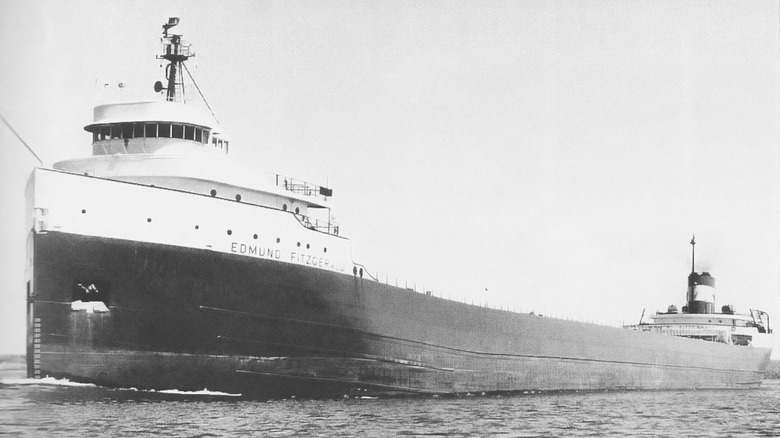
At 729 feet, the SS Edmund Fitzgerald is the largest vessel to ever sink in the Great Lakes. She’s also the most famous because it was relatively recent, and because Gordon Lightfoot released a hit song in 1976 — “The Wreck of the Edmund Fitzgerald” — that forever seared the tragedy into our consciousness. She headed out across Lake Superior under clear weather conditions with 29 crew members and 26,000 tons of taconite iron ore pellets. On November 10, 1975, she ran into 50-knot winds and 35-foot waves; she was found on November 14 at a depth of 530 feet — broken in half amidships. No one survived, and no “official” cause was ever declared.
The SS Daniel J. Morrell, at 603 feet long, also went down in 1966. At the time, she was transporting limestone, coal, and iron ore, something she’d routinely done for 60 years. On November 28, she set sail across Lake Huron on her last run of the season. The very next day, she ran into 70+ mph winds and 25-foot waves. Of the 28 crew members, only one survived. The cause was blamed on the hull’s age, which had become brittle and unable to carry the weight.
Lengthy, elderly ships tend to snap in half
On November 18, 1958, an empty SS Carl D. Bradley was heading home across Lake Michigan. Like the others, she ran into a storm with winds exceeding 65 mph and waves cresting at 25 feet, broke in half, and sank 370 feet deep in water. Thirty-three of the 35 crew perished. First launched in 1927, she measured 639 feet. As with the Morrell, structural failure was due to old, brittle steel.
The 545-foot SS Henry B
Smith was shorter than others on the list, but that didn’t matter. On November 9, 1913, she met the same fate, going down during a three-day squall known as the most destructive storm in Great Lakes history. Often referred to as the “White Hurricane,” it had blinding snow, 100 mph winds, and 35-foot waves that destroyed 19 ships and killed over 250. The captain wasn’t able to dispatch a distress signal, and only two bodies were ever found.
Finally, we have the SS Mataafa. Built in 1899, she’s not only the oldest ship of the bunch, but at “just” 430 feet long, also the shortest. She also had a very different ending. On November 27, 1905, a two-day storm ravaged Lake Superior, taking out 20 ships and killing 36 mariners. Carrying iron ore and towing a barge, the Mataafa tried to return to Duluth but was smashed against the pier — twice. She broke apart 700 feet offshore, with some 10,000 people watching the tragedy during which nine crew members died. The Mataafa was salvaged, rebuilt, and sailed for another 60 years before being scrapped in 1965.