
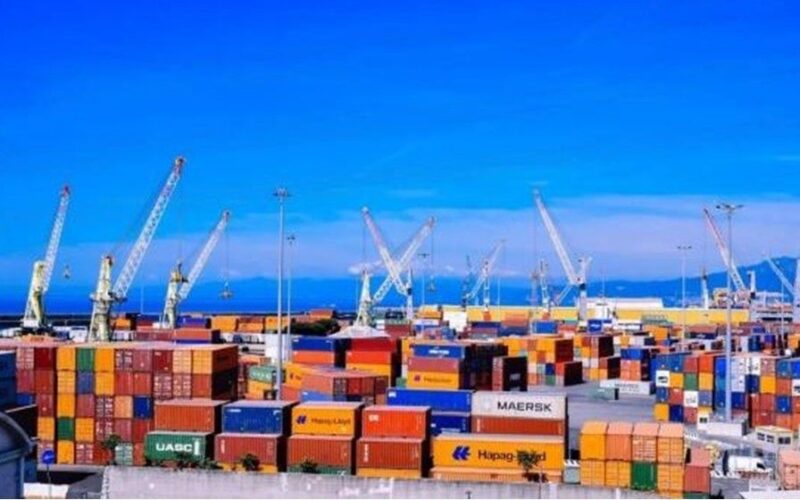
0.6 days vessel turnaround time at the Port of Aqaba
High efficiency in handling operations at Aqaba
Jordan possesses the groundwork to serve as a regional logistics hub
Accelerated pace of loading, unloading, and discharge operations
Jordan ranked third in the Arab world in the Logistics Performance Index, highlighting its strategic and vital role within the region’s transport network across various modes, and reinforcing national efforts to position the Kingdom as a major hub.
A policy paper issued by the Jordan Strategy Forum (JSF) regarding Jordan’s logistics performance for 2024 pointed out key operational strengths within Jordanian ports according to the Logistics Performance Index, providing a solid foundation for Jordan to serve as a regional logistics hub.
The paper revealed that vessel turnaround time at the port reached approximately 0.6 days, placing Jordan 21st globally and third in the Arab world, while the dwell time for export containers at the port stood at 4.7 days—a performance outstripping the global median.
Ongoing regional tensions and challenges present a strong opportunity for Jordan to act as a secure logistics corridor for regional nations regarding cargo transport and transit trade, overcoming hurdles facing supply chains and transport.
The JSF noted that economic corridors are no longer limited to constructing roads and railways; rather, they now combine maritime and land transport, energy networks, digital infrastructure, logistics services, as well as industrial and investment cooperation.
These challenges have driven several countries to diversify transport routes and reduce reliance on a limited number of maritime passages and strategic chokepoints.
First Vice Chairman of the Amman Chamber of Commerce and Chairman of the Logistics Sector Skills Council, Nabil Al-Khatib, stated that the Kingdom’s performance in the logistics index reflects high efficiency in handling operations at the Port of Aqaba. He emphasized that this represents a major competitive advantage, which will directly impact maritime transport costs and enhance the port’s attractiveness to shipping lines.
Al-Khatib added that Jordan possesses a distinct strength in port operations, and utilizing it effectively will serve the Kingdom’s vision of becoming a regional logistics hub. He stressed that this requires addressing subsequent steps regarding connected supply chains to achieve overall logistical efficiency across all stages.
For his part, economic expert Muneer Dayeh confirmed that despite the geopolitical conditions and challenges in the region, the Port of Aqaba achieved numerous successes and reached record figures matching the performance of major international ports.
He noted that the port accelerated container loading, unloading, and discharge processes, handling 101,000 TEUs (Twenty-foot Equivalent Units) last July. This brought the total volume handled by the port from the beginning of the current year through late July to nearly 560,000 TEUs—a new record for Aqaba’s ports.
He explained that through prudent, strong, and efficient logistical management, the port brought vessel turnaround time down to 0.6 days, ranking Jordan 21st globally and third in the Arab world. He called this a crucial indicator of the port’s ability to adapt to global maritime shipping disruptions and compete with major regional and international ports in execution speed.
He further clarified that export container dwell time dropped to just 4.7 days, which is below the global average for export container dwell times at ports.
Dayeh affirmed that the Port of Aqaba has become one of the most critical ports in the region—a safe haven and a strategic alternative for several regional countries relying on it for imports and exports—making it a prominent logistics center for the surrounding region.
It is worth noting that the Aqaba Container Terminal (ACT) handled 101,900 TEUs last July, compared to 88,781 TEUs during the same month last year.
This increase came amid turbulent regional conditions that led to port congestion in neighboring countries and delayed cargo arrivals. Nevertheless, the port maintained high levels of productivity and operational efficiency to service incoming vessels and absorb the surge in overland truck traffic.
Petra