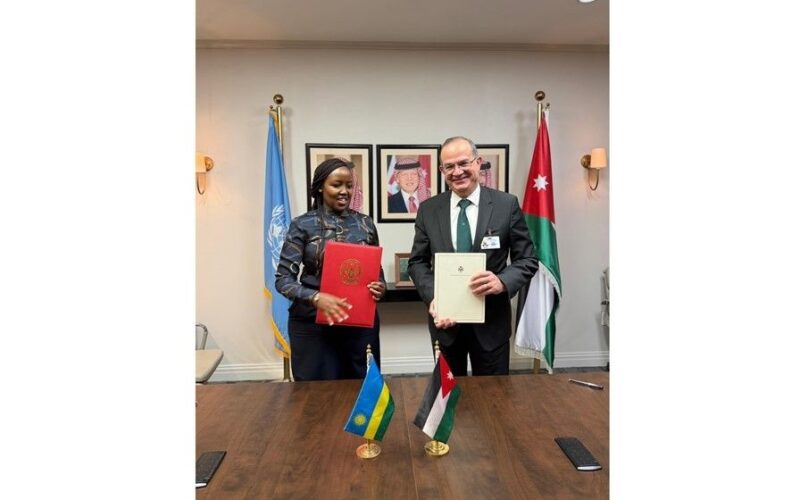
The Government of the Hashemite Kingdom of Jordan, represented by the Ministry of Digital Economy and Entrepreneurship, and the Government of the Republic of Rwanda, represented by the Ministry of Information and Communications Technology and Innovation, signed a memorandum of understanding (MoU) to strengthen bilateral cooperation in information and communications technology (ICT).
The MoU was signed on the sidelines of the 81st session of the United Nations General Assembly in New York.
The agreement was signed on behalf of Jordan by Minister of Digital Economy and Entrepreneurship Eng. Sami Smirat, and on behalf of Rwanda by Minister of Information and Communications Technology and Innovation Paula Ingabire.
The MoU aims to expand cooperation between the two countries in digital transformation and emerging technologies, exchange expertise and experiences in developing the ICT sector, promote innovation and build digital capabilities, contributing to digital development in both countries.
Smirat emphasized the importance of the MoU in strengthening cooperation between Jordan and Rwanda and opening new avenues for exchanging expertise and experiences in the fields of the digital economy and technology.
He noted that international cooperation is a key pillar for accelerating digital transformation, developing government services, building capabilities, and capitalizing on opportunities created by emerging technologies.
He said the MoU enables the two countries to cooperate in several priority areas, particularly artificial intelligence, cloud computing, digital identity, cybersecurity and data protection, as well as developing telecommunications infrastructure, digital payment systems and interoperability.
These efforts will contribute to sharing successful experiences and developing digital solutions that serve citizens and businesses in both countries.
Smirat added that the ministry looks forward to building on this partnership to enhance cooperation among government institutions, the private sector, and academic and research institutions in both countries, develop digital skills, support research, development and innovation, and translate the agreed areas of cooperation into joint projects and programs that deliver tangible results.
The MoU also covers knowledge sharing and the exchange of best practices in digital policies and strategies, the Internet of Things, big data, smart cities and e-commerce, as well as cooperation in disaster recovery services for data centers.
Under the MoU, the two sides will work to strengthen communication and coordination among relevant entities in both countries, exchange expertise and information, and cooperate in planning and implementing joint projects and programs in the agreed areas.
The MoU also provides for the establishment of a joint technical committee comprising representatives from both sides. The committee will coordinate the implementation of cooperation areas, follow up on joint projects and activities, and assess their progress.
It will hold meetings every three months or as needed, helping translate areas of cooperation into practical programs and projects that serve the shared interests of the two countries.