
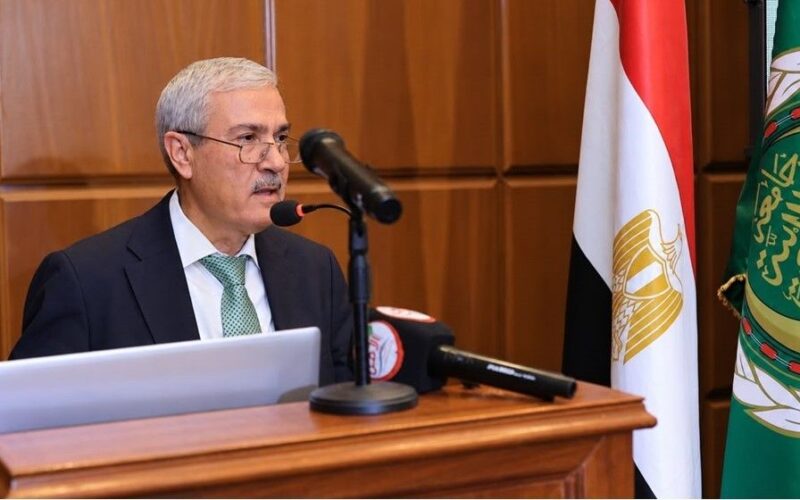
Professor Mashhour Al-Refai, Secretary General of the Higher Council for Science and Technology (HCST), participated in the first conference of the Arab Network of Scientific Research Centers, organized by the Federation of Arab Scientific Research Councils under the patronage of Egypt’s Minister of Higher Education and Scientific Research, in cooperation with the Academy of Scientific Research and Technology and the National Research Centre.
Held at the National Research Centre in Cairo, the conference marked the official launch of the Arab Network of Scientific Research Centers. It brought together representatives of more than 60 research centers from around 12 Arab countries, as well as leaders and representatives of scientific research institutions and a group of researchers and experts.
The conference addressed a range of strategic issues shaping the future of scientific research in the Arab world, including the development of research and innovation systems, artificial intelligence applications and their impact, food and water security, energy and health, as well as ways to strengthen cooperation and integration among Arab research institutions and centers.
In his remarks at the opening of the conference, Al-Refai said that the Higher Council for Science and Technology serves as Jordan’s principal national umbrella for science, technology and innovation, and plays a central role in coordinating scientific research efforts among research centers andaligning them with national priorities.
He noted that the Council had completed a project to identify Jordan’s scientific research priorities for 2026–2035, covering 15 sectors. More than 700 Jordanian experts from universities and the public and private sectors contributed to formulating these priorities.
Al-Refai also highlighted Jordan’s research partnerships with regional and international institutions to implement joint research projects and programs, as well as cooperation in artificial intelligence, cybersecurity, health and green technologies. These partnerships, he said, help put scientific research to practical use in addressing shared development challenges.
Al-Refai stressed that the conference reflects a firm belief in the importance of joint Arab action in addressing the major challenges facing the region, from climate change and economic crises to rapid technological transformation. He emphasized that responding effectively to these challenges requires shared research perspectives and integrated scientific cooperation.
He added that the Arab world possesses significant scientific expertise, capabilities and successful experiences, and that the challenge lies in bringing these resources together within an Arab scientific ecosystem capable of forming research teams, carrying out cross-border projects, and translating knowledge and research findings into solutions with tangible development impact.
Concluding his remarks, Al-Refai welcomed the launch of the Arab Network of Scientific Research Centers, which the Council had previously proposed establishing during the preceding session held in Baghdad. He said the network provides a practical framework for building partnerships, implementing joint Arab research projects, and promoting the exchange of expertise and capabilities among research centers.
He added that the network can support collective efforts to address challenges facing Arab countries and help translate scientific research findings into solutions and policies that serve Arab societies and advance their development.
Dr. Ramzi Al-Ghazawi