
High Mileage Vs. High Mileage Extended Performance Motor Oil: What’s The Difference?
We may receive a commission on purchases made from links.
There was a time when engine oil was a simple substance with a simple job to do: keep your engine lubricated and running smoothly. On the face of it, this is still very much the case; the oil in your car’s engine still lubricates.
But modern engine oils are far more advanced, and are often engineered for specific engine types. Essentially, as engines evolved and became more complex, the oil that lubricates has evolved in tandem. Nowadays, it can feel like you need a chemical engineering degree just to understand what oil your vehicle needs.
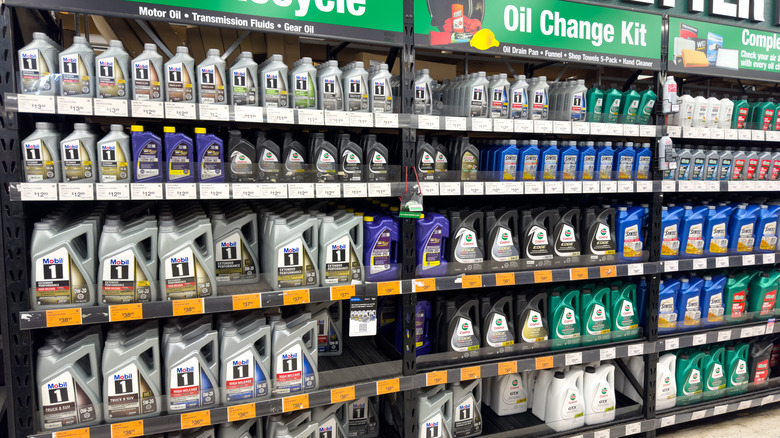
This is a point recognized by anyone who’s stood scratching their head while staring at the bewildering amount of engine oils to choose from. Do you need to choose semi-synthetic or synthetic engine oil? Or, what does the W stand for in engine oil? These are just two of the metrics where engine oils can substantially differ. Another metric to consider is whether you need high-mileage or high-mileage extended performance engine oils?
We’ll break down the differences between these two oil types in more detail a little later. However, as the name suggests, high-mileage motor oil is for engines that have reached a certain age. For engines, 75,000 miles is generally considered the magic number where high-mileage oils can be beneficial. Extended performance versions do the same job, but need to be changed less frequently.
In short, time and mileage wait for no man, and as engines age, so their lubricant needs can change. Let’s take a close look at high-mileage motor oils and how they differ from the extended performance version.
How high-mileage and high-mileage extended performance motor oils differ
The ravages of time and mileage aren’t kind to engines, and as they age, they need a little more care and attention if they want the odometer to keep ticking over.
This care and attention is what high-mileage motor oils are formulated to do
Among the specific additives in the recipe are seal-conditioners that maintain the aging seals within the engine. They can also include detergents designed to clean out the “sludge” that can accumulate in older engines. Also, as engines age, they often begin to consume more oil, at least some of this can be attributed to oil burn – high-mileage lubricants are formulated to be less-volatile to minimize this oil loss.
These are the basic attributes of most high-mileage oils. So, just what is the difference between high-mileage motor oil and the extended performance variant? The short answer is about 15,000 miles, or so. For instance, Mobil claims that its Mobil 1 High-Mileage oil is good for up to 10,000 miles (less if the engine is “sludgy”). Whereas, the extended performance version of the oil is formulated to go for 25,000 miles (or one year) before an oil change is required.
For the motorist, understanding this can help to avoid at least some of the head-scratching when you’re confronted with shelf upon shelf of motor oil. Put simply, motorists that cover tens of thousands of miles annually would benefit from the extended performance version. For lower-mileage drivers, the standard high-mileage motor oil will do everything that’s required.