I did not delay writing about King Abdullah II’s address to the UN General Assembly. I preferred to first watch the reactions and analyses, because a speech with this timing and content deserves to be read away from the emotion of the moment. But the more I followed what was said and written, the more convinced I became that this event cannot be put off, especially since the King’s tone toward what is happening in the region, and specifically toward Israeli moves in southern Syria, seemed sharper and clearer than usual, to the point that its echo appeared in the Israeli media in a striking and provocative way.
What struck me in the speech was not only the raised tone, but also the way the King placed Syria within the equation of Jordanian security. When he links the security of the northern border with water security, he is not speaking of geography alone. He is putting before the international community a broader concept of security, whose premise is that the stability of Jordan’s surroundings has become part of its own stability, and that a stable Syria can turn from a source of concern into a gateway to opportunities.
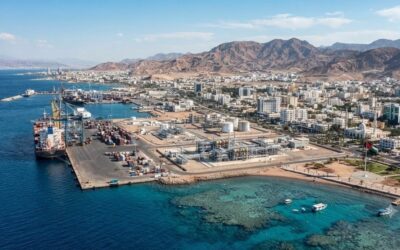
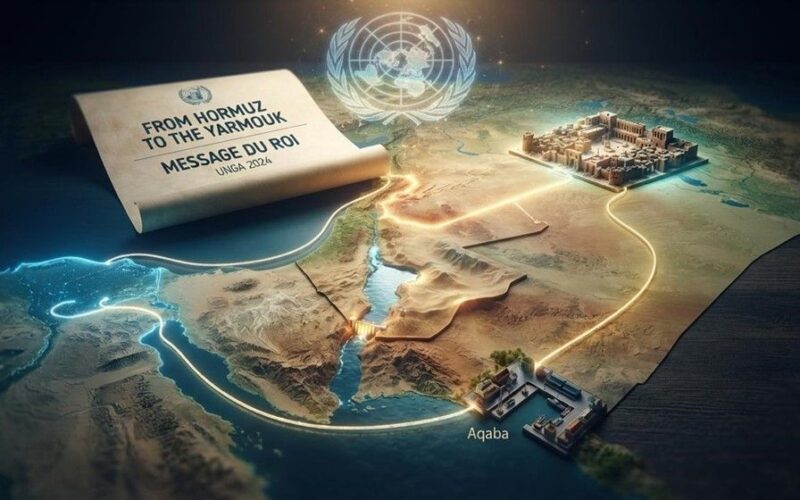
Jordan understands that its geographic location is one of its most important economic assets. Aqaba opens the way to the Red Sea, the Gulf is a center of energy, capital, and markets, and Iraq is an economic extension to the east, while Syria opens the road north toward the Levant and the Mediterranean. Among these geographies, a commercial and logistics corridor can take shape, one whose value grows as trade and energy routes are disrupted, especially after the Strait of Hormuz crisis, which brought back to the forefront the importance of diversifying supply routes.
From here, Syria appears in Jordan’s calculations as more than a neighboring country. Its stability means the possible return of overland trade, the revival of the Jaber crossing, more truck traffic, and expanded transport, customs clearance, storage, and logistics services. It also means Aqaba could benefit from transit traffic running from the Gulf and Iraq through Jordan and Syria toward the Mediterranean. Syria’s recovery, if accompanied by political and security stability, could therefore create direct and indirect opportunities for the Jordanian economy.
But the story does not begin with trade alone. It begins with water, and here the Yarmouk River and the Wehda (Unity) Dam become essential to understanding the royal message. Shared water makes the security of the two countries interlinked. In Jordan, water is not merely a service issue but an economic and sovereignty issue, because it is tied to agriculture, food security, social stability, and the cost of production. Protecting water resources and managing shared basins in a stable manner therefore ultimately means protecting part of the Jordanian economy.
From this angle, one can understand the sharpness that appeared in the King’s remarks on southern Syria. Jordan does not view what is happening there as a distant matter, because any prolonged instability on its northern border could affect security, water, trade, and investment. An unstable border does not create economic corridors, threatened water does not build a stable economy, and roads in a turbulent environment do not become arteries of regional trade.
Perhaps the deeper message of the King’s speech is that Jordan does not want its northern border to remain a security line separating two states. It wants it to become an economic gateway linking the Gulf with Iraq, Syria, and the Mediterranean. This transformation requires a stable Syria capable of regaining its commercial role, which is why Syria’s stability is, for Jordan, not only a political position but a direct economic interest.
Hence the question becomes bigger than Syria and bigger than the border. After Hormuz, the value of alternative routes has risen, and geographic location has become part of economic security. Jordan has Aqaba, its location, and logistics services, while Syria has its extension toward the Mediterranean. If this geography meets Gulf capital and Iraqi resources and markets, a new economic network may take shape.
For this reason, the King’s message is clear in essence: Jordan wants not only to protect its borders and its water, but to turn its location into an economic strength, and a stable Syria may be the northern key to this transformation. From Hormuz to the Yarmouk, it appears the coming battle is not only over the region’s security, but over the shape of its roads, its corridors, and its economy.
Related Stories
Israel and the Eastern Border Obsession
Is Amman Growing Concern About Ramallah?