
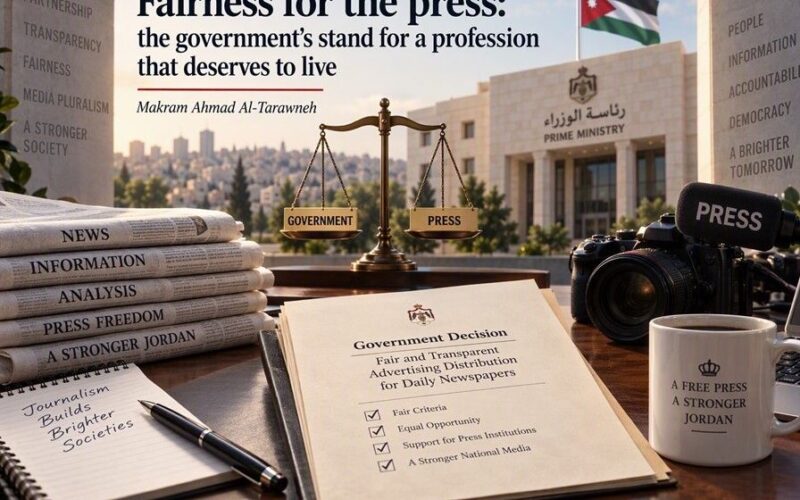
The government’s approval of the principles for distributing advertisements to the daily newspapers comes to confirm, once again, the relationship linking official institutions and the press, as two arms working on the basis of the national interest.
The decision, which the newspapers had been waiting for, set fair and transparent principles for distributing advertisements, and it certainly serves the newspapers’ interest, especially given the economic crises facing press institutions. Still, it’s only fair to say that with this decision, the government responded to a professional and national issue, and recorded its stand beside the newspapers to strengthen their survival, a step that deserves appreciation.
The importance of the decision lies in the principle it establishes: that public money must be managed by fair, publicly declared criteria, and that government advertising must not turn into a privilege for certain institutions, or a source of discrimination among newspapers. Fairness means equal opportunity, clear criteria, and everyone being subject to a single set of rules, away from personal considerations, connections, or undisciplined discretion.
The decision took into account the diversity of Jordanian newspapers, in their differing sizes, capabilities, and reach, and considered that they play important roles. The principles thus came to balance professional and economic criteria, preserving each institution’s right to fair competition, and preventing the monopolization or concentration of opportunities in a way that weakens press pluralism.
When the government treats the newspapers fairly, it acknowledges a fundamental truth: that press institutions aren’t merely companies seeking revenue, but vast reservoirs of professional expertise, centers for producing knowledge, information, and analysis, and schools in which generations of journalists graduated, and they still house hundreds of workers across various journalistic, technical, and administrative specializations.
These institutions, despite the crises that have befallen them, still hold a large part of the professional memory of Jordanian journalism, and the accumulated expertise in editing, investigation, and documentation. Their journalistic models still operate under a system of responsibilities, standards, and mechanisms for review and accountability, a system whose importance grows in an era when information flows without controls, and accurate news competes with rumors and misleading content.
From this angle, supporting the sustainability of newspapers should be viewed as assistance to weighty national institutions, and also as an investment in protecting the professional structure of national media. When newspapers weaken, the loss extends beyond these institutions themselves to journalists, their jobs, and the profession as a whole, and society loses institutions capable of producing serious journalism, exercising oversight, and providing reliable information. The state recognizes this reality, and translates its recognition into fair policies, fulfilling its responsibility to protect a balanced media environment.
The decision can’t be discussed without pausing at the role of the Jordan Press Association, for which the issue of government advertising remained one of the files it worked on, within its efforts to improve the economic conditions of press institutions and protect their workers. The decision represents an important fruit of a path of demands, dialogues, and union follow-up, and confirms that serious union work, when it has clarity of demands and perseveres in pursuing them, can move issues into the circle of decision-making.
This is an achievement that should be credited to the association, just as the government’s responsiveness to it should be credited, representing a success for the idea of institutional partnership between the government and the press body when it rests on dialogue, mutual respect, and recognition of legitimate interests.
The decision restores the standing of the idea of press pluralism, which isn’t achieved merely through the existence of many newspaper names, but requires an environment that allows these institutions to survive, compete, and produce. And when the state treats its press fairly, it treats an important professional sector fairly, just as it upholds society’s right to retain a press capable of working, holding to account, and critiquing.
Related Stories

Preventing Another 2024 Budget Shortfall

Arab Thirst in Numbers