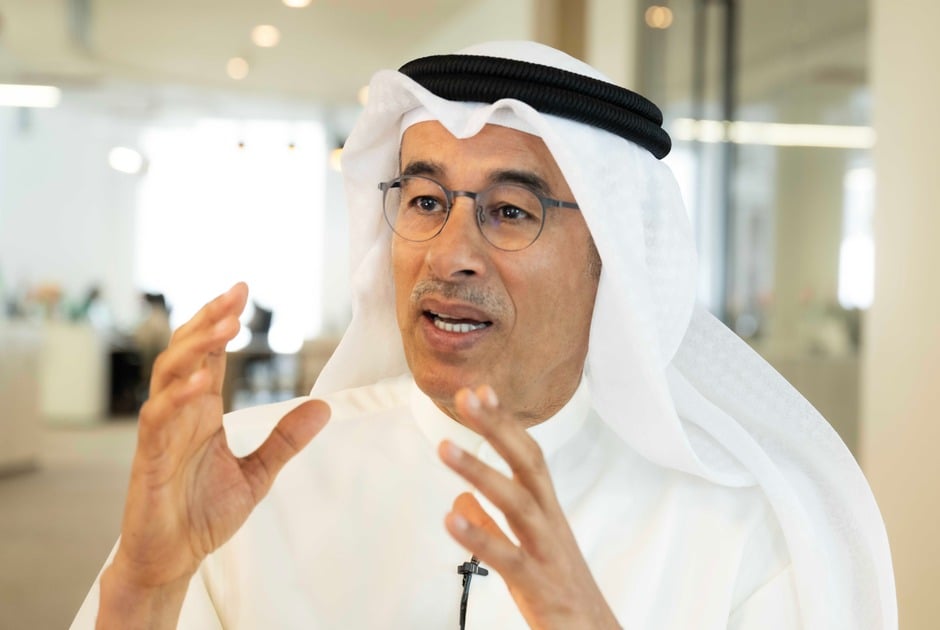
Mohamed Alabbar, founder of Emaar Properties, says recent attacks targeting the UAE will ultimately reinforce confidence in the country’s stability, arguing that events in recent days have demonstrated the strength of its institutions and security systems.
Speaking in an interview with <a href="https://www.cnbc.com/video/2026/03/06/no-concern-over-dubai-property-market-emaar-founder-alabbar-says.html” target=”_blank” rel=”noopener”>CNBC that aired on Friday, Alabbar said the UAE’s ability to intercept incoming threats has underscored its reputation as a global safe haven.
“The past days have proven that we are really a safe country,” Alabbar told the channel.
The developer said the UAE’s long-term policy consistency and stability have been built over decades and cannot easily be undermined.
“If you were to look and study the trajectory of UAE policies, you will see consistency, you will see sustainability, you will see wisdom, you will see stability — all for one purpose: to create an incredible life for the people who live here,” he said.
“You don’t build this over one year, two years: it took us over 40 years for the leadership to establish this.”
Alabbar added that recent developments are unlikely to weaken investor confidence in the UAE.
“Success does not happen by luck,” he said
“Because of years of great policies, stability, competence and fairness that exist in this country, that really have pushed tremendous belief in this country and what the future holds.”
Alabbar also dismissed concerns about a major correction in Dubai’s property market, despite regional tensions.
“I know my business well. I know the banking system. I know the business environment,” he said.
“I have no concerns
”
He also pushed back against predictions made by the likes of global ratings agency Fitch in 2025 about a 15 per cent property price correction.
“In my opinion, the way I look at my business and the data, I think it is very unrealistic,” he said.
High interception rate
Meanwhile, Alabbar’s comments on the UAE’s levels of safety, in particular, come as figures released by the UAE Ministry of Defence on March 5 show that the country’s air defence systems have intercepted the vast majority of missiles and drones launched toward the UAE since the escalation began.
According to the ministry:
- 1,072 drones were detected, with 1,001 intercepted
- 196 ballistic missiles were detected, with 181 intercepted
- Eight cruise missiles were detected, with all eight intercepted
A total of 71 drones impacted on land, while two ballistic missiles struck inside the country and 13 fell into the sea, according to the ministry’s latest update.
The figures highlight the scale of the attacks but also the effectiveness of the UAE’s layered air defence systems.
Meanwhile, the intensity of strikes across the region appears to be declining.
Across the region, Iranian ballistic missile launches were down 90 per cent from the first day of fighting, while drone attacks have fallen 83 per cent, according to reporting by <a href="https://www.wsj.com/world/middle-east/its-missile-threat-degraded-iran-is-taking-fewer-shots-at-more-targets-7b715195?st=4yYpdt&reflink=desktopwebshare_permalink” target=”_blank” rel=”noopener”>The Wall Street Journal on Friday.
Separately, conflict monitoring group ACLED said its analysis showed an 80 per cent drop in missile events and a 42 per cent drop in drone events across the Middle East between Saturday and Wednesday.
Institutions holding firm
Analysts say the UAE’s response to the crisis may ultimately reinforce investor confidence.
Simon Wolfe, co-founder and managing partner of Marlow Global, said the country’s institutions and communications have remained strong despite the scale of the attacks.
“There is an immediate and a longer-term conversation about where the UAE stands,” Wolfe told Gulf Business this week.
“In the short term, there is a physical reality here that optimism cannot shortcut. Airports, ports and energy infrastructure will take weeks to come back online, and the disruption to trade flows and aviation connectivity is real and immediate.”
However, Wolfe said the UAE’s response demonstrates the strategic qualities that attracted global investors to the country in the first place.
“Look at what the UAE has actually done in the face of an extraordinary assault: its institutions have held, its government has communicated with clarity, and it has called for negotiated resolution within days of being targeted by a country it had explicitly kept itself out of conflict with,” he said.
“And perhaps most importantly, the air defences have, in large part, held. This demonstrates exactly the kind of strategic maturity that made it attractive to global capital in the first place.”