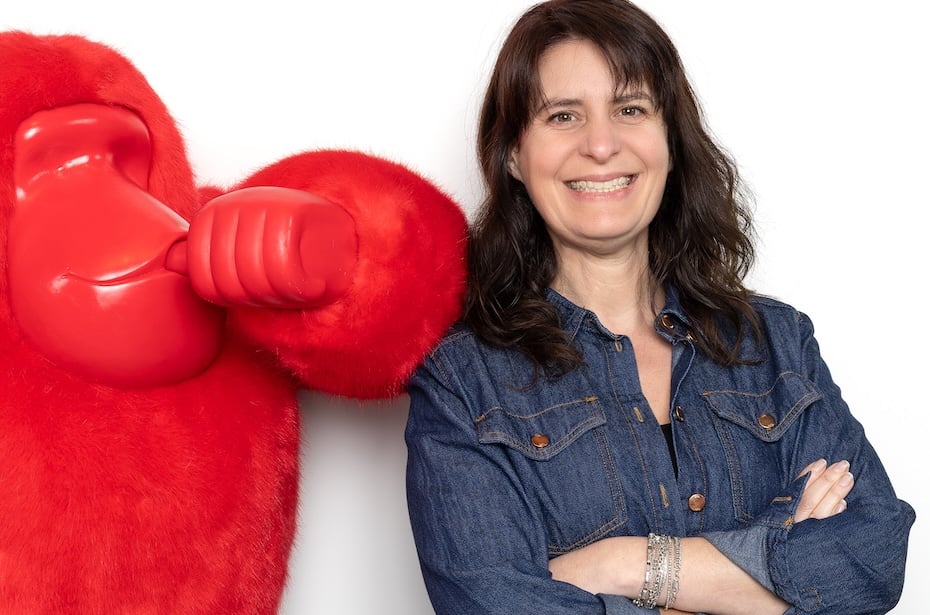
There is a giant plush monkey in the middle of the Dubai Mall. It is roughly the size of a small child, and it is attracting a steady stream of shoppers who want to cuddle it, photograph it, and post it to their feeds. The monkey is not for sale. It is not, strictly speaking, a product at all. It is a mascot — and a statement of intent.
The creature belongs to Kipling, the Belgian accessories brand that has just refreshed its flagship store in one of the world’s busiest shopping destinations. “The Dubai Mall flagship store is the true expression of what Kipling is: colourful, joyful, and as fun as our icon — the furry ‘Monkey’,” says Domitille Parent, VP Global Brand Management. “This store is a destination; it draws you in. You want to enter and take part in the experience, cuddle the monkey, take selfies… and of course check out our new bag collection!”
The emotional connection
Kipling’s reinvention is not merely cosmetic. It is, by the brand’s own admission, an attempt to recapture something it had lost. “I’m being really transparent with you,” Parent says. “In the past years, Kipling became a little static, a bit soft. So, this is something we have been working on re-establishing, like bringing a smile to people’s faces when they see a Kipling ad or when they see a Kipling product. This is super important.”
The diagnosis is bracingly honest for a brand that sells 23 bags every minute somewhere in the world, and whose products are owned by more than 35 million people globally. But the honesty reflects a broader reckoning in the accessories market. After years of digital-first expansion, brands are rediscovering that physical retail is not merely a distribution channel; it is an emotional theatre.
“In the past years, we also went really digital,” Parent explains. “We opened all the digital channels, which are great because for bags products, digital is easy, you don’t really need to try the product on. But what we realised was that people were missing the retail environment. When you’re not visible in the retail environment, you’re not top of mind. People want to go back into retail. They want to touch the product. They want to experience.”
The monkey, in this context, is more than a mascot. It is an emotional anchor. “We want to connect with it,” Parent says.
A partnership built on trust
The Dubai flagship exists because of a relationship that has quietly endured for a quarter of a century. Kipling’s regional partner is the Jashanmal Group, one of the Gulf’s most established retail houses, founded in 1919 and now operating over 150 stores across the UAE, Kuwait, Bahrain, Oman, and India.
The two have worked together for 25 years — more than half of Kipling’s 40-year existence. Jashanmal operates 10 Kipling stores across the Middle East.
“The reopening of Kipling’s flagship store in Dubai Mall marks a proud moment for us and reflects our long-standing partnership built on trust, shared values, and a passion for delivering exceptional retail experiences,” says Shuja Jashanmal, CEO of Jashanmal Group. “This refreshed flagship beautifully captures the brand’s playful DNA while elevating the in-store journey. Kipling has always stood for creativity, colour, and joyful self-expression, and this reopening brings that spirit vividly to life.”
Parent is effusive about what the partnership has meant. “What’s great is that they are really great partners because they tag along with the brand message and the brand vision. They are really aligned. But what they do is they implement it in a really, really great way. It’s not only because they’re investing in the brand, which is always important. But they’ve been doing such a great job that the brand has always been so relevant in the Middle East.”
The investment goes beyond capital
“They do activation — when we had our collaboration with the Minions, they had Minions running around the mall. They are really investing financially, for sure, but also investing their time, their creativity within the brand, which is vital to keep the brand momentum and desire.”
The Middle East is now one of Kipling’s fastest-growing markets globally. The next regional refurbishment will be the Festival City store.
Why the monkey matters
Kipling’s origin story has a literary charm that the brand has never outgrown. In 1987, three entrepreneurs — Xavier Kegels, Paul Van De Velde, and Vincent Haverbeke — founded the company in a small flat in Antwerp, Belgium. They named it after Rudyard Kipling, the British author of The Jungle Book, whose tales of Mowgli and his animal companions captured a spirit of adventure and playfulness they wanted their brand to embody.
The monkey came almost immediately. “The brand was founded in 1987, so almost 40 years ago, and the monkey was already there,” Parent explains. “When the brand was founded, the name was chosen — Kipling, which is linked to the writer of The Jungle Book. And then the founders were like, it would be nice to have a small icon. So first they had the monkey in the logo with a really big tail, and then they had the small monkey on the bags, which we’ve kept forever.”
“What’s really funny is that they thought people would attach it to their keys or something, but actually, people leave it on their bags. It’s really a success story. And it’s so deep that some people, they call it the “monkey” brand. If you say, ‘I work for Kipling,’ they say, ‘Yes, you know, the monkey.’ It’s really linked to the brand. It’s part of the DNA.”
Each season introduces new monkey designs, and each is named after a Kipling employee somewhere in the world. It is a small gesture of internal community that has turned the keychain into a collector’s item.
The brand’s other signature — its distinctive crinkled nylon fabric, lightweight, water-resistant, and almost indestructible — was a happy accident. The founders had set out to make colourful, functional bags that broke with the monotony of conventional luggage. The crinkled texture came from a production quirk that they decided to embrace rather than correct. The brand adopted a fitting motto: Fashion is too important to take seriously.
Durability over trends
One of Kipling’s quiet selling points has always been longevity. The bags are built to last — and to be passed on. Parent is candid about the tension this creates with the sustainability discourse.
“We belong to a big group called VF Corporation, which has super high standards when it comes to production. We use bluesign fabric facilities. We are really working on non-waste — when we are using something on a product, we do not want to waste, we do not want to use things which are useless. That’s the first mindset.”
“The second mindset is really the durability of the product. We’ve been looking, transparently, at recycled material, or coconut leather, or these kinds of things, but the products were not as resistant. And for us, what’s most important is that when you buy a product, you know the product will be there for a long time. You can even put it in a washing machine if you want. You can give it to your sister. This is for us the key message: when we do a product, of course, it has an ecological footprint, but we want to make sure that we erase it within the years because you will have it for so long.”
What works here
Kipling maintains a global product range, but regional partners curate locally. “In terms of products, we have a global offer, but the offer is quite wide, so it enables the region to go more for their specificity,” Parent says. “We will have many colours, but maybe the Middle East will say, ‘No, we don’t want the yellow.’ That’s fine — they can really curate their assortment.”
Two categories perform particularly well in the region. The first is back-to-school: children’s backpacks, trolleys, lunch bags, and pencil cases in seasonal prints and colours that can be purchased as coordinated sets. “Every season we come with new prints, new colours, but you can also buy the full assortment,” Parent notes. The second is travel — a category that surprises some customers who associate Kipling primarily with everyday bags. “People don’t always think that Kipling has travel, but we do. The bags on wheels are doing really well in the Middle East.”
Reaching the next generation Kipling’s challenge is generational
It has an intensely loyal customer base, but that base is getting older. The brand must find a way to stay relevant without abandoning its identity.
Parent says. “What’s important for us is that we stay relevant for the next generation. But as Kipling, we do not want to go for the young, young hipster. We want to grow with our consumers. We want to go with the adjacent category, the active woman, who is busy and has a family. We see that our population is getting older, but we can go back one step and regain. It’s not only about the age, but also more like somebody who is vibrant and active. She knows that Kipling has everything she needs to go to work, to pick up the kids.”
In an era when retail is often discussed in terms of logistics, conversion rates, and omnichannel integration, there is something refreshingly simple about Kipling’s bet: that a giant plush monkey can make people smile, that a durable bag can be passed from mother to daughter, and that a quarter-century partnership built on trust can still be the foundation of something new. It is not a complicated thesis. But then, Kipling has never believed that fashion should be taken too seriously.