
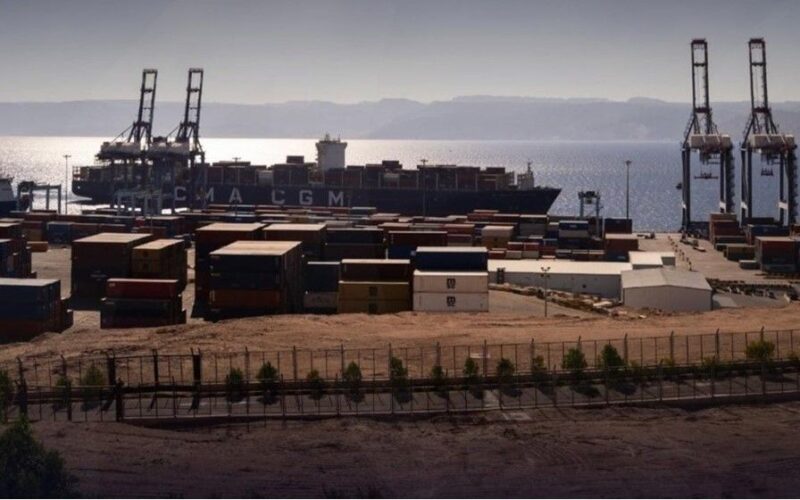
Cargo handling through Aqaba’s ports and the Aqaba Container Terminal rose 12.7% during the first eight months of 2026, reaching 17.65 million tons, compared with 15.66 million tons during the same period in 2025, an increase of nearly 2 million tons, according to data from the Jordan Shipping Association.
The association’s Secretary-General, Mohammad Al-Dalabeeh, said the growth was driven by higher imports, container traffic and roll-on/roll-off vehicle movements, alongside a significant increase in transit and re-export activity, despite declines in the movement of some commodities and exports.
Imports rose 33.8% to more than 10.8 million tons, while vehicle imports jumped 72.6% to 105,719 vehicles through the end of August. Vehicle exports surged by more than 1,106% to 16,330 vehicles.
Al-Dalabeeh said the sharp increase in vehicle traffic was mainly linked to growing transit trade destined for Gulf markets, noting that 37 specialized vehicle carriers carried out unloading operations at Aqaba Port in August alone.
At the Aqaba Container Terminal, cargo handling increased 5.5% to 679,145 twenty-foot equivalent units (TEUs). Transit containers surged 185.6% to 60,817 TEUs, while imported refrigerated containers rose 25.2% to 13,612 TEUs.
Grain imports increased 59.3%, driven by a 126.3% rise in bulk corn imports to more than 1 million tons, a 101.6% increase in soybean imports to around 424,800 tons, a 33.8% rise in barley imports to approximately 915,400 tons, and a 22.3% increase in wheat imports to about 744,300 tons.
Imports of petroleum products, gas and mineral oils rose 11.3%, while jet fuel imports surged 1,243.8% to around 195,000 tons. Imports of automotive gasoline increased 14.5% to approximately 543,700 tons.
By contrast, phosphate exports fell 21.1% to 3.44 million tons, while general cargo exports declined 26.4%. Bulk potash exports edged up 0.5% to 1.59 million tons.
Imports of construction steel also fell 27% to 327,301 tons, while pipe imports declined 28.6%, sulfur imports dropped 30.8%, and ammonia imports decreased 2.9%.
Al-Dalabeeh said the eight-month indicators reflected diversified sources of growth in Aqaba’s cargo activity, particularly imports, food commodities, transit trade, containers and vehicles.
He stressed the importance of continuing to develop infrastructure and operational capacity and improving the efficiency of procedures related to transit cargo.
He added that enhancing the efficiency of Aqaba’s port system and logistics services would help strengthen Jordan’s position as a regional trade and transit hub and support the competitiveness of the national economy.