
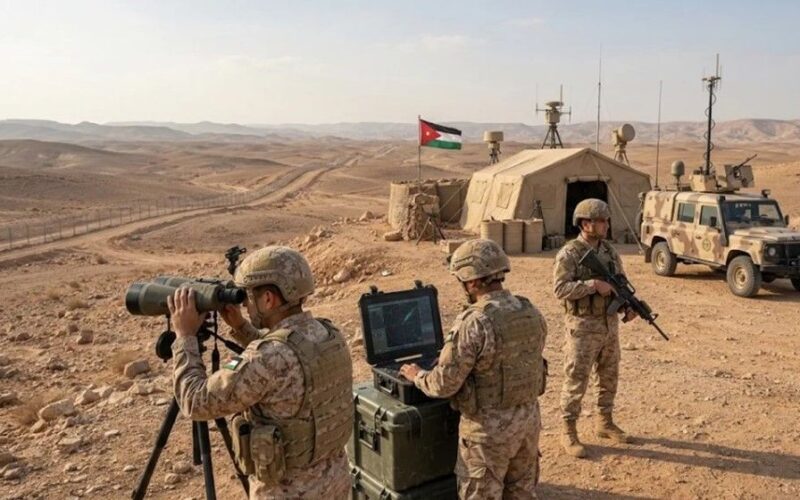
There are no signs of a tangible decline in drug smuggling operations across the northern and western borders. Until recently, estimates suggested the high wave of smuggling would subside once conditions in Syria stabilized somewhat. The only change, however, has been in the methods: from attempts to breach the border overland, to drones, and now helium balloons as the latest means of smuggling.
This shift coincided with rising smuggling rates on the western and southern borders, using much the same methods. Jordan’s political geography seemed this time to serve the drug and arms gangs, and not merely to offer alternative routes for trade and transport.
Syria’s new government is not slow to play its part in confronting drug and arms smuggling, whether into Jordan or to and from Lebanon. Joint operations rooms coordinate constantly, exchange information and intercept shipments. But southern Syria remains an open theater for drug gangs and terrorist groups entrenched in isolated social environments.
Until recently, these groups and gangs were stronger than the Syrian security services and army, thanks to their far-reaching influence, rooted in the era of the former regime. The Israeli occupation and its continuing raids on villages and towns in southern Syria limit the Syrian government’s ability to organize its presence there and deploy its forces.
On the western border, cross-border groups operating with Egypt and Israel have exploited the conditions that followed the war on Gaza to activate their operations and develop their capabilities. There are evidently what could be described as facilitations offered to these groups by the Israeli occupation army, which claims to be fighting smuggling. Indicators suggest the smuggling gangs possess advanced capabilities and logistical facilities serving their operations, in areas that have long been havens for drug and arms dealers. Israeli media have previously revealed the involvement of occupation soldiers in smuggling and trafficking.
Along the Jordanian border, this activity is matched by desperate attempts to smuggle weapons into Israel and into parts of the West Bank, where growing demand multiplies prices several times over, making it a lucrative trade for smugglers.
In all these cases, the heaviest burden in this open war falls on the shoulders of the Jordanian Border Guard forces and the security and intelligence teams, who are engaged in near-daily confrontation with ceaseless attempts by balloons and drones loaded with drugs and sometimes weapons.
This confrontation is one manifestation of the instability and chaos prevailing in our region, whose repercussions fall on a stable country like Jordan, which circumstances have forced to fight it on behalf of the region’s states.
Undoubtedly, such a war imposes heavy financial burdens on the armed forces and calls for continuous development of military capabilities to control and monitor the borders. Beyond that, it requires a permanent state of alert for army units, with all the needs this entails, and continual reinforcement of manpower.
These efforts do not receive sufficient appreciation from neighboring countries, even though Jordan is the first line of defense and the state that allocates the most resources to carrying out its duty.
Jordan cannot remain alone in this war. Other parties must shoulder their responsibilities, since the confrontation will clearly be a long one and the smuggling gangs are neither receding nor weakening, particularly on the Syrian side. If security conditions deteriorate in Suwayda, those gangs will be able to expand their area of operation, putting us before a wider and more dangerous confrontation.
Related Stories

Fuel Price Freeze and the Role of the State
Turning Syrians Against the Revolution