The third session of the Jordan-Syria High Coordination Council came at a sensitive moment. Although it had been scheduled for some time, its significance lies in the fact that it took place after two incidents along the Jordanian-Syrian border.
The first incident involved the shelling of a site where a family was present, causing civilian casualties. The second involved gunfire aimed at a group of young men near the border. Both incidents left an impact and were used on social media to launch highly offensive campaigns against Jordan. The motives behind them were mixed. Some people were genuinely affected, others had political agendas against Jordan, a third group was simply seeking popularity in their circles, and others were involved in stoking strife between Jordan and Syria rather than acting sensibly and leaving the matter to specialists to handle in any case.
Jordan has not abandoned its responsibility. The government’s spokesman expressed the government’s regret over the civilian casualties, which in practical terms means Jordan has not walked away from its responsibility, even if the wording was politically softened. Deputy Prime Minister and Foreign Minister repeated the same regret in Damascus during his recent visit, using a new phrase, “redress of harm”, which means Jordan does not abandon its responsibility and implicitly signals an intention to compensate for the losses.
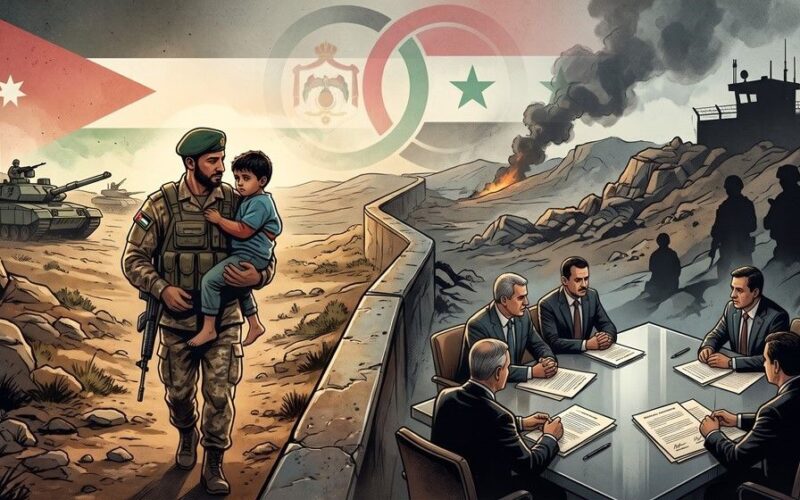
Civilian damage can occur unintentionally in military operations, especially from a country like Jordan, whose army has had a unique humanitarian experience in receiving Syrian brothers and whose soldiers carried children across the border on their shoulders during the chaos in Syria.
Those who do that do not kill Syrian children. Everyone knows that southern Syria is exposed to dangers such as terrorism, drugs, arms smuggling, attempts to create breakaway statelets, and fears of Israeli expansion, which has established bases and camps in southern Syria. There are also fears of tribal, clan, sectarian or confessional fighting that could trigger new waves of migration into Jordan. That is another file, added to the others, such as water, and the Syrian refugee issue in Jordan, along with the lack of an encouraging environment for their return, with all that implies inside Jordan.
What is said here is that communications between Jordan and Syria after the two incidents, at the security, military and political levels, were very effective, and helped calm the situation and put out the fire. That is why official Syrian voices took a calm tone, despite closing the border for one day as a message expressing Syrian concern over what happened. Official Damascus also recognises that Jordan does not target Syria at all, at a time when Damascus itself does not have sufficient control over open areas that are full of dangers.
The Jordanian delegation, led by the Deputy Prime Minister, arrived loaded with messages. This is clear from the accompaniment of the army commander and the director of intelligence, and from the security and military meetings held, which means the security and military side was not absent. An important point to note concerns the border. Before the two incidents, the border remained a source of threat to Jordan through infiltration attempts, drug smuggling and other activity. Jordan is therefore in a difficult position: either it protects its borders itself, or the Syrians take on the task of clearing those areas, so that the heavy burden does not shift from Damascus to Amman.
Jordan has not abandoned its responsibility. The interests between Jordan and Syria, and the bonds of blood, are far greater than what has happened, and we are all affected by any harm that might befall Syrians. It should also be noted that on many previous occasions, gunfire came across the land border from Syria at Jordanian crews, Jordanian lorries were attacked and drivers were threatened, on top of the victims of drugs and the crimes they bring. This is said to keep the discussion balanced, so the analysis does not tilt as though one side were the aggressor and the other the victim. We do not want to list the damage Jordan suffered on earlier occasions. All we want is to settle the accounts and move past this stage.
Most important of all, the relationship between Jordan and Syria must remain strong. Jordan monitors many risks, from extremist groups and drug traffickers to the scenario of Syria being divided, and Israeli encroachment on water and geography. All of this calls for avoiding blame and recrimination, and for focusing on developing relations through the agreements and memoranda that have been signed. It also requires everyone to read the maps of the region, and to ask: where are we all heading?
Related Stories

Execution draft and reforming collection tools

2027 budget: domestic revenues face the commitments