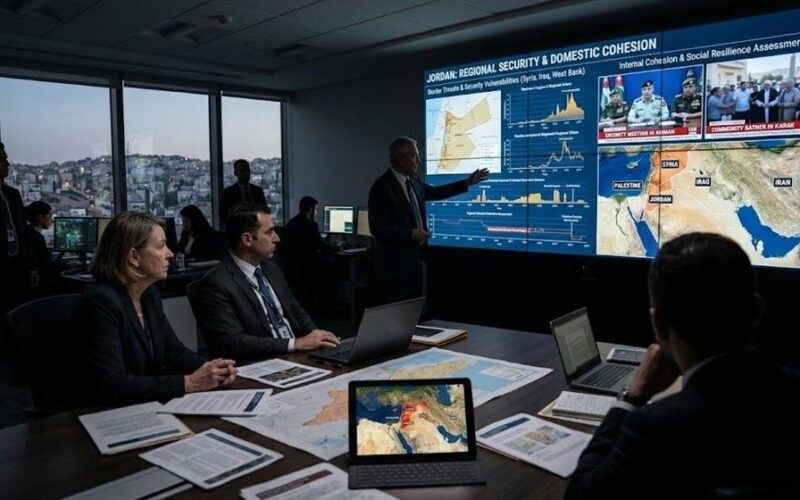
Intelligence agencies across the region and around the world will interpret the church attack in different ways, as will embassies in Jordan. They will arrive at assessments, draw conclusions and seek to understand the domestic situation and its future in Jordan.
This is to be expected and is not unusual, particularly in the case of a country like Jordan, whose geopolitical importance is growing amid current developments. Jordan lies at the centre of a region engulfed in conflict: to the west is the Israeli occupation; to the east is Iraq and its various armed groups, followed by Iran; to the south is the Yemen file and its far-reaching repercussions; and to the north is Syria, with all its complexities and numerous armed groups. Jordan is also known for its resilience against instability, having weathered crises at home and in its surrounding region without incurring significant costs.
Analyses are expected to focus on several issues, including Jordan’s stability and whether the country is stable or vulnerable to fragmentation and partition. They will examine whether Jordan could be engulfed by major internal strife along religious, ethnic or identity-based lines; the degree of resilience in the domestic response; and the strengths and weaknesses in managing the situation. They will also assess whether the Jordanian state is strong or weak, what might happen if the incident were repeated in the same or a different form, whether Jordan is susceptible to internal destabilization, which parties might benefit from any resulting chaos, what Israel’s calculations are in this context, and what plans Israel may have developed to deal with Jordan if the country were drawn into turmoil.
These questions lead to other lines of inquiry, including how the West views Jordan in the aftermath of the incident. Jordan is regarded as a model of coexistence among citizens without religious discrimination, a positive perception also shared by the Vatican, European countries and others.
Further questions concern whether dormant cells exist and whether new ones might emerge; how developments in southern Syria and the groups operating there could affect these possibilities; how a US withdrawal from Iraq might influence the return of armed groups to western Iraq; and whether there is a possibility of threats to Jordan’s security during the timing of any anticipated war with Iran. Analysts may also examine Jordan’s domestic demographic composition, the possibility of emigration from Jordan for various reasons, and the prospect of displacement from Palestine into Jordan following attempts to create chaos inside the Kingdom.
These questions and others are no secret. The world’s capitals and intelligence agencies analyse everything and think calmly or, I would say, dispassionately about the implications of the attack in the south. Meanwhile, we must pay attention to three things. First, we must not become so absorbed in answering these questions through policies and decisions that we appear merely to be sending messages. Second, we must review many domestic issues strategically, rather than doing so only under the pressure of a particular circumstance. Third, every one of us must recognize our responsibility towards our country in light of the potential risks at this time.
The perpetrator of the church attack sought, by targeting a place of worship and killing innocent people, to provoke religious exchanges that could lead to religious and tribal strife in a country that has remained resistant to sabotage to this day. The perpetrator also wanted to demonstrate that Jordan could be disrupted at any time and to shake the country’s political, economic and social stability, while exploiting fear among its people.
In this sense, the possibility that the group had external handlers cannot be ruled out, whether those directing it were acting directly or whether others stood to benefit from the consequences of such an operation.
The central message today is that placing Jordan under the international security spotlight and analysing the country’s internal landscape requires all of us to remain alert to future risks, particularly given the deep-seated hostility towards Jordan among various states and entities. The attack must not be trivialized, especially at this highly sensitive time for the Kingdom.
We must first answer our own domestic questions quickly, before becoming preoccupied with the questions others are asking about us. We must also recognize that the church attack was not directed solely against the people of Hamoud village, but against an entire country and all its people, without exception.
Related Stories
Turning Syrians Against the Revolution
Who benefits from weakening Saudi Arabia?