
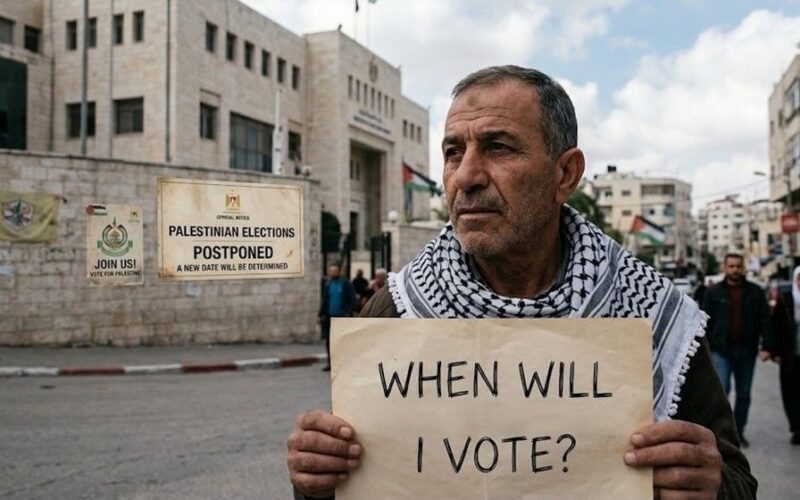
The decision taken by the Oslo Authority on the 10th of this month to postpone the presidential and legislative elections to a later date serves Israel’s interests, whether intentionally or otherwise.
The last presidential elections held in the West Bank and “forgotten Gaza” took place in 2005. Since 2009, the current president of the Palestinian Authority has repeatedly had his term extended. The last legislative elections in the West Bank and “forgotten Gaza” were held in 2006. Clashes between the Palestinian Authority and Hamas in “forgotten Gaza” followed, leading to a Palestinian split. No elections have been held since then.
The elections were also postponed in 2021, on the grounds that Israel was preventing residents of Jerusalem from participating. The latest postponement, however, was based on the overall security situation in the West Bank and “forgotten Gaza.”
Is it reasonable, at a time when Israel is intensifying its aggression against Palestinians and seeking to dismantle the Oslo Authority, annex the West Bank and occupy what remains of it, for there to be no legitimate Palestinian political institutions or complete, internationally recognized structures at the parliamentary and presidential levels? This is happening before a world that now sees institutions on the verge of collapse, with extremely low public support, financial problems and no popular mandate, as well as no Palestinian, regional or international political backing.
Ultimately, postponing the elections serves Israel’s interests. There would be no political institution resulting from the Oslo Accords left to stand in its way, nor any legitimacy to protect it. This would help Israel dismantle the Authority and its institutions—a threat it repeats daily and could easily carry out. Postponing the elections also means the end of all Palestinian constitutional institutions and the burial of the Oslo Accords.
The Authority says the postponement is due to technical reasons arising from the circumstances. But looking at Estonia’s model, we find that it holds elections through electronic voting using digital identity. Over the past two decades, the Authority could have prepared for this type of voting instead of citing the security situation and the inability to hold a vote.
This solution would also serve Jerusalem’s residents, allowing them to vote online from anywhere. Some cantons in Switzerland use similar methods. The West Bank and Gaza could have overcome technical obstacles and security restrictions in this way, particularly given the availability of internet access.
Elections could also be held under legal amendments allowing some seats to remain vacant because of conditions in certain areas, rather than suspending the entire electoral process for both the presidency and parliament.
The postponement comes at the worst possible time. The Oslo Authority, which Israel is threatening with war, should instead have responded by holding elections to renew the Palestinian political landscape. Yet serious assessments suggest that fair and transparent elections, free from interference, would cost Fatah its parliamentary majority and allow Hamas representatives to gain control in the West Bank. Even more concerning are assessments that Gaza would once again vote for Hamas, contrary to predictions of growing public disillusionment with the movement. Presidential elections held without interference would likewise offer no guarantee that the current president would return to office.
The West Bank and “forgotten Gaza” are facing a structural crisis at a dangerous moment that affects Palestinian interests. Any decision could benefit Israel. We are seeing threats to invade the West Bank and dismantle the Authority if its personnel fire on Israel. Israel itself could manufacture a security incident to use as a pretext for ending the Authority and reoccupying the entire West Bank.
The better course would have been to hold presidential and parliamentary elections, reform the Authority and present its credentials to capitals around the world at a time when Israel is preparing to eliminate it. Instead, the response to Israel consists of two things: preventing any armed resistance in the West Bank and, at the same time, preventing any political representation.
No armed resistance and no peaceful political representation—who are you leaving the West Bank to, gentlemen?
Related Stories


Preventing Another 2024 Budget Shortfall