
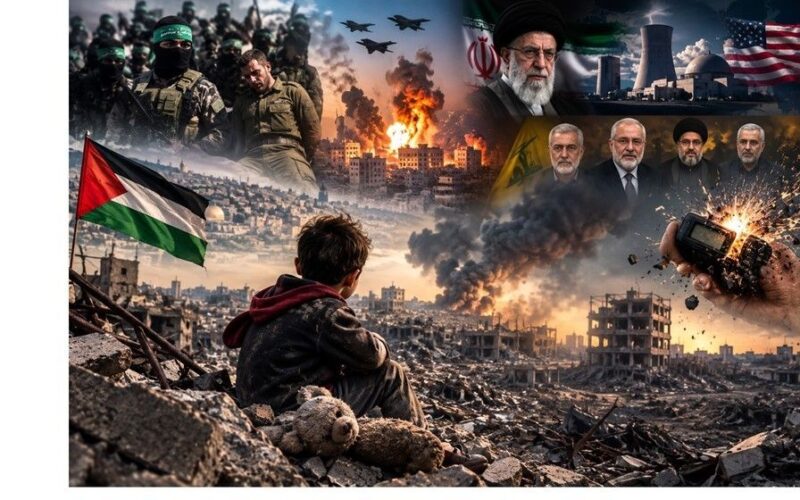
Three years on, what remains as evidence of October 7, apart from the catastrophe that befell the Gaza Strip, the war of extermination that claimed the lives of tens of thousands, displaced more than two million people, and turned the Strip’s cities and refugee camps into rubble?
When you consider that major event alongside everything that followed, it is like comparing a minor earthquake with a devastating one that swept away the memory of that “flood” and extinguished the exhilaration of the crossing.
The events that unfolded across the Middle East afterward appeared too significant to be mere repercussions on the margins of “October 7.” They were even more horrific than the battles in Gaza. Worse still, they overshadowed the humanitarian catastrophe, reducing it to a secondary story on the evening news.
Israel appeared as though it had been preparing for that day for many years.
It unleashed its forces on every front. It did not stop at occupying and destroying the Gaza Strip. It took control of a fifth of Lebanese territory, seized the buffer zone with Syria, and stationed its army on the overlooking heights, closely monitoring every movement at the presidential palace in Damascus. All of this came after a swift victory that brought down the weakened Assad regime.
But the most significant developments were yet to come. Israel was no longer content with intermittent attacks on Iran’s proxies. It went directly to Tehran and struck at the heart of the regime.
It assassinated the Supreme Leader and targeted Iran’s nuclear facilities. It then drew Washington into a major regional war that remains ongoing, in which the Arabs have suffered greater material losses than Israel and the United States combined.
In contrast to the humiliating images of its soldiers being held by Hamas fighters, Israel was soon confronted with another shocking scene that reverberated around the world: images of pagers exploding in the hands of Hezbollah fighters and operatives.
Everyone who claimed victory on October 7 was eventually targeted and killed by Israel: Sinwar, Haniyeh, Nasrallah, the Supreme Leader, and other senior figures within the axis.
Israel did not allow October 7 to settle, even for a moment, in the collective global memory as a Palestinian victory. It was determined to destroy that image and drown it in blood and images of thousands of victims.
Its overriding objective, and it remains so, was to convince the world that what happened on that date was merely evidence of an Arab intention to kill Jews and eradicate their state.
The Zionist mindset never paused to ask about the decades of oppression endured by the Palestinian people, or the disastrous consequences that oppression ultimately brought upon Israel itself.
It is true that Israel did not win the battle for public opinion. Unlike Israel, the world has largely retained in its collective consciousness the images of death and killing in Gaza.
But leaders of the Zionist right are betting on time to overcome the enormous damage inflicted on Israel’s image. I believe they are right to place that bet, because the massacres in Gaza were not unprecedented in Israel’s history to the extent that they would remain forever etched in the world’s memory.
Global public opinion will move beyond the memory of Gaza and settle for remembering the tents and humanitarian aid.
That is painful and regrettable. Israel will continue its wars across the region. This is only the beginning.
The temporary and emergency arrangements on the various fronts will eventually become permanent realities. And the wars to come will eclipse those that preceded them.
October 7 was merely the spark that ignited major fires. Who will remember the spark from now on, when the flames around it are reaching the sky?!
Related Stories

The World Cup: Jordanians in Their Respectable Presence
Jordan and the Gulf States: The Dilemma of War