
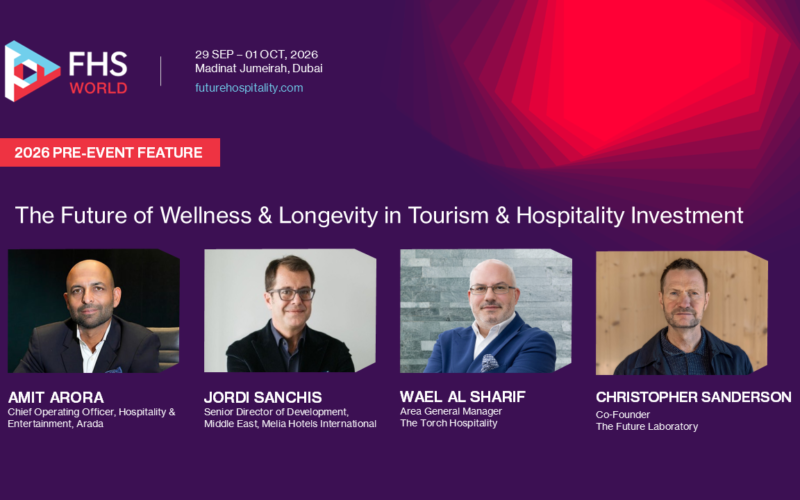
Lifestyle and wellness continue to evolve as core drivers of the global travel sector, with today’s investors seeing wellness as a lucrative real estate and hospitality asset class. In the run-up to Future Hospitality Summit – FHS World 2026, which features Lifestyle and Wellness as a key conference track, experts share insight and opinion on investing in the sector, travellers’ expectations, market misconceptions, the future of longevity tourism and more.
With input from Amit Arora, Chief Operating Officer, Hospitality and Entertainment, Arada;Jordi Sanchis, Sr. Director of Development – Middle East, Meliá Hotels International;Christopher Sanderson, Co-Founder, The Future Laboratory;andWael Al Sharif, Area General Manager, The Torch Hospitality.
With growing investor interest in longevity science and preventative healthcare, can they become credible pillars of hospitality, or are they still considered somewhat niche? From an owner or investor lens, is wellness a revenue enhancer or a standalone asset class?
Amit Arora, Chief Operating Officer, Hospitality and Entertainment, Arada, believes wellness has evolved into a core driver of global travel experience, with today’s investors viewing wellness as a distinct, highly lucrative real estate and hospitality asset class.
“Guest expectations have shifted too, toward an ecosystem where wellbeing is integrated into sleep hygiene, functional nutrition, and bio-harmonized programming,” he says. “At Akala Hotel and Residences, Arada capitalises on this shift by pioneering a mixed-use model that combines ultra-luxury hospitality with preventative healthcare, precision diagnostics, and advanced therapeutics. By treating wellness as an integrated operational thesis, owners can capture premium ADR and drive sustained customer lifetime value.”
It’s a view shared by Jordi Sanchis, Senior Director of Development – Middle East at Melia Hotels International, who says that wellness is no longer limited to spas or relaxation.
“It’s about helping guests live better, longer and with more balance,” he says. “Longevity science will increasingly become a credible pillar, particularly in premium and luxury segments, but it will enhance hospitality rather than replace it. From an owner’s perspective, wellness today is both a revenue enhancer and a long-term value creator, and, in certain destinations, is already evolving into a standalone asset class, especially when integrated into mixed-use projects and branded residences.”
Wellness is a winner when it comes to returns, according to experts
Christopher Sanderson, Co-Founder, The Future Laboratory, points out that while hard hotel-level data is tricky to source, where it exists, wellness wins outright.
“RLA Global and HotStats’ 2025 analysis of more than 12,000 hotels found properties with major wellness offerings generated more than double the Total Revenue per Available Room of hotels without such offerings in 2024. UBS separately tips longevity for above-average equity returns this decade. Traditional luxury chases occupancy; wellness tends to compound it,” he says.
Meanwhile, according to Wael Al Sharif, Area General Manager, The Torch Hospitality, wellness is both apowerful revenue enhancer for existing assets and emerging as a standalone class.
“Dedicated modern recreation facilities command premium pricing, but integrated wellness amenities also significantly boost the performance and valuation of traditional hotels,” he says.
Where does the strongest value creation sit for wellness tourism and what metrics prove performance?
For Arada’s Amit Arora, optimalvalue creation lives between hospitality and integrated lifestyle programming, particularly within high-yield, mixed-use wellness real estate developments.
“Traditional spas typically operate on localised treatment margins, whereas a holistic destination ecosystem drives performance across the entire asset,” he says. “For a pioneering concept like Akala, value is unlocked by pairing luxury hospitality with medical wellness infrastructure, creating strong resonance and multi-season touchpoints with an affluent demographic. Performance evaluation must look beyond standard metrics like RevPAR towards success through ecosystem-wide KPIs such as total revenue per available room (TRevPAR), Wellness Capture Rates, and customer retention/lifetime value (LTV).”
The Future Laboratory’s Christopher Sanderson believes that value really starts to coalesce where hospitality stops behaving like hospitality, and it’s the membership access, not the room, that carries the margin.
“The Surrenne private members’ club at The Emory in London charges £10,000 a year plus a £5,000 joining fee for longevity access. Yet 2025’ s RLA Global/HotStats data show it is lean ‘minor wellness’ hotels, not sprawling spa-led resorts, posting the strongest RevPAR growth. Diagnostics, not décor, are critical here. At this early stage of the longevity curve being able to deliver on a simple longevity framework is the metric that counts,” he says.
When asked whether longevity could be the next frontier or is simply a rebrand of wellness, Melia’s Jordi Sanchis feels that longevity is wellness’ natural evolution, but it should be kept human, accessible and lifestyle-driven, adding that “hospitality should not become clinical, but should create environments that encourage healthy living, connection, movement and recovery. As awareness around prevention grows, longevity-inspired hospitality will become increasingly mainstream.
In the words of Wael Al Sharif of The Torch Hospitality, “longevity represents genuine evolution, not rebranding – and, in time, will become mainstream. Traditional wellness offers relaxation and temporary fitness gains; longevity provides measurable health optimisation through biometric tracking, personalized nutrition, sleep science, and preventative healthcare. As populations age and healthcare costs escalate, preventative longevity travel will achieve mainstream status. It’s transitioning from luxury indulgence to health necessity.”
Travellers’ expectations of a wellness stay have changed significantly over the last few years. Just five years ago, a baseline wellness offer consisted of a standard fitness centre and a generic spa menu. Today, it’s very different, say industry gurus.
Wael Al Sharif says that today’s traveller expects a results-oriented, holistic program – integrating mental, physical, and nutritional health with personalised data tracking – moving far beyond a standard spa menu to a curated, transformative health journey during their stay.
Meanwhile, Amit Arora believes that tomorrow’s affluenttraveller demands data-driven personalisation and hyper-customised programming, with modern guests expecting advanced circadian optimisation protocols for sleep, hyper-functional nutrition tailored to metabolic needs, and proactive stress-mitigation spaces. Crucially, they demand flexibility and autonomy to pursue an intense performance recovery session in the morning, experience advanced regenerative PRP treatments, and enjoy a world-class culinary experience at night without feeling restricted by a more rigid, clinical protocol.
How important is authenticity and local culture compared to high-tech solutions?
For Christopher Sanderson, both are equally important. “As an example, Soneva layers Ayurveda and yoga onto cryotherapy and stem-cell therapy, yet, to keep it real, hires only yoga teachers who have lived in ashrams, to keep it real,” he says. “SHA’s Mexico clinic pairs gene therapy with shamanic temazcal ceremonies; and Mia Kyricos counters that the experiences with the strongest return on wellness carry the least tech behind them. As Scorpios’ Thomas Heyne puts it, ‘belonging cannot be bottled’.”
And for Jordi Sanchis, authenticity remains the core differentiator
“Technology supports diagnostics and personalisation, but the emotional and cultural layer creates lasting impact. In our spa and wellness approach at Paradisus resorts, for example, we integrate local traditions, nature and rituals, ensuring that wellbeing is deeply connected to the destination,” he says.
Experts also share common misconceptions in the market about wellness hospitality, with Wael Al Sharif, citing one major misconception being that wellness is women-centric or leisure-only. “Our data shows 48% male participation, with business travellers increasingly prioritising wellness facilities for stress management and performance optimisation. Wellness is becoming essential business infrastructure, not leisure amenity. Wellness guests spend significantly more per stay, return more frequently, and generate powerful word-of-mouth awareness”, says Wael.
Amit Arora believes that wellness hospitality is often misunderstood as a niche service exclusive to fitness enthusiasts or health ascetics when, in reality, the addressable market spans the entire luxury travel demographic because wellness is highly individualised.
“For one traveller, it might mean a regimented, high-tech longevity protocol; for another, it may simply mean an environment designed for mental decompression and deep rest. Our Inaura lifestyle concept, by design, integrates kinetic wellness into the broader lifestyle of the property. Physical and mental optimisation happens naturally throughout the stay, shifting wellness from an isolated retreat into an everyday reality,” he says.
Asked to describe the future of wellness and longevity tourism and hospitality investment in one sentence, Amit Arora says: “The future belongs to an integrated asset model where wellness is no longer treated as an amenity, but is structurally embedded into wellness real estate design, operational DNA, and the long-term compounding value of the destination.”
For Jordi Sanchis, it’screating integrated lifestyle ecosystems where preventative wellbeing, community, destination authenticity and real estate value come together to deliver long-term performance.
Christopher Sanderson believes that, with the Global Wellness Institute forecasting wellness tourism to grow 9.1% a year to 2029 and longevity travel to nearly double, from $27bn in 2024 to $44bn by 2030, investors who still treat wellness as a spa line item, rather than the fastest-growing driver of hotel revenue this decade, risk retrofitting an asset class that has already arrived.
And, in Wael Al Sharif’s view, wellness evolves from amenity to asset class as preventative longevity science, personalised health optimisation, and measurable outcomes transform hospitality from temporary accommodation into essential health infrastructure—commanding premium valuations through superior revenue diversification, extended stays, and demographic tailwinds driving sustained demand growth globally.”
FHS World, taking place 29 September to 1 October at Madinat Jumeirah, Dubai, features a dedicated content track on Wellness with insight from global leaders in their field with sessions covering a wide range of topics from ‘Why Longevity is the Ultimate Luxury’ and ‘Turning Health Science into Hospitality & Real Estate’ to a TenX Leadership Talk on Building Health, Not Just Hotels and a session on ‘Building the Middle East’s Next Generation of Healthy Communities.’ For the full agenda, visit the event website.