All the Jordanian and Arab friends living in distant countries tell the same story: the spread of waves of high prices, rising fuel costs, and economic setbacks, as if a single reality has descended on everyone without exception.
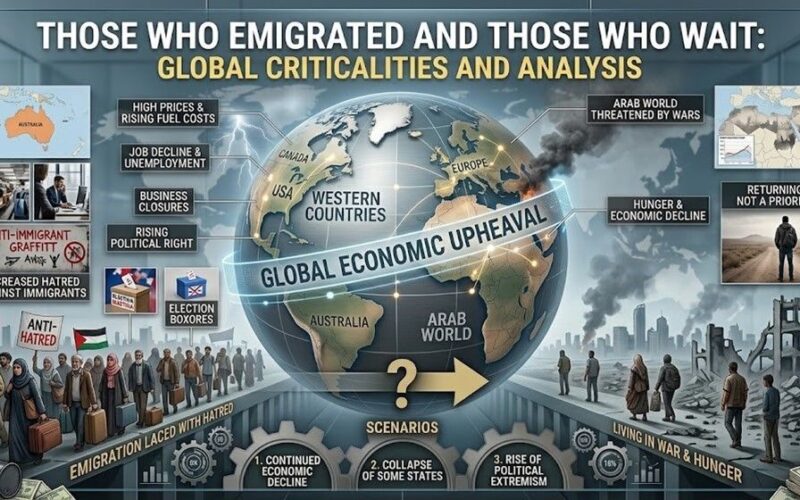
These changes emerged after the war in the region, though they have older roots. Those living in Australia, Canada, the United States, Britain, or other Western countries speak of the same details: declining job opportunities, high prices, rising fuel costs, spreading unemployment, and waves of businesses and companies shutting down.
This means the world is undergoing a major economic upheaval and changing significantly. This is not a justification for any economic setbacks in the Arab world and its countries, but it does give an indication that a new reality is forming in both nearby and distant countries.
The greatest challenge facing peoples is preserving their rights and privileges and curbing these changes, but it is also clear that individual debt and the world’s economies are bearing down heavily on life in expatriate communities.
This, in turn, explains the political and social backlash in those countries.
Nothing illustrates this more clearly than the rise of the political right in many countries, the intensification of waves of hatred against immigrants, and the victory of extremist political movements in elections in numerous countries. If the economic situation remains in decline, hate campaigns against immigrants are expected to intensify, even against those who have taken on the citizenship of those countries and fulfilled the duties required of them.
The reason for this is that climates of economic strangulation generate a reaction: either governments are accused of being the cause, suffering from mismanagement, or recognized immigrants or undocumented refugees are accused of competing for the benefits owed to citizens of those countries, with their impact extending to job opportunities, as if they are taking a share of everything.
Despite this picture, comparisons between these countries and the Arab world show that the setbacks in those countries have not made returning to the Arab world a priority, since the social and economic systems there remain far better than in our region, and have not reached the point of total collapse. This means that all Arab immigrants will remain in the countries they emigrated to, which in their view remain far better than living in an Arab world threatened by wars.
But the real knot lies elsewhere: in the continued, deepening economic decline and the growing strength of the political right in those countries, a right that exploits every possible angle, from the political and religious identity of those societies and the threats they face, to what they consider violations of their way of life and laws, to high prices, poverty, and government and individual debt.
These are all themes that stir up those societies and reveal that their internal structural unity is not as strong as the initial impression suggests but rather has fragility and points of weakness.
What is certain, as we watch crises spread everywhere, no longer confined to their local settings but taking on regional and international effects, is that we will witness further economic setbacks, and perhaps the collapse of some states and the rise of others. Alongside all this comes the expansion of waves of hatred within many countries, and a further rise of the political right.
The Arab individual is caught between two choices: either living in an Arab world threatened by wars and hunger, or emigration laced with hatred, economic decline, and political campaigns, some carrying religious overtones, within contexts of incitement and exploitation.
Related Stories
Displacement Instead of Return
Could This Be the Last Population Census in Jordan?