
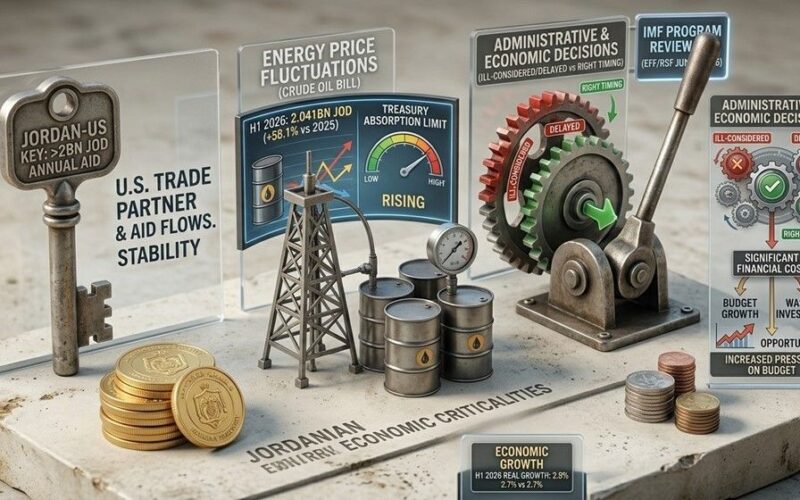
In the Jordanian economy, there are three factors I consider most capable of revealing the level of economic stability, not because they are the only important indicators, but because they have a direct capacity to generate rapid pressure on the treasury and public finances and thereby affect economic activity as a whole. The importance of this stands out especially given that the 2026 budget deficit, after grants, is estimated at around 2.125 billion dinars, with public debt interest allocations of around 2.260 billion dinars.
The first of these factors is the relationship with the United States, because this relationship is not merely political, but carries immense economic and financial weight. This is especially true given that the United States is Jordan’s largest trading partner, as well as its largest donor of aid, providing more than two billion dinars annually through various forms of support and assistance. A very large share of external grants also comes from the US, which makes the continuity of this relationship a key factor in sustaining financial inflows to the treasury and supporting economic stability. Consequently, any fundamental disruption in this relationship would have direct repercussions on public finances and the economy.
The second factor is fluctuations in energy prices, oil and gas specifically. The bill for crude oil imports, its derivatives, and mineral oils rose to 2.041 billion dinars during the first half of 2026, an increase of 58.1 percent over the same period in 2025. The treasury’s ability to absorb sudden, large increases in energy prices is limited, both in time and financially. If prices exceed the assumptions the budget was built on for an extended period, pressures emerge quickly, especially if the full increase cannot be passed on to the consumer. At that point, the gap turns into an additional cost on the treasury, which could mean a rising deficit and a need for more borrowing, and consequently an increase in debt and its servicing costs.
The third factor is flawed or delayed administrative and economic decisions. An ill-considered decision, or failing to make the right decision at the right time, can turn into a significant financial cost for the state. In a resource-limited economy, the cost of a mistake doesn’t stop at a direct financial loss, but can extend to weakening growth, squandering investment opportunities, and increasing pressure on the budget.
Alongside these factors, Jordan’s program with the International Monetary Fund remains one of the important pillars of institutional strength, because the continuation of the program, along with its periodic reviews and progress in implementing reforms, gives markets and international institutions a clear signal that fiscal and monetary policy are proceeding within a disciplined framework. This is particularly significant given that the Fund approved, in June 2026, the fifth review of the Extended Fund Facility and the second review of the Resilience and Sustainability Facility, providing total financing of approximately 188 million dollars.
It is true that economic growth remains modest and does not reflect the full potential available, yet the economy continues to achieve growth and maintain a degree of cohesion despite the difficult regional environment. Real growth reached 2.9 percent in the first quarter of 2026, compared to 2.7 percent in the same quarter of 2025.
Therefore, reading the Jordanian economy should not rest on a single figure, but on monitoring these three pillars: the strength of the relationship with the United States, the trajectory of energy prices, and the quality of economic decision-making. These are the fastest channels through which shocks can pass to the treasury, and from there to the economy as a whole.
Related Stories

What No One Wrote About the King’s Visit to China

Budget 2027: What Do We Want?