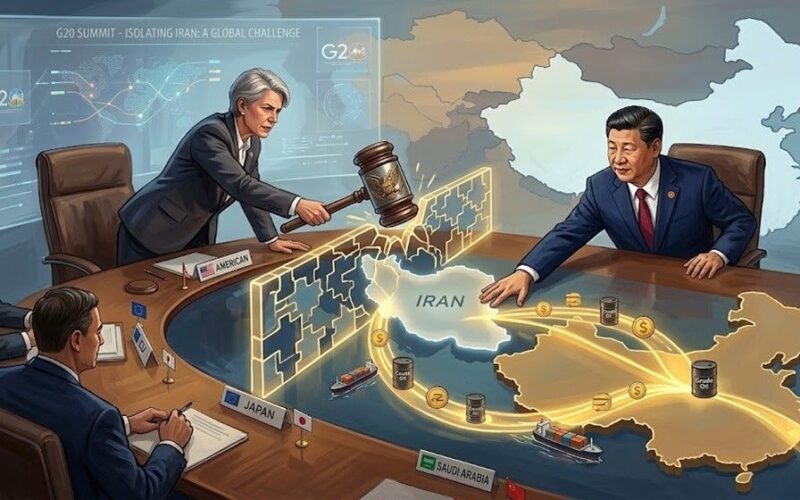
Watching the developments at the G20 summit held in the United States, alongside the accompanying American moves toward Iran, it becomes clear that the scene extends far beyond the boundaries of an economic gathering where nations discuss growth, trade, and debt. Behind the economic table, another, far more sensitive battle is unfolding Washington wants to turn the isolation of Iran into an international project, not merely an American policy, and to narrow the spaces that still allow Tehran room to breathe economically.
In this battle, however, there is one player who is hard to ignore: China. The United States can impose sanctions, pursue shipping companies, target intermediaries and banks, and threaten secondary sanctions against anyone dealing with Iran but it cannot guarantee the success of its isolation policy as long as Iranian oil keeps finding its way to the largest remaining market open to it. Here, China shifts from being merely Iran’s trading partner to becoming the most critical link in the American strategy.
The issue is not simply the volume of oil China buys, but Tehran’s ability to convert what it sells into revenue that gives its economy a chance to keep going. Even as trade grows more complicated and the costs of shipping, insurance, and payment rise, the mere existence of a buyer capable of absorbing Iranian crude prevents the blockade from being complete.
For this reason, Washington appears to be testing Beijing more than it is testing Tehran. The goal is not necessarily to get China to declare an end to its economic ties with Iran that would be a difficult demand to extract but rather to push Beijing to recalculate the cost of that relationship in terms of its own economy.
Beijing, however, has a different calculation. It may accept adjusting certain trade channels and may push its companies toward greater caution, but it does not want to concede that Washington has the right to determine who China trades with. For Beijing, the matter is not about Iran alone it concerns a broader principle relating to sovereignty over economic decision-making.
This is what turns American sanctions into a double-edged sword: they are capable of raising the cost of trade with Iran and weakening its revenues, but the more they expand to touch larger Chinese interests, the more likely they are to push Beijing toward developing financial and trade tools that reduce its dependence on the system led by the United States.
This is what makes the current confrontation different. Iran does not need to open every door in the world; one door China is enough. China, meanwhile, does not need to rescue Tehran; it needs to retain its own right to decide when that door opens and when it closes.
For this reason, what is happening at the G20 summit deserves to be read from an angle broader than sanctions alone. Washington is trying to test its ability to rally the world around a policy of isolating Iran, but at the same time it is testing the limits of its own influence over China. If it succeeds in pushing Beijing to reduce its trade with Tehran, the isolation project will move closer to its goal. But if China manages to keep an economic artery open even a limited and costly one, Iran will remain able to hold out.
The most realistic outcome here may be a middle ground: Iran economically weaker, China more cautious, and the United States more able to raise the cost of trade but without any side fully achieving its goal.
In the end, the question that imposes itself while following events at the G20 is not whether Washington is capable of imposing new sanctions on Iran that part of the equation is clear. The real question is whether it is capable of isolating Iran when China remains willing to keep an outlet open before it, however narrow.
Sanctions can strangle an economy, but they do not create isolation on their own. True isolation begins only when the adversary is left with no one to buy from, no one to transport for it, and no one to finance it.
Related Stories

Jordan and the Gulf States: The Dilemma of War