His Majesty King Abdullah II’s visit to the People’s Republic of China from August 18 to 24, 2026, came as part of a series of visits the King has undertaken to various countries and regions in recent months, including the United Kingdom and several Asian countries.
The visits form part of Jordan’s ongoing efforts to diversify its economic relations and open new markets for Jordanian exports and the private sector.
The visit marked the ninth time King Abdullah has visited China since assuming his constitutional powers, according to official confirmation from the Chinese Foreign Ministry.
The number reflects the depth and continuity of bilateral relations between the two countries since diplomatic ties were established, as they approach their 50th anniversary.
The repeated visits indicate that Jordanian-Chinese relations are no longer based on occasional protocol meetings, but rather on an ongoing process of engagement that keeps pace with economic and international developments.
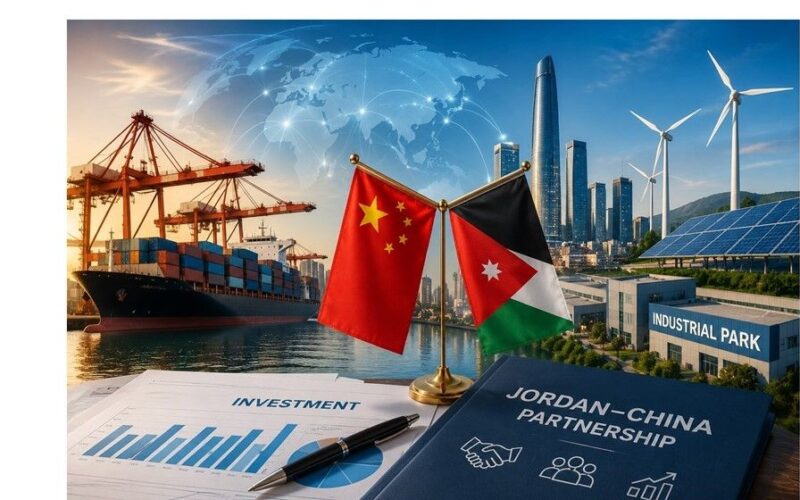
The visit was not merely a traditional diplomatic rapprochement. Instead, it placed a clear emphasis on moving relations from limited trade exchanges toward advanced investment and technological partnerships, in line with Jordan’s Economic Modernisation Vision and the Kingdom’s need for diversified sources of financing, investment and knowledge transfer.
Key Meetings and Agreements
During the visit, His Majesty met with Chinese President Xi Jinping, Premier of the State Council Li Qiang, and Zhao Leji, Chairman of the Standing Committee of the National People’s Congress, in addition to holding extensive meetings with Chinese economic leaders and representatives of major companies across a range of sectors.
The King and President Xi oversaw the signing of a number of agreements and memoranda of understanding between the two countries. His Majesty said the agreements demonstrate the shared determination to continue building strong relations between Jordan and China.
Among the most prominent agreements and memoranda signed during the visit were a protocol between Jordan’s Ministry of Agriculture and China’s General Administration of Customs concerning quarantine and veterinary health requirements; a memorandum of understanding between Jordan Radio and Television Corporation and China Media Group; a memorandum of understanding between the Jordan Gazette Agency (Petra) and China Media Group; and a memorandum of understanding between Jordan’s Higher Council for Science and Technology and China’s Ministry of Science and Technology in the field of science and technology.
Other agreements included a memorandum of understanding on cooperation in mineral resources, a letter of intent between Jordan and China on social affairs, and a memorandum of understanding between Royal Jordanian and Air China to strengthen air connectivity, explore codeshare opportunities and establish new routes between Amman and Beijing.
The agreement is expected to strengthen air connectivity between Jordan and China and attract Chinese tourists to the Kingdom, which is rich in historical, cultural and natural attractions.
China is one of the world’s largest sources of international tourists, yet Jordan has so far not fully benefited from this market.
The royal visit is expected to contribute to increasing the number of Chinese visitors to the Kingdom, particularly given Jordan’s security and stability, which are rare in the region.
However, greater efforts are needed from both the public and private tourism sectors to meet the ambition reflected in the King’s efforts to open this market for Jordan.
China has a potential outbound tourism market of around 165 million travelers. Therefore, the realistic goal is not to compete with Thailand in terms of the number of Chinese tourists, but rather to position Jordan as a specialized, high-spending destination.
If 100,000 Chinese visitors were to come to Jordan and each stayed, for example, five to seven nights, spending on hotels, restaurants, transportation, tourist sites and shopping, the economic impact would be far greater than simply focusing on the number of visitors.
Jordan also has a strong tourism story to market to Chinese travelers, including Petra, the Dead Sea, Wadi Rum, Jerash, Madaba, the Baptism Site, Arab cuisine, the desert, and the country’s security and stability.
The Ministry of Tourism itself considers the current number of Chinese visitors unsatisfactory and is working to facilitate their arrival.
Figures from the Ministry of Tourism and Antiquities confirm growth in the number of Chinese tourists visiting the Kingdom. Their numbers increased by 15.9 percent during the first seven months of 2026 compared with the same period last year.
According to ministry statistics, 11,931 Chinese tourists visited Jordan during the first seven months of this year, compared with 10,293 during the same period in 2025.
The royal visit included stops in Beijing, Shanghai and Shenzhen, featuring productive discussions on deepening economic cooperation in agriculture, pharmaceutical, food and engineering industries, tourism, education and culture, as well as green energy, scientific innovation and civil aviation.
The objectives include attracting investment, localizing technology, and transforming Jordanian-Chinese relations from a relationship centered primarily on importing goods into a development-oriented investment partnership.
The visit also seeks to create opportunities for major Chinese companies to invest in infrastructure, renewable energy particularly solar panel and component manufacturing mining, pharmaceuticals and logistics.
The King’s visit also supports Jordan’s ambition to become a regional hub, leveraging its strategic geographic location and network of free-trade agreements connecting it to Western and regional markets.
This could position the Kingdom as a logistical and industrial gateway for Chinese companies seeking access to Middle Eastern and North African markets.
At the same time, this approach contributes to diversifying Jordan’s economic options and strengthening its economic and diplomatic resilience by building partnerships across multiple poles and balancing its longstanding relationships with growing ties to emerging economic powers such as China, particularly amid successive regional crises and ongoing efforts to support stability in the Middle East.
The Significance of the Royal Tour’s Three Main Cities
The decision to divide the visit among Beijing, Shanghai and Shenzhen was not merely a matter of protocol. Rather, it carried precise functional significance, reflecting the distinctive role each city plays within China’s economic and political system.
His Majesty’s visit to Beijing was significant because it is the political and diplomatic center of the country. There, the King held summit-level meetings with the Chinese president and premier, agreements were signed, and diplomatic convergence was reaffirmed on regional and international issues.
The visit to Shanghai, meanwhile, reflected its position as a major financial and commercial center. The King held meetings with the heads of major companies and business leaders to attract capital and investment to productive and financial sectors.
The visit to Shenzhen was particularly significant because of the city’s status as a center of technological innovation. It focused on developing partnerships in advanced technology, telecommunications and smart manufacturing with major Chinese technology companies, supporting the modernization of Jordan’s technology and vocational sectors.
China’s Importance to the Global Economy
The growing Jordanian-Chinese relationship derives much of its significance from China’s expanding weight in the global economy, as reflected in the latest data and estimates from international institutions for 2026.
China is a major engine of global growth Estimates from the International Monetary Fund indicate that China is expected to account for approximately one-quarter of global economic growth around 24–26 percent of total real global growth in 2026, the highest contribution by any single country. By comparison, the European Union as a whole is expected to account for around 9.5 percent of global growth.
China also represents a major share of global output, accounting for approximately 19–20 percent of global GDP when measured by purchasing power parity, the largest share held by any single economy. In nominal terms, its share is approximately 16–17 percent.
In simple terms, China can be described as the world’s workshop and a central hub of global supply chains. It is the world’s leading manufacturing and exporting power, with global industries relying on China for finished goods, electronic components, semiconductors and essential manufacturing materials.
This means that any disruption to Chinese production or trade has a direct impact on international supply chains.
China has also emerged as a leader in the green and technological transformation of industries, particularly electric vehicles, lithium batteries and solar panels, alongside rapid advances in smart communications and artificial intelligence.
These are precisely the areas from which Jordan seeks to benefit under its Economic Modernisation Vision.
China is also a major consumer force in commodity markets, being among the world’s largest importers of raw materials, energy and minerals. As a result, its economic performance is a direct indicator of global trends in energy and commodity prices.
The Strategic and Diplomatic Dimension of the Visit
The visit forms part of Jordan’s efforts to diversify its economic and diplomatic options amid successive regional crises and to support efforts toward stability in the Middle East, without affecting the Kingdom’s other partnerships.
The meetings held by King Abdullah with the Chinese leadership demonstrate that a significant part of the discussions focused on regional and international issues of mutual interest, alongside economic and investment matters.
King Abdullah II’s ninth visit to China represents another cumulative milestone in an extended bilateral relationship that is gradually moving beyond traditional political and trade ties toward a deeper investment and technological partnership, at a time when China continues to play a central role as a major engine of global growth and innovation.
Jordan is seeking to leverage this relationship to diversify its economic and diplomatic options and strengthen its potential position as a regional hub connecting Chinese investment and industries with markets across the Middle East and North Africa, without compromising its longstanding partnerships with Western countries.
What is required today from both the private sector and the government is to capitalize on the economic, technological and investment breakthroughs achieved through the King’s visit to China and other countries, build upon them and ensure their sustainability, while making every possible effort to turn these openings into tangible results.