
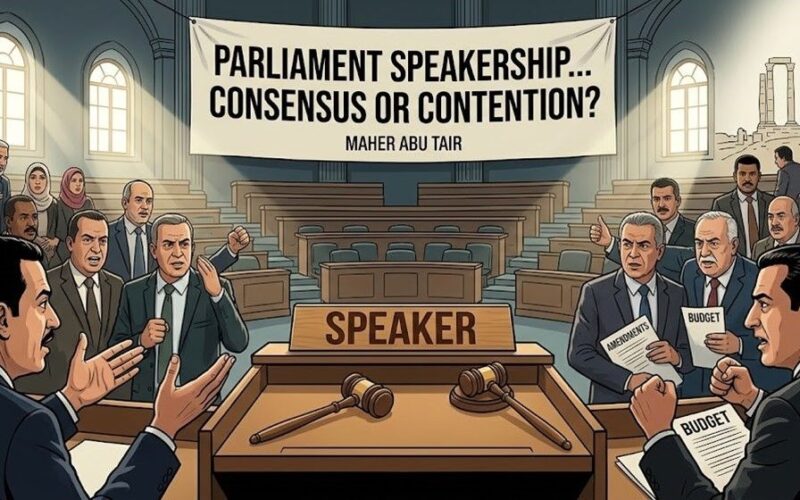
Talk has already begun about the position of the Speaker of the House of Representatives, and whether the current Speaker will remain or be replaced during the upcoming ordinary session. As happens every year, the names of candidates are circulating in the media.
I have read leaks attributed to MPs saying they do not want pre-arranged consensus over the parliamentary speakership — the same thing heard every time. Yet last time, consensus was reached on everything, including the parliamentary committees, which means that consensus-building as a principle will not be absent from the current House.
The problem with consensus arrangements is that they resemble a kind of genetic engineering of parliament: instead of holding elections at every level, a formula of consensus arrives to close the whole file and prevent friction within the House.
What can be said here is that consensus may, each time, lead to unease within the House, because it can look like a pre-arranged appointment — as though a decision has already been made to choose one person over another — even though parliament does not actually need such consensus, since the majority of MPs represent a single political current. It would make no real difference if one candidate ran and another won, because the vast overwhelming majority belong to one color. Still, consensus may reflect a desire to control the scene and distribute positions within a broader context that could conflict with the principle of free choice within parliament.
In earlier parliamentary sessions, years after democracy began, the parliamentary speakership rotated among different figures. The late Abdul Latif Arabiyat, a prominent Islamist figure, once served as Speaker, and no earthquake occurred in Amman. Rather, the speakership remained governed by various factors, including the importance of cooperation with the other branches of power and regulating the council’s performance. This means that concerns over the political identity of the Speaker, for instance, or of committee members or committee chairs, do not justify the principle of consensus, which reflects a pre-managed outcome for the scene.
The upcoming ordinary session is a pivotal one, featuring amendments to the Social Security Law, the budget, and possibly other issues that may include amending the Elections Law — which, if not addressed in the upcoming ordinary session, will simply be postponed, though it will eventually be amended regardless. This means the upcoming speakership may be the most sensitive one yet. Here, we are not taking sides in criticizing or praising anyone, because we are facing a wide pool of aspiring candidates — unless it gradually shrinks due to consensus-building, a pattern we see every time: ten declare their intention to run for the speakership, then the number drops to a single candidate competing against himself.
From now on, contacts and maneuvering around the speakership have already begun, and one hears nothing but praise for MPs who have held the position, or criticism of them, along with a thorough dissection lengthwise and crosswise — of names who might aspire to it, with everyone weighing their strengths and weaknesses. It is certain that official Amman has its own view, cast in the shadows, tied to various assessments.
What we are facing is a timing question about the parliamentary speakership not a battle for the speakership. And the difference between the two is significant.
Related Stories

The New Significance of “Companies”

Four Rules of War