
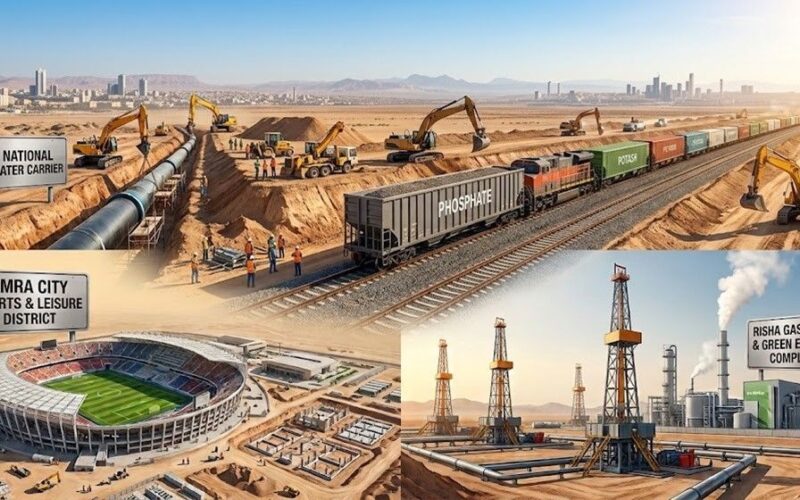
Despite difficult regional and economic challenges, the government continues to move forward with implementing a number of major projects that, if completed according to plan, could mark a genuine turning point in the shape of the national economy in the coming years. During the first half of 2026, implementation began on 343 projects out of 394 listed under the second executive program of the Economic Modernization Vision.
The National Water Carrier, the Aqaba Port railway, energy and gas projects, Amra City, and other strategic projects are no longer mere ideas or postponed studies, but have become part of an executive agenda the government is seeking to turn into reality — even though they stand at varying stages: some have entered preliminary works, some have completed designs and agreements, while others await financial closure.
The importance of these projects lies not only in the scale of investment they will bring into the economy, but in their capacity to redefine Jordan’s economic position. An economy long described as small and limited in market size could become more connected to its surroundings and more integrated into regional supply chains, particularly through railways, ports, energy, and gas.
The Aqaba Port railway project, for example, is being implemented through a Jordanian-Emirati investment estimated at about $2.3 billion, and includes building a 360-kilometer network linking phosphate and potash production areas to the industrial port, with a transport capacity of about 16 million tons annually. Its financial closure is expected to be completed in early 2027, with implementation over five years.
The project should not be seen merely as a means of transporting mining products within the Kingdom — it represents the first core of a national network that could expand in the future toward Syria, Turkey, and Europe, and toward Saudi Arabia and the Gulf states, while the government is studying the construction of a 42-kilometer link to the Ma’an development zone, integrated with the Ma’an-Aqaba inland port project.
As for the National Water Carrier, it goes beyond being merely a water project — it is an investment in national security and economic stability, with an estimated capital cost of about $4.3 billion and a total cost of nearly $5.8 billion including financing costs. It aims to desalinate 300 million cubic meters of water annually, covering about 40% of the Kingdom’s drinking water needs, via a 438-kilometer carrier line, with water pumping expected to begin in the last quarter of 2030.
In the energy sector, the government signed a contract to drill 80 new production wells in the Risha field, aiming to raise production to 418 million cubic feet per day by 2029 — a quantity the government expects will cover Jordan’s annual natural gas needs. Jordan also signed an agreement for a green ammonia project costing $1 billion, with a production capacity of 100,000 tons annually.
In Amra City, preliminary work has begun on the Hussein bin Abdullah II International Stadium, which will accommodate 46,000 spectators, while designs have been approved for an exhibition and conference center costing 50 million dinars with a capacity of 15,000 people, alongside an entertainment city whose first phase is being implemented at a cost of 50 million dinars.
However, the greatest challenge lies not in announcing these projects, but in financing and implementing them without burdening the treasury beyond its capacity — especially since the 2026 budget aims to keep the deficit at 2.125 billion dinars, or 4.6% of GDP. Here, partnerships, foreign investment, and development financing must take precedence over direct government borrowing.
These projects need to serve as a lever for growth, revenue, and job creation, with financing models designed in ways that do not increase the deficit or raise indebtedness, alongside clear disclosure of the costs, commitments, and risks that public finances may bear in the future.
Jordan stands before a historic opportunity to enter its second century with an economy more productive and more connected to the region — but the success of this vision will be measured by the government’s ability to turn these projects from plans into productive assets, without the treasury paying the price at the expense of future generations.
Related Stories
Lightning, Thunder and Rainfall: Nature’s Dramatic Signs of a Storm
How are intelligence agencies and embassies analyzing the situation?