
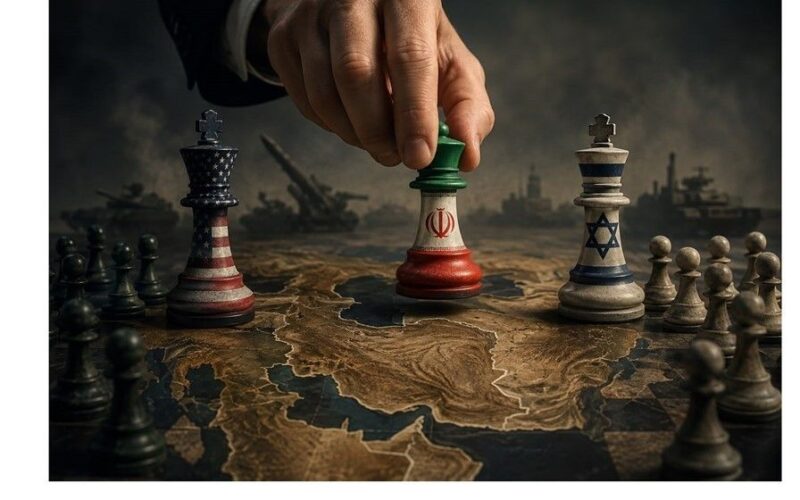
Military and political analyst Nidal Abu Zaid, a friend, has presented an important theory regarding the war against Iran, U.S. policies in the region, and what Washington specifically wants.
Abu Zaid argues that Washington wants Iran to be weaker than Israel, but at the same time stronger than the Arab countries of the region.
He explains this by saying that the United States seeks to guarantee Israel’s military superiority on the one hand, while controlling the Arab region by regulating Iranian behavior on the other. In other words, we are facing a balance of objectives on both sides of the battlefield.
There is no contradiction in this argument. Abu Zaid was essentially responding to a question about whether Washington is incapable of occupying Iran, overthrowing its regime, and bringing the war to a definitive end.
To enrich the discussion around this issue, I believe what Abu Zaid said is highly accurate. Ensuring Israel’s superiority is clearly understandable as part of U.S.
motivations. But the fact that the war or conflict has not been brought to an end, and that Iran is being weakened rather than completely defeated, while still being left stronger than the Arab region in general, is intended to pressure the Arab world into seeking protection, purchasing arms, and strengthening the U.S. presence in the region.
None of this can happen unless there is an adversary that threatens the region on a daily basis, within certain limits.
This means that Washington is pursuing a number of objectives that may appear contradictory. A superficial analysis would always suggest that the United States is unable to bring the war to an end.
Naturally, this is not a particularly deep argument, because the United States is investing in the war and prolonging it in order to achieve several objectives, including keeping Iran as an adversary that threatens the Arab countries of the region within certain limits, thereby pushing the region to turn to Washington for help.
The region is being subjected to U.S. pressure amid this war. This raises the question of the importance of Iran recognizing what the region is being subjected to, so that the region does not become an easy prize for the Americans.
This, in turn, requires an Iranian response capable of preventing Washington from exploiting the war against its neighbors.
The U.S.-Iranian confrontation is devastating, and its costs extend far beyond the two sides themselves, The bills of the conflict are being distributed among countries and peoples.
It is also well known that Washington has kept the conflict unresolved so far in order to pursue objectives against China, Russia and Europe, due to the closure of shipping routes, damage to global trade, and disruptions in the flow of oil and energy.
These repercussions are also dragging the Arab countries into the crisis, which helps explain the prolongation of the war and conflict without bringing them to an end, this is despite Washington repeatedly declaring that Iran’s nuclear stockpile has been buried and is no longer a threat.
So why do we not hear about a political or military end to this situation?
Since the beginning of the war, Washington has threatened a broader conflict, yet all of its bombing operations have weakened Iran without ending the war, because Washington wants to pressure the entire region and seize its wealth.
On the other hand, Washington may be avoiding a military victory because it knows that the collapse of Iran could lead to its division and the emergence of new ethnic and sectarian entities.
It could also trigger a civil war inside Iran, resulting in waves of refugees fleeing into neighboring countries, in addition, Iran’s military stockpiles could be dispersed among armed groups in Iran, Iraq and Syria, potentially reaching Lebanon and other neighboring countries.
There is also the possibility that leaders from Iran’s Islamic Revolutionary Guard Corps could inherit the current Iranian regime and decide to set the entire region ablaze, without regard for political calculations or any of the rules of diplomacy and international law.
Washington’s game in the region has become increasingly exposed, I wrote in a previous article that the Americans are among the most skilled at using adversaries in functional roles, even without those adversaries’ willingness to play them, just as they benefit from their allies.
This means that Washington invests more in enmities than in alliances.
Related Stories

How Will Jordan Settle the Battle?
Do economic sanctions bring victory for Trump?