
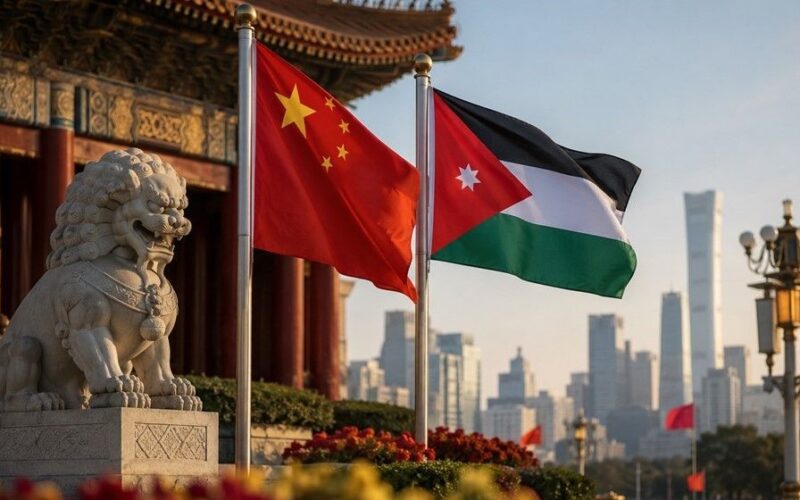
Early in his reign, King Abdullah II placed relations with China among the priorities of Jordan’s foreign policy. Since then, relations between the two countries have followed an upward trajectory, culminating in the signing of a strategic partnership agreement in 2015.
China’s remarkable economic success story must be a source of inspiration for a small, resource-constrained country like Jordan.
What the King sought, as he shaped the vision for modern Jordan, was to draw on the experiences of successful countries and make use of every available opportunity to build an economic and development model for Jordan one capable of achieving ambitious goals for modernizing the country’s economy, increasing growth rates, and keeping pace with sweeping technological transformations.
China stood at the forefront of countries that had created such a model and was willing to share it with others.
For many years, China has become a trusted trading partner for Jordan, ranking first among Jordan’s trading partners last year. Its presence has grown significantly across numerous industrial and commercial sectors, as well as through partnerships in major projects.
This partnership, which has arguably benefited Jordan more than China, could have reached record levels in recent years.
However, a number of political considerations, coupled with the sharp polarization between the United States and China, had repercussions for Beijing’s relations with countries across the region, including Jordan.
During that period, several issues emerged between the two countries regarding economic and investment cooperation.
Among the most prominent was the controversy and dispute surrounding the Al Attarat oil shale power generation project, financed by Chinese banks, The dispute ultimately went to arbitration, after which the project was brought into operation and became part of Jordan’s electricity generation mix.
This was never the level of ambition the King had envisioned for relations with China. Jordan therefore maintained strong political and diplomatic ties with Beijing until circumstances improved enough to allow the partnership to regain momentum at a higher pace.
Jordanian diplomacy kept channels of communication open with the Chinese leadership, maintaining a high level of coordination, particularly on issues related to regional security and the Palestinian cause, with Beijing regarded as a key ally of the Arab world on these matters.
The transformations the world and the region have witnessed over the past three years have compelled Jordan and other countries in the region to reassess their calculations and move toward diversifying their options, as part of a proactive approach to the consequences and lessons emerging from these changes.
Here, the King is once again drawing on a skill in which Jordan has long excelled: keeping relations alive and friendly with all sides in a way that serves the country’s higher national interests.
Throughout its long history, Jordan has succeeded in navigating regional challenges and international shifts while minimizing their costs.
The King’s current visit to Beijing represents a vivid example not of a shift in historical alliances, as some may interpret it, but rather of activating a deeply rooted relationship with a major global partner that has consistently treated Jordan with great respect and highly valued the King’s standing and his wise approach to the region’s various issues and conflicts.
Certainly, the royal visit to Beijing will not begin relations from scratch, The partnership between the two countries is already open across numerous fields.
At this stage, the objective is to build on what already exists, expand the scope of economic and investment cooperation, and restore momentum through new areas of partnership.
Related Stories


Budget 2027: What Do We Want?