
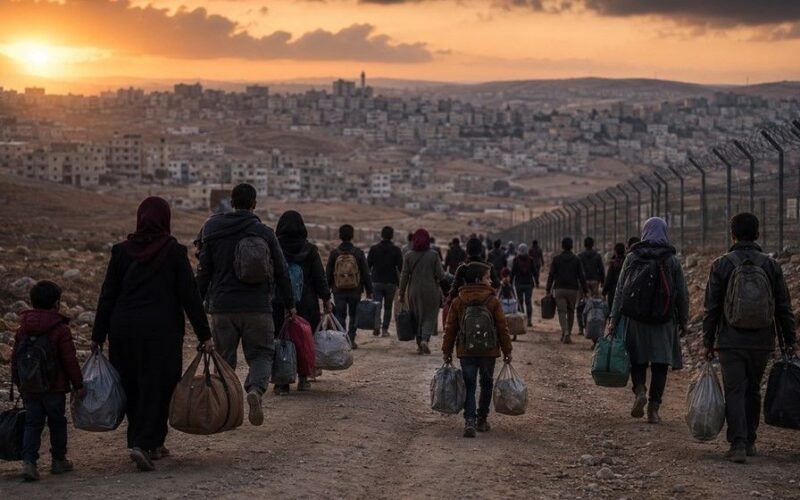
All of Jordan’s neighboring crises have driven waves of migrants toward the country, though I hesitate to use the term “refugees” given the sensitivity surrounding it, particularly when some use it to describe Arab brothers and sisters who have come to Jordan.
This is not the point, The terminology is not what matters; what matters is Jordan’s willingness to shoulder crises that other Arab countries were unwilling to accept, we have witnessed waves of people arriving from Syria and Iraq, waves from Yemen, and, before that, from Palestine.
Millions of Arabs have passed through and lived in this country. Some stayed, while others eventually left. The majority of those who came to Jordan, however, did not leave again, with the exception of Iraqis, most of whom either returned to Iraq or obtained asylum in foreign countries and did not return.
There has always been an ethical dimension governing Jordanian society. Jordanians may complain about waves of refugees, but it is virtually inconceivable for a Jordanian to attack anyone or cross social boundaries.
The experiences recounted by our grandparents are testament to this, as are the experiences we continue to witness today, without flattering ourselves, Jordan dealt with Syrians, for example, in a completely different manner from what they encountered in Turkey, Lebanon and Iraq.
This is something Syrian brothers and friends themselves have acknowledged without reservation, despite the impact on the demographic makeup of cities such as Irbid, Mafraq and Ramtha, among others.
Most Arab countries were unable to cope with waves of refugees. In fact, their populations launched political campaigns that turned into campaigns of hostility against refugees in the media and on the streets.
There are many examples that I do not wish to mention. Some countries had already closed their doors to refugees or restricted the granting of visas.
The reason I raise this issue is a figure I obtained two days ago: 222,000 Syrians have returned to Syria since the change of regime, while more than 1.25 million Syrians remain in Jordan.
Some have officially migrated to third countries or obtained asylum through international organizations, but the majority have remained here.
The significance of this figure is linked to the start of the academic year in Jordan.
This means that most of them will enroll their family members in Jordanian schools, despite the fees imposed for education and the work permits required of their fathers. We should also remember that nearly a quarter of a million Syrian children have been born in Jordan since Syrian families began arriving.
This is not an attempt to make an inflammatory case against our Syrian brothers and sisters. Rather, it is an effort to analyze the situation.
Despite the decline in all forms of financial, health and food assistance, the majority of Syrians have chosen to remain in Jordan despite their economic hardships.
They work in various professions, and most speak of an unstable security situation in Syria whose future remains uncertain, in addition to the difficult economic conditions and accounts from those who returned to Syria expressing regret over their decision.
The Syrian crisis has, in some respects, become a Jordanian crisis. Concerns are now growing over the possibility of new waves of refugees, particularly if the security situation in Syria deteriorates, especially in the southern regions. This is a possibility.
There is also the prospect of sectarian conflict erupting in western Iraq in an attempt to undermine the government aligned with Iran, potentially leaving Jordan as the only destination for Iraq’s Sunnis.
This comes in addition to the situation in the West Bank and the threats it poses to both Jordanians and Palestinians.
It is no exaggeration to say that Jordan’s neighborhood, engulfed in crises, could send new waves of refugees toward the country at a time when Jordan is already carrying a heavy burden and can no longer afford the economic, political or security costs of any demographic displacement into its territory amid efforts to reshape the region.
What will we do in such a situation, beyond issuing statements of condemnation, rejection and denunciation, or even closing the borders, when we know that a massive human influx will inevitably seek to cross any official land borders?!
Related Stories

The Disarmament Scenario

Diesel Diplomacy