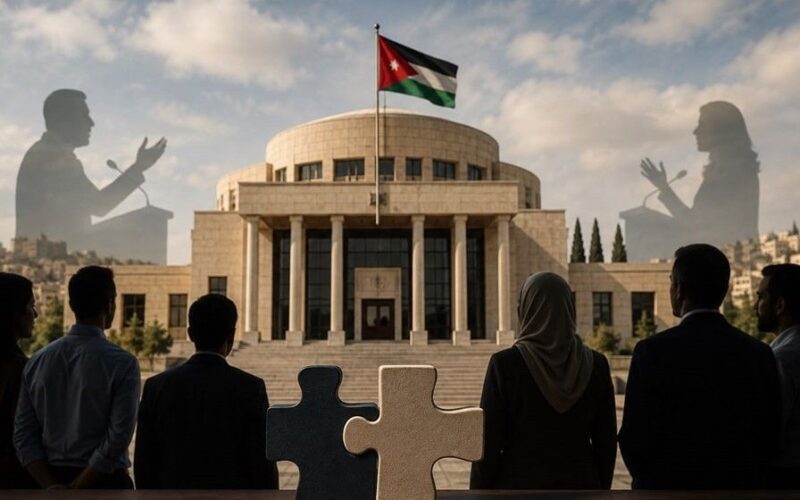
The parliamentary discussions taking place under the dome this week on the draft Local Administration Law, after it has been thoroughly examined by the relevant committee, represent a new opportunity for a genuine democratic exercise one that can elevate the relationship between the two branches of government and make Jordanian citizens feel that the public interest takes precedence over other considerations on both sides.
This is a responsibility that rests with the House of Representatives its leadership and parliamentary blocs, both the majority and the opposition and equally with the government, which should seek to achieve the greatest possible degree of national consensus on a law that directly affects people’s lives.
Parliamentary committees are the kitchen of legislative decision-making. They are expected to shoulder the responsibility, on behalf of members of the House, of conducting professional discussions on legislation and building understandings that transcend parliamentary blocs before legislation is referred for debate and approval under the dome.
Parliamentary blocs, meanwhile, should organize their interventions under the dome in a way that does not consume the House’s time, while respecting MPs’ right to express their views during voting and approval sessions.
This mechanism has not yet functioned ideally in the House of Representatives, and it may require amendments to the House’s internal rules amendments that MPs had previously committed to pursuing through a special committee formed for this purpose.
For this reason, there remains a lack of cohesion between parliamentary blocs and their representatives on committees, which becomes particularly evident during debates under the dome.
The positions taken by representatives of party blocs in committees do not always find an echo in the interventions of bloc members under the dome.
The divergence becomes particularly clear when voting on individual provisions of a law. The opposition, represented by the Umma Party Bloc, attempts to put forward its amendments through the parliamentary committees, and when it fails to do so, it returns to present them under the dome, despite knowing that the chances of their passage appear slim.
In general, the debate over legislation under the dome has remained largely unchanged for many years. All the political modernization steps adopted by the state have yet to bring about a development in the way debates are managed and legislation is passed.
The parliamentary majority, for its part, remains in a constant state of flux. It has been unable to establish a clear identity or structure, and at times moves randomly, the positions of its blocs sometimes vary according to personal considerations, to the extent that observers have noted clear contradictions between the interventions of members of some blocs and their voting positions.
The executive branch, represented by the government, has legislative priorities that it seeks to accomplish, and that is naturally its responsibility, it is also keen to give the House of Representatives sufficient time to discuss legislation and engages extensively with its committees to establish its position on these laws. That, too, is its responsibility.
But this should not come at the expense of the overall direction of Parliament, while recognizing the principle of majority and minority rule that prevails in parliaments around the world, where legislation is sometimes passed by a margin of one or two votes in chambers made up of political parties.
This means that the responsibility of the authorities at all levels is to ensure that the public space for debate remains alive, open, and as broad as possible without allowing disagreement and debate to become tools that obstruct the passage of legislation or hinder the executive decision-making process in the country, as sometimes happens in other countries.
At times, those interested in public debate in our country feel that the public space is narrowing without justification.
There is no meaning to having a parliament without parliamentary life, nor political parties without party life, nor politicians without political life and the same applies across the cultural, artistic, and media spheres.
The public space is the clearest evidence that public life exists in the country.
Related Stories
Gaza Between Disarmament and Reconstruction
Baghdad's thieves are not alone