
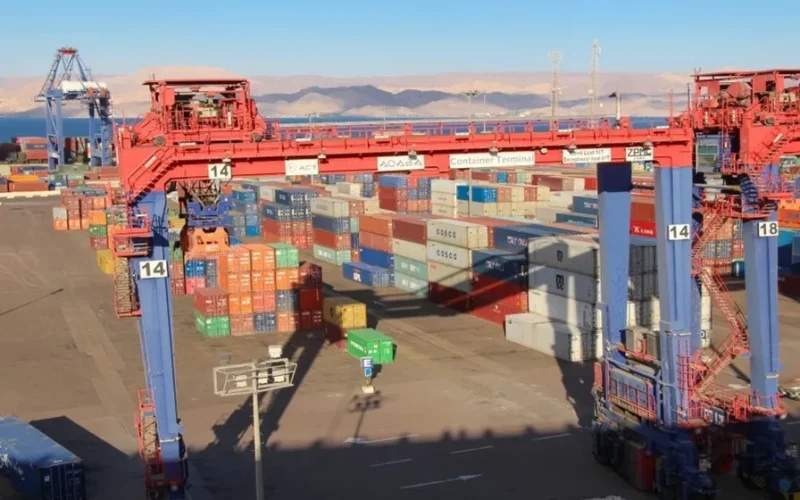
Jordan Shipping Association: Transit growth reflects the expanding role of Aqaba Port in serving the Iraqi market.
Transit containers bound for Iraq surged by 933.1% in 7 months.
Truck traffic through the Karameh–Treibil border crossing increased by 131.2% in 7 months.
Outbound loaded truck movement from Jordan to Iraq rose by 148.9%.
Refrigerated transit containers through Aqaba jumped 546.8% in 7 months.
Total volume of 4 essential commodities via Aqaba increased 50.6% to 2.49 million tons.
Bulk corn shipments through Aqaba rose 89.2% to 778,000 tons.
Total throughput via Aqaba grew 3.2% to 574,582 TEUs.
Inbound refrigerated container traffic through Aqaba increased by 20.9%.
Shipping Association: Rising reliance on Aqaba Port for transporting goods and commodities to the Iraqi market.
Shipping Association: Growth in transit movement represents a shift in trade patterns rather than a temporary spike.
Shipping Association: Transit growth presents an opportunity to reinforce Aqaba’s position as a regional logistical hub.
The Jordan Shipping Association affirmed that regional developments and shifts in international maritime navigation throughout 2026 have directly impacted trade movement patterns and supply chains, noting that the Port of Aqaba experienced remarkable growth in transit traffic, particularly for goods destined for the Iraqi market.
The Secretary-General of the Jordan Shipping Association, Captain Mohammad Al-Delabeh, stated that operational data for the first seven months of the current year confirms a clear shift in the trade movement map through the Port of Aqaba. He explained that the substantial rise in transit containers highlights Aqaba’s growing importance as a logistical corridor serving neighboring markets, led by Iraq.
According to the data, transit containers passing through the Port of Aqaba increased from 30,763 TEUs during the first seven months of last year to 80,235 TEUs during the same period in 2026, marking an increase of 49,472 TEUs or a growth rate of 160.8%.
Al-Delabeh pointed out that the most notable increase was recorded in transit containers bound for Iraq, which surged from 3,599 TEUs to 37,182 TEUs—a growth rate of 933.1%. He emphasized that these figures clearly demonstrate the growing reliance on the Port of Aqaba for transporting goods to the Iraqi market.
He added that the recorded growth in transit traffic through Aqaba was not limited to containers, as data showed a clear increase in the volumes of several bulk commodities and essential goods during the first seven months of 2026, reflecting heightened cargo movement toward regional markets.
Bulk corn recorded an increase from 411,211 tons to 778,055 tons, up by 366,844 tons or 89.2%, while bulk barley shipments rose from 509,642 tons to 761,167 tons, up by 251,525 tons or 49.4%.
Bulk wheat volumes also increased from 547,900 tons to 616,643 tons, an increase of 68,743 tons or 12.5%, while bulk soybeans saw significant growth, rising from 183,285 tons to 331,562 tons, an increase of 148,277 tons or 80.9%.
Consequently, the total increase across these four commodities alone reached 835,389 tons compared to the same period in 2025, with overall volumes rising from 1,652,038 tons to 2,487,427 tons, representing an overall growth rate of approximately 50.6%.
Al-Delabeh noted that these figures clearly illustrate the expanding movement of essential commodities through Aqaba and its elevated role in meeting regional market needs, particularly in Iraq.
He added: “When looking at the figures for corn, barley, wheat, and soybeans, we are not merely discussing an increase in handling volume, but a growth in essential commodities directly linked to food security and supply chains. This makes maintaining port efficiency and smooth cargo clearance critically important.”
He explained that the sharp rise in these commodity volumes coincides with exceptional growth in transit containers and trucks heading to Iraq. He noted that the upcoming challenge lies in ensuring that operational capacity and infrastructure keep pace with this growth to maintain Aqaba Port’s competitiveness and ability to serve regional trade.
These figures come at a time when the Port of Aqaba serves as a primary center for bulk grain handling, reinforcing its role in supporting trade and securing basic goods for regional markets.
The Secretary-General explained that the rise in transit traffic also positively impacted refrigerated containers (reefers). Total inbound reefer container traffic during the first seven months of 2026 grew by 20.9%, rising from 18,668 TEUs to 22,572 TEUs, while refrigerated transit containers saw an exceptional growth rate of 546.8%, rising from 936 TEUs to 6,054 TEUs.
Meanwhile, total handling throughput during the first seven months reached 574,582 TEUs in 2026 compared to 556,843 TEUs in 2025, representing a 3.2% growth rate.
Al-Delabeh mentioned that this growth imposes additional operational challenges, particularly regarding reefer capacity and electricity connection points within port yards. He noted that the capacity for reefer plug-in points was gradually expanded from roughly 700 plugs to nearly 1,000 electrical sockets.
He stressed that expanding reefer capacity is a crucial step to ensure the uninterrupted processing of food shipments and temperature-sensitive goods, especially amidst the surge in transit traffic.
Regarding land transport, data revealed a significant increase in truck movement through the Karameh–Treibil border crossing. Total truck traffic during the first seven months of 2026 jumped from 99,491 trucks to 229,997 trucks, an increase of 130,506 trucks or 131.2%.
Additionally, loaded outbound truck traffic from Jordan to Iraq rose by 148.9%, while empty inbound truck traffic into the Kingdom increased by 148%.
Al-Delabeh affirmed that these numbers demonstrate how the rise in maritime transit traffic through Aqaba directly translated into land transport toward Iraq. Managing this growth requires ongoing efforts to raise border crossing efficiency, expand staging yards, and enhance operational capacity across both maritime and land transport routes.
Regional Developments and Their Impact on Navigation
Al-Delabeh explained that the substantial growth in transit traffic represents a vital economic and logistical opportunity for the Kingdom. However, it simultaneously creates operational pressures that must be proactively addressed, given the rapid changes in global maritime navigation.
He added that the association continuously monitors the impact of regional developments on vessel and container movements, including fluctuations in ship traffic through the Bab al-Mandab Strait, changes in shipping line schedules, and operational pressures at key transshipment ports, led by Jeddah Islamic Port.
He noted that these developments have led to rerouting and schedule adjustments for certain maritime services, as well as the reliance on alternative transshipment hubs, which impacts shipment transit times, costs, and supply chain consistency.
The Secretary-General emphasized that the current phase requires treating transit growth as a structural shift in trade patterns rather than a temporary rise in container and truck numbers.
He stated: “The figures recorded during the first seven months of the year represent a genuine opportunity to solidify Aqaba Port’s standing as a regional logistical hub, particularly in serving the Iraqi market. However, capitalizing on this opportunity requires matching this growth with operational capabilities and infrastructure capable of absorbing the rising volumes.”
He added: “We are facing significant growth in container, truck, and cargo traffic. Maintaining smooth traffic flow, rapid handling, and timely cargo release has become a priority, alongside ensuring necessary reefer capacity, yard space, and truck availability.”
He reaffirmed that the Jordan Shipping Association will continue monitoring operational indicators and trade trends periodically, coordinating with relevant authorities to address any challenges that might impact supply chain fluidity, while highlighting the importance of continuously developing infrastructure and operational procedures at Aqaba Port and border crossings.
In conclusion, he stated: “The objective is not merely to accommodate current increases, but to build sustainable capacity that enables Jordan to leverage its geographical location and reinforce its role as a secure and efficient corridor for regional trade.”