
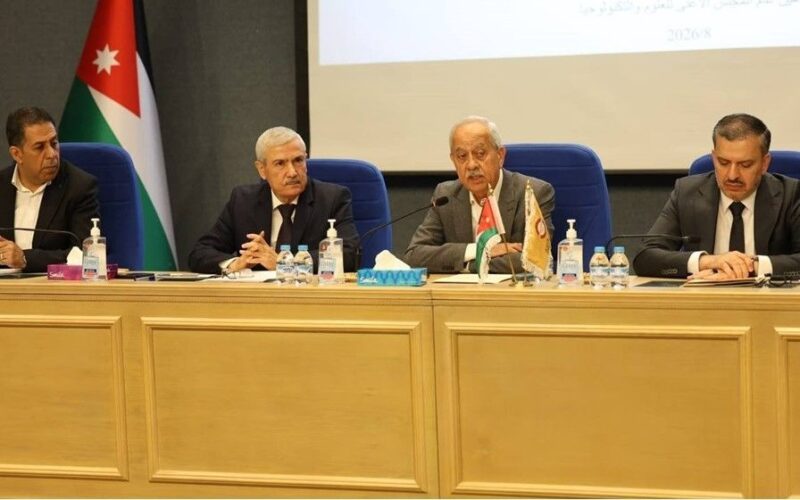
The Amman Chamber of Industry hosted an introductory workshop on
Tuesday at its headquarters to present the support programs offered through the
Higher Council for Science and Technology and discuss opportunities to
strengthen cooperation with Jordan’s industrial sector.
Eng. Fathi Al-Jaghbir, Chairman of the Jordan and Amman Chambers of
Industry, commended the longstanding partnership between the Chamber and the
Higher Council for Science and Technology, noting that it has provided
technical and financial support to hundreds of industrial enterprises over more
than a decade.
He explained that the joint financial support provided by the Amman
Chamber of Industry and the National Fund for Enterprise Support (NAFES) has
enabled more factories to benefit from programs designed to improve their
competitiveness.
These programs include support for obtaining international
certifications related to quality, environmental and occupational safety
management systems; conformity marks and certifications required for export;
productivity improvement; automation; and the implementation of Enterprise
Resource Planning (ERP) systems.
Al-Jaghbir also highlighted the Chamber’s cooperation with the
Scientific Research and Innovation Support Fund, including participation in
specialized committees and the organization of training programs in technical
and engineering fields.
These programs have contributed to strengthening the
capabilities of dozens of engineers and technicians working in factories across
different industrial sectors.
Prof. Mashhoor Al-Refai, Secretary-General of the Higher Council for
Science and Technology, said Jordan has a genuine opportunity to rebuild its
scientific research and innovation ecosystem on a more efficient basis and
align it more closely with national development needs.
He noted that the transfer of the Scientific Research and Innovation
Support Fund to the Higher Council represents a strategic shift which, for the
first time, places the identification of national research priorities and their
funding under a single umbrella.
This, he said, will help direct available
resources toward challenges with direct economic and social impact.
Al-Refai reviewed the state of scientific research in Jordan, noting
that spending on research and development remains modest compared with many
other countries.
He also pointed to the limited contribution of the private
sector to research funding and stressed the need to strengthen partnerships
with industry and expand its role within the national research, development and
innovation ecosystem.
He referred to a national study conducted by the Council involving
more than 1,500 Jordanian researchers. The study identified several challenges
facing scientific research, including the need to update legislation governing
the Scientific Research and Innovation Support Fund, weak cooperation between
research institutions and industry, limited financial resources, and
insufficient alignment between research activity and the needs of the national
economy.
In this context, Al-Refai also reviewed the National Research
Priorities 2026–2035 project, developed by the Council through 15 sectoral
committees with the participation of more than 700 experts.
He explained that
these priorities provide a national framework for directing research efforts
and funding toward Jordan’s most pressing development challenges and
strengthening the connection between scientific research, sectoral needs and
the Economic Modernization Vision.
He said the coming phase will see the Scientific Research and
Innovation Support Fund place greater emphasis on applied research aligned with
national priorities.
The Fund’s support will focus on sectors including water,
energy, food, health and the environment, as well as emerging technologies,
particularly artificial intelligence and the Internet of Things.
The objective
is to strengthen the contribution of scientific research to addressing national
challenges and generating economic value.
He added that the Council is working to expand the range of
beneficiaries of its support programs to include entrepreneurial and innovative
companies and institutions, while strengthening partnerships between
universities and the private sector.
This direction includes supporting
cooperation through joint research centers, business incubators, and mechanisms
for transferring technology and intellectual property from universities to the
market, with the aim of helping transform research outputs into viable products
and services.
Prof. Tareq Mukattash, Director of the Scientific Research and
Innovation Support Fund, delivered a presentation on the Fund’s efforts to
strengthen partnerships with the industrial sector and support applied
research.
He emphasized the importance of converting research outputs into
economic value and strengthening the contribution of research and innovation to
a knowledge-based economy.
Eng. Moath Al-Alawin, Director of the National Fund for Enterprise
Support (NAFES), presented an overview of the program and the support it
provides to enterprises through subsidized consultancy, training, and
administrative and financial development services.
He also reviewed the
partnership between NAFES and the Amman Chamber of Industry, highlighting
support provided in areas including ISO quality systems, ERP systems and
training.
Eng. Rose Al-Samadi, Quality and Environment Officer at the Amman
Chamber of Industry, and Eng. Bashar Qutaishat, the Chamber’s Support and
Guidance Officer, reviewed opportunities for cooperation between the Chamber
and the Higher Council for Science and Technology in supporting industrial
projects.
The workshop concluded with a discussion on the needs of the
industrial sector and the opportunities available through the programs
presented.
The HCST delegation also toured the Jordanian Innovation Center for
the Fourth Industrial Revolution, located at the Chamber’s premises.
The
center, described as the first of its kind in Jordan to be managed by the
private sector, aims to promote digital technologies and applications
associated with the Fourth Industrial Revolution.