
The
Board of Directors of Royal Jordanian Airlines approved the company’s financial
results for the first half of 2026, under the chairmanship of Said Darwazah,
following their review by the appointed external auditor.
The results showed an
improvement in the company’s operations and operational performance indicators,
while Royal Jordanian continued implementing its strategy to modernize its
fleet, expand its route network, enhance its service standards, and improve the
on-time performance of its flights.
Royal
Jordanian’s financial results for the first half of 2026 showed a net profit of
JOD 1.4 million, compared with a net profit of JOD 12.7 million during the
corresponding period of 2025.
The company’s revenues increased by JOD 86
million, representing a 23% increase compared with the same period last year,
driven by higher operating activity and the expansion of the airline’s route
network. Meanwhile, operating costs increased by JOD 69.5 million as a result
of higher operational activity and rising fuel prices.
Fuel costs alone
accounted for nearly half of the increase in operating expenses, rising by JOD
33 million, or 37%, due to the global increase in fuel prices.
Financing costs
also increased significantly by JOD 18 million, mainly due to higher interest
rates on aircraft lease obligations, while the company’s share of profits from
its subsidiary company declined by JOD 6 million.
Royal
Jordanian carried approximately 1.984 million passengers during the first half
of the current year, representing a 5% increase compared with the corresponding
period in 2025. Meanwhile, the seat load factor stood at 71.8%, down 8.6
percentage points compared with the corresponding period in 2025.
The
company also operated 19,066 flights, totaling 60,443 flight hours,
representing increases of 14% in the number of flights and 19% in flight hours
compared with the corresponding period in 2025. Air cargo volumes also
increased by 36% to reach 21,460 tons.
In
this context, the Vice Chairman / CEO of Royal Jordanian, Samer Majali,
commended the government’s decision to continue covering part of the increase
in fuel costs, in line with the support provided to other sectors across the
Kingdom.
He affirmed that this support helped mitigate the impact of global
fuel price increases on the national carrier and enabled the company to
maintain positive financial and operational results despite the exceptional
circumstances witnessed across the region.
Majali
noted that the company’s financial and operational performance remains below
the targets set out in the 2026 budget due to the exceptional geopolitical
developments witnessed across the region and their resulting direct and
indirect impact on the aviation sector.
Majali
affirmed that the developments witnessed across the region, particularly the
military escalation between the United States and Iran and the repeated
closures of airspace that followed, had a direct impact on the company’s
results.
Demand for travel to the Kingdom declined, tourism activity slowed,
and reliance on transit passengers increased.
Revenues from the company’s
supporting business units, particularly ground handling, the cargo terminal,
and technical and maintenance services, were also affected as a result of
reduced operations by several regional and international airlines to the
Kingdom.
He added that the company also faced the repercussions of the sharp
increase in global fuel prices.
In addition, the company was compelled to
temporarily suspend certain flights, introduce operational adjustments to other
flight schedules, and reroute a number of flights through alternative air
corridors due to the closure of airspace in certain countries.
This resulted in
longer flight times, higher fuel consumption, increased operating costs, and
additional insurance costs.
Majali
pointed out that Royal Jordanian’s continued fulfilment of its national mission
throughout these exceptional circumstances would not have been possible without
the tremendous efforts of the Jordan Armed Forces, the Civil Aviation
Regulatory Commission (CARC), and the relevant authorities in safeguarding
Jordan’s airspace and ensuring the safety and continuity of its operations.
This enabled Royal Jordanian to continue operating its flights and maintain
Jordan’s connectivity with the world at a time when many regional and
international airlines suspended or reduced their services to the Kingdom and
the region, reaffirming its role as the national carrier with a responsibility
that extends beyond commercial considerations to serving the nation and its
passengers.
Majali
explained that Royal Jordanian has demonstrated its ability to adapt to changes
and operational challenges in a balanced and sustainable manner.
During the
first half of 2026, the company continued implementing its expansion plans
through the launch of new destinations across its route network, including
Misrata, Munich, Hamburg, Sharjah, Alexandria, Dallas, Vienna, and Tashkent.
This forms part of the company’s strategy to strengthen air connectivity
between Jordan and regional and international markets, provide passengers with
broader travel options, support tourism and trade, and reinforce Royal
Jordanian’s position on the global aviation map.
Regarding
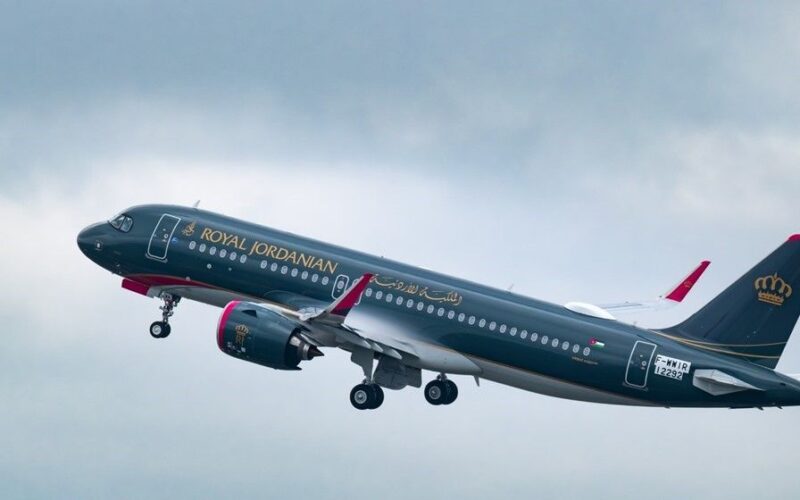
fleet modernization, Majali said that Royal Jordanian took delivery of seven
new aircraft during the period, including two Boeing 787-9 aircraft for
long-haul routes, four Airbus A320neo aircraft for medium-haul routes, and one
Embraer aircraft for short-haul routes.
This brings the total number of new
aircraft added to the fleet over the past twelve months to 19, making Royal
Jordanian’s fleet one of the youngest in the region.
Majali affirmed that Royal
Jordanian continued fulfilling its national role alongside its economic and
commercial responsibilities during the first half of the year by supporting a
number of national initiatives.
Foremost among these was its support for
Jordan’s national football team in its international participation, reflecting
the airline’s commitment to supporting national achievements and strengthening
Jordan’s presence on the international stage.
The company also operated a
relief flight to the Republic of Venezuela, transporting the Jordanian Search
and Rescue Team of the Public Security Directorate / Civil Defense Directorate,
together with its equipment and relief supplies, in implementation of the Royal
directives to assist in responding to the earthquake that struck Venezuela.
In
addition, Royal Jordanian continued coordinating with the relevant authorities
to facilitate the transportation of Jordanian citizens and foreign nationals
stranded in crisis-affected areas around the world.
Majali
pointed out that the air cargo sector represents one of the main pillars
supporting the national economy.
He noted that the development of cargo
operations contributes to facilitating the movement of goods and connecting
Jordan efficiently and swiftly with various markets, thereby supporting supply
chains, strengthening national exports, and leveraging Jordan’s strategic
geographic location as a regional and international logistics hub.
This has
prompted Royal Jordanian to invest JOD 30 million in the expansion and
modernization of the air cargo terminal at Queen Alia International Airport.
Majali concluded by
affirming that the company will continue closely monitoring regional
developments and taking the necessary operational measures to respond to
changing circumstances, ensuring the continuity of its operations, maintaining
its financial and operational stability, and achieving its strategic
objectives.