
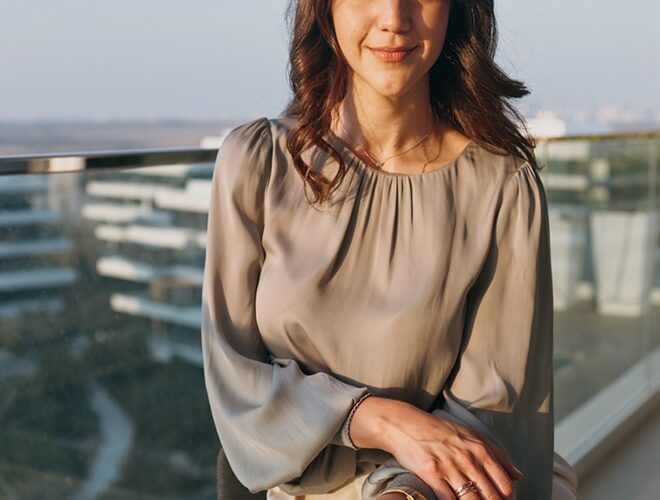
Four years after launching interior architecture and strategic design agency Warû, shortly before her 30th birthday, founder Rasha Al-Tekreeti has learnt several lessons, namely, that reputation matters more than rapid growth.
Established in June 2022, Warû was inspired by the belief that design is a nomadic journey. The company’s name is derived from an ancient Akkadian word meaning “to guide, to lead and show the way”. It reflects Rasha’s Iraqi heritage and the firm’s commitment to creating spaces that evolve with the people who use them, fostering a sense of belonging.
Since its early days, Warû has grown from a boutique startup into a wider team operating across the UAE, Saudi Arabia, and Lebanon. The firm has delivered projects for a range of regional and international clients, consultants and contractors, including Siemens Energy, Microsoft, Riyadh Bank, Wafi Gourmet, Linklaters, CBRE and JLL. It has also won multiple awards.
However, for Rasha, the company’s most significant achievement is not about size or industry accolades. “I am immensely proud that our growth has been driven mainly by word of mouth. Clients approach us because someone they trust has recommended us. And in a relationship-driven industry, that is a major indicator that we are doing something right.”
Reflecting on the realities of entrepreneurship, Rasha says one of her biggest challenges has been building a team that shares the firm’s values and approach.
“When you are growing a boutique business, finding the right people is about more than technical ability. You need people who genuinely believe in what you are trying to create and who demonstrate true passion for their work.”
Externally, Warû has been affected by industry-wide issues including approval timelines and payment delays; Rasha hopes the latter will eventually be addressed through tighter government regulations.
At the end of 2025, Rasha took a deliberate step back to assess how the business could operate more effectively. The result was the development of the Warû Playbook, designed to improve internal processes, strengthen collaboration and create greater consistency across projects. Much more than a checklist, it is a strategic framework that shapes how the business operates on a daily basis.
“Like many businesses, we have had to navigate challenges over the last year. Taking the time to pause, reflect and recalibrate gave us greater clarity. Crucially, this helped us to strengthen our foundations, so we could maintain momentum and continue supporting clients during the recent regional uncertainty.”
Trusting her instincts has been another key component of Rasha’s success, as well as recognising that rewarding client relationships have to work both ways.
“If something doesn’t feel right at the beginning of a project, it rarely becomes easier later on. Learning when to say no has been just as important as knowing when to say yes. Business is a partnership. The most successful projects happen when there is trust and open dialogue. It is rare to have clients who are consistently available, collaborative, and willing to be challenged, but when they are, the design becomes far stronger. If a client is unwilling to engage in that process, it becomes difficult to move beyond surface-level solutions.”
Looking at the wider market, Rasha believes the industry needs to focus more on individuality and human experience.
“Good design starts with understanding people, not aesthetics. Our role is often less about selecting materials and more about listening, questioning, and uncovering the real objectives. That is why psychology has been embedded into our methodology from day one, helping us understand behaviours, motivations, and needs that are not always immediately visible.”
Over the next 12 months, Rasha will remain heavily involved as Design Director, while dedicating more time to strategy, deepening relationships with key clients and adding greater value by launching a new division.
“As a founder, it is easy to become consumed by day-to-day delivery. I will also stay closely connected to the design process, but I also intend to focus more on where we are heading next. The last four years have taught me that growth is important, but building a stable and sustainable business is even more so.”