
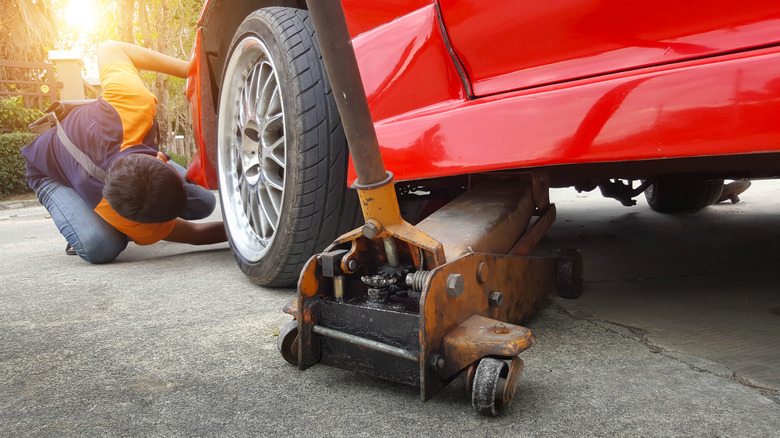
4 Dangerous Mistakes People Make When Using A Floor Jack And Jack Stands
For most people, floor jacks and jack stands rank among the sort of garage tools that largely qualify as an unnecessary extravagance, relying instead on the small jack that comes with most modern vehicles. If, however, your idea of a good time is hanging out in the garage and working on or even under your everyday driver or project car, these more powerful pieces of equipment are about as indispensable a tool as you can have on hand.
Whether you’re using a floor jack from a no-name brand or one from the more popular manufacturers in the game, it should go without saying that it is absolutely vital that you use it correctly. Ditto goes for jack stands; failure to do so could, after all, result in not only serious damage to your vehicle, but also bodily harm to you or anyone in close proximity. To that end, it’s not at all far-fetched to claim that using a floor jack or jack stand incorrectly could easily result in that being the last time you ever work on your car — or do anything else, for that matter.
Using a floor jack or stand incorrectly is, quite frankly, inexcusable, as each and every one of those devices was likely sold with a set of instructions included. Indeed, those instructions should have laid out quite clearly the do’s and don’ts of using the device. Nevertheless, people are still prone to making a few common mistakes on the occasion when their floor jack and jack stand are pressed into action. Here’s a few you should do your best to avoid the next time you use yours.
Ignoring manufacturer mandated weight restrictions
If you’ve purchased a good floor jack from Harbor Freight Tools or any other brand, the tool almost certainly came with detailed instructions. Even if you have floor jack and jack stand experience, you should’ve at least skimmed those instructions, as each manufacturer’s usage standards can vary significantly in terms of safe usage.
That is particularly true when it comes to the tool’s specified weight restrictions. And yes, floor jacks and jack stands are all designed to hold specific weights. Odds are that you may not even need to read an instruction booklet to know what those restrictions are, as they may actually be printed on the device itself, or at least laid out clearly on the box it came in. Whatever the case, ignoring those weight restrictions may result in the jack or stand outright failing, and if you’re underneath the vehicle when it does, you’re very much going to have a bad time.
There are, of course, other factors to consider when it comes to those weight restrictions. For instance, you should not think solely about the weight of the vehicle when you put your jack to use. After all, even if the weight of the car itself is within the correct parameters, the contents of the vehicle may put it over the top. So, if you’ve got heavier items in your back seats or truck beds, you should remove them before you use the floor jack. As an added bonus, this may also help keep things balanced when the vehicle is hoisted, resulting in better overall stability.
Utilizing incorrect lifting points on the vehicle
Once you’ve fully taken into account the mandated weight restrictions of your floor jack, there are a couple of other important factors to consider before you actually use it. It is easy enough to argue that the placement of the device’s saddle is one of the most critical. That part of the floor jack or jack stand is sometimes also called the lifting pad; as its name implies, it is the part of the tool that actually makes contact with the vehicle when you are lifting it off the ground.
If you don’t have much experience with floor jacks or jack stands, you may think that part of the floor jack will work just fine wherever you place it underneath the vehicle you’re trying to lift. However, that is very much not the case. In fact, every vehicle has very specific points on the frame or undercarriage designated for use with a standard car jack or floor jack.
These points are typically referred to as jack points, and in general, they tend to be located just behind a vehicle’s front wheel of a vehicle or just in front of its rear wheel. Your floor jack may still be able to lift your car or truck if you do not utilize these lift points, though it can be incredibly dangerous to ignore them, as the vehicle will likely not be as steady when it’s lifted. Using any other spot may also result in damage to the vehicle’s frame. Pro-tip: Those lift points should be clearly set out in the vehicle’s owner’s manual.
Not using backup holders
A floor jack is clearly an invaluable tool for anyone who regularly needs to lift a vehicle. But even as they are designed to hold your ride high off the ground for extended periods of time, a floor jack is no guarantee that the vehicle will stay hoisted. Even still, we’d wager that plenty of folks that do use floor jacks on the regular will raise their vehicle without any sort of backup holder on the off chance that the primary method does fail.
That possibility is, of course, one of the biggest reasons that the jack stand exists. While it may seem contrary, in general the floor jack is not utilized by most garage gurus as the primary method of keeping a vehicle up off the ground. Rather, the floor jack works better as the backup to a jack stand, as the latter device’s stationary base can provide a more steady support than its traditionally wheeled counterpart.
Apart from the wheels, floor jacks also function using hydraulics, and those are generally better suited for lifting rather than holding. Thus, jacks should never be used as the primary method of keeping a vehicle off the ground. There is a method to the madness, by the way: You should use the floor jack to lift the vehicle, then slide the jack stand into place and lower the the car or truck gently onto the stand, while leaving the jack in place. It should go without saying that you need to use a quality jack stand that is properly graded to hold the weight of the vehicle as well.
Using the jack on uneven surfaces
Whether you’re trying to properly change a tire or conducting some more serious sort of work underneath your vehicle, one of the many do’s and don’ts that should fall under “painfully obvious” is that you should never use any type of jack or jack stand to lift and support your car on an uneven surface. Yet this is also one of the more common, and potentially dangerous mistakes people make when using these types of tools.
Just in case the reason why you shouldn’t use either on an uneven surface isn’t as painfully clear as it should be, we’ll point out that doing so means the jack or jack stand itself cannot be properly steadied at the base. If that device isn’t evenly supported at the point it touches the ground, it’s not just possible but even likely that it will eventually topple, bringing thousands of pounds of automotive engineering down with it — and possibly right onto you.
Just for the record, “uneven” does not refer strictly to inclines. It also covers surfaces like those covered with stones or ones with bricks that aren’t entirely flat. Yes, it especially applies to surfaces composed of dirt, sand, mud, or even soft asphalt. Still, you may one day find yourself with no choice but to lift your vehicle on such a surface. In that case, you may be able to steady the vehicle by using wheel chocks, which should really be used anytime you jack a vehicle. If it’s at all possible, you’d still be better off waiting to work on the vehicle on a flat, paved surface to avoid the risk altogether.