Do Mudflaps Help Or Hurt Your Fuel Economy? It Depends
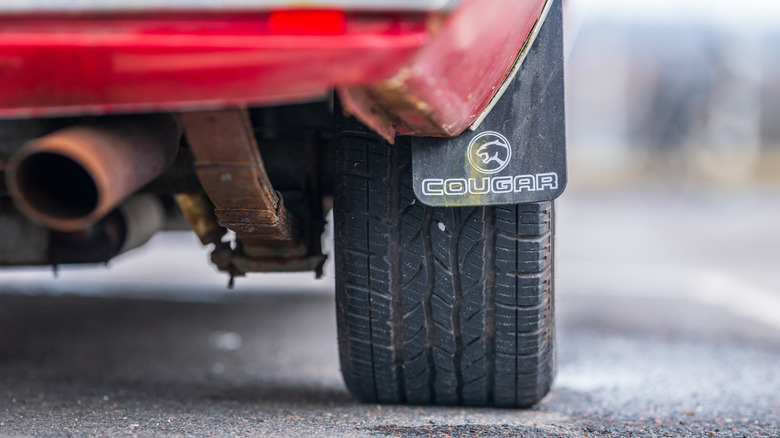
Decorative mudflaps can be just as much of a stylish accessory on your vehicle as license plate frames or even LED lighting. But while designs like Yosemite Sam are considered classics, the mudflap itself is actually there for a reason. One of those reasons has to do with fuel efficiency, though the effect depends heavily on design and installation. But there’s actually a bit more to it than <a href="https://jordangazette.com/5-foldable-finds-from-harbor-freight-that-can-help-save-space-in-the-garage/”>that.
When mudflaps are properly fitted to a passenger vehicle, they can help manage some of the airflow building up behind the tires. But if mudflaps aren’t installed correctly, are too big for the vehicle, or flap too much at high speeds as a result, that’s a problem. At that point, fuel economy is negatively impacted and you could actually see about a 1 to 2 percent drop under certain conditions. But even with mudflaps that have been correctly installed, the differences in fuel economy are very small at best.
In real-world testing, properly fitted mudflaps show little to no impact on overall fuel efficiency. Highway tests comparing vehicles with and without modern mudflaps, which are often referred to as splash guards, found differences of less than one percent. In most cases, vehicle-specific designs also showed no meaningful change in fuel economy. So in the end, while it’s not impossible for a vehicle to get a slight bump in gas mileage, the difference is usually too small to matter in everyday driving.
Semi-truck mudflaps and how tires impact fuel economy
The same turbulence that happens around the wheels of your car is magnified for larger vehicles like semi-trucks. This unsteady airflow can increase drag, and thus cause the engine to work harder over long distances. But aerodynamically-designed mudflaps can help manage that flow, smoothing how the air moves around the tires. Though the differences may be small at the time, when multiplied over thousands of miles (and across large fleets of trucks), fuel efficiency can greatly improve.
Beyond your vehicle’s mudflaps, your tires can impact fuel economy as well. Rolling resistance actually plays a major part in how much fuel your vehicle uses. Every time your tires move and make contact with the road, they flex, and energy is lost as a result. This is also impacted by tire tread, and even the tire’s design, which can both affect how much resistance is created during motion. But perhaps the most important factor affecting fuel efficiency in regards to your tires is air pressure.
Underinflated tires can cause your vehicle’s miles per gallon to go down due to increased rolling resistance. That’s because the tires flatten against the road’s surface as they move, and even a small difference in tire pressure can have a big impact over time. In fact, fuel economy can decrease by about 0.2% for every 1 PSI drop across all four tires. Because tires naturally lose air gradually, it’s important to top off to the exact amount based on the manufacturer’s recommended PSI.