
5 Circular Saws That Outshine Milwaukee’s In Price And Quality
We may receive a commission on purchases made from links.
A good circular saw is an essential tool for everything from construction and DIY repair to home woodworking, but there are a lot of different qualities that one might look for in one. Portability, blade size, power, speed, handle style, adjustability, and other factors can all play a role in what makes a circular saw right for your individual needs.
Milwaukee has a whole host of circular saws in its current lineup to accommodate many of these needs. There are a few corded models listed on the Milwaukee website, though these seem to be out of stock at most major retailers as the brand leans into its cordless platforms. The company’s smaller 12V system has the M12 Fuel 5 ⅜-inch Circular Saw, while the larger 28V system has the M28 6 ½-inch Circular Saw. But the majority of the options are part of the popular Milwaukee M18 tool system. This boasts 6 ½-inch saws in standard and plunge track models, 7 ½-inch saws in standard, Fuel, and rear handle models, and an M18 Fuel 10 ¼-inch Rear Handle model is on the way.
Suffice to say, that's a pretty wide variety
What’s more, Milwaukee is often considered one of the best power tool brands on the market, and these saws are all frequently rated as some of the best options currently available. Even so, no brand is the top of its class in every category. There are even tools out there that can outperform one of the Milwaukee models in some metrics while also being available at a lower price.
Skilsaw SPT77WML-01 Worm Drive Saw
The Milwaukee M18 Fuel 7 ¼-inch Rear Handle Saw is an impressive machine. The design is made to replicate that of a worm-drive circular saw, giving it more power and faster cutting than many of it’s top-handled peers. It does have the benefit of being part of the Milwaukee M18 cordless battery system. It’s also very fast, being able to turn the blade at a rate of 6,000 RPM. That said, it retails for $299.00 without the battery, which is definitely on the pricey side.
Compare that to the Skilsaw SPT77WML-01. This is a 15-Amp 7 1/4 corded saw, so it will lose the portability benefits, but it’s much more affordable at just $199.00 and has some compelling specs as well. It’s a hair slower, at 5,300 RPM, but its real strength comes in terms of its torque. This is a true worm drive saw, meaning that it has a worm-gear drive system that allows its Dual Field motor to transfer even more torque to the blade. It has a magnesium construction, a die-cast magnesium foot with bevel and cut depth scales that allows for a 53-degree bevel range, and it comes with a 24-tooth carbide tipped Diablo blade.
The Skilsaw has a 4.8 out of 5 with a 96% recommendation rate on Home Depot and identical 4.8 score and 96% recommendation rate at Lowe’s. Users on both sites have praised it for its lighter weight, its smooth and easy handling, and the powerful performance of the worm drive system. Gear Lab gave the tool an 88 out of 100 in their review, calling it “a professional-grade tool that experienced carpenters will appreciate and that newer users can use to grow and expand their carpentry skills.”
Ryobi One+ HP 18V Brushless Compact 6 ½-inch Circular Saw
One of the more affordable options that Milwaukee offers is its standard M18 Cordless 6 ½-inch Circular Saw which retails for $149.00. This is a decent tool with everything you need to get you up and running, including a brushed motor that can produce a modest 3,500 RPM. That said, those who are looking for a budget saw can find brushless models from other brands that are closer to Milwaukee’s larger brushless Fuel model.
The first of these is the Ryobi One+ HP 18V Brushless Compact 6 ½-inch Circular Saw. This is cheaper, at $119.00, and it shares the Milwaukee’s smaller blade size, but its brushless high performance motor offers some significant leaps in performance. It can deliver rotation up to 4,900 RPM and up to 350 cuts on a single charge. This extra speed and longevity should be very noticeable when using the saw on and off throughout the day. It also has a 50-degree bevel capacity, a vacuum dust adapter, a built-in LED work light, a steel base, and an adjustable depth gauge that can go down to 2-¼-inches.
The Ryobi saw has a 4.6 out of 5 on the Home Depot site with 93% of users stating that they would recommend it, and a 4.8 out of 5 on the Ryobi website. Users claimed that the tool has an excellent power-to-weight ratio, solid battery life, and that it cuts well, even through hardwoods and other dense materials. Pro Tool Review claimed that the One+ HP 18V Brushless Compact 6 ½-inch Circular Saw is significantly more powerful than previous generations and that it can easily handle most of the types of weekend projects that users would buy a smaller saw like this for.
Hercules 20V 6 ½-inch Circular Saw
If the Ryobi isn’t your speed than another more budget-oriented option you might consider in place of the $149.00 M18 Cordless 6 ½-inch Circular Saw is the Hercules 20V 6 ½-inch Circular Saw. Harbor Freight’s Hercules line is the store’s premium power tool brand, generally offering the best performance of the tools sold in the store.
The 20V 6 ½-inch Circular Saw is a cordless, brushless tool, much like the Ryobi model, which means that it will typically deliver more power, speed, and battery life than a brushed alternative (like the Milwaukee.). It promises even more speed than the Ryobi, offering up to 5,000 RPM, and is even cheaper at just $79.99. This makes it particularly compelling for someone looking for Milwaukee-like performance at a sub-$100 price point. In terms of its other specs, the tool has a 2 3/16-inch cut depth, a 50-degree bevel capacity, a built-in LED work light, an aluminum shoe, and a blade guard with an attachable dust port. It also has soft start and electric break functionality.
The tool has a 4.7 out of 5 on the Harbor Freight website with 93% of customers claiming that they would recommend it to other buyers. Customers praised its reduced weight and easy cutting capabilities. YouTuber mikelasttime reviewed the saw and was particularly impressed with the brake as a safety feature. He also demonstrated a few cuts, showing how cleanly and easily it can cut through standard boards. He recommended it for light duty work.
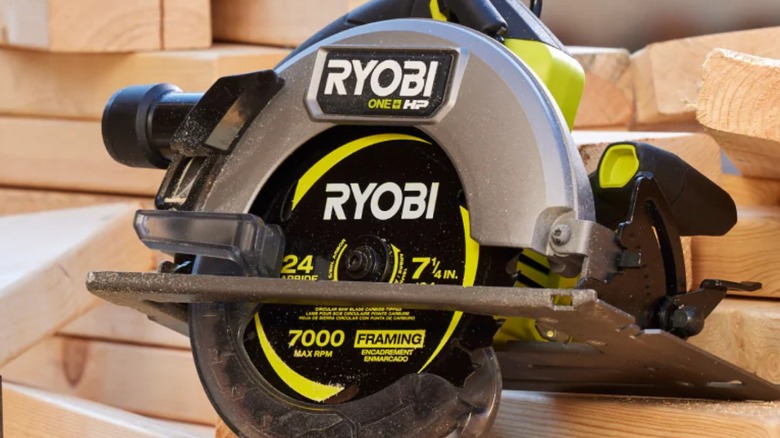
Ryobi One+ HP 18V 7 ½-inch Circular Saw
When we get up to the 7 ½-inch size top-handle saws things get a little more complicated. Milwaukee has two models, a $229.00 standard one and one that is part of the company’s high-performance Fuel series that goes for $279.00. None of the cheaper models from other brands appear to be able to compete with the Milwaukee Fuel in raw specs, but much as we saw with the 6 ½-inch saws, there are a couple of brushless models from other brands that will either match or beat the standard Milwaukee model in both price and performance.
The Ryobi One+ HP 18V 7 ½-inch Circular Saw is significantly cheaper at just $139.00, but it’s able to generate up to 5,000 RPM with its brushless high performance motor. This puts it right on par with the standard Milwaukee in terms of speed. Additionally, it has several other desirable features. It’s able to make up to 370 cuts on a single charge and has a cut depth of 2 9/16 inches, has a 56-degree bevel with detents at 0, 15, 22 ½, 30, 45, and 56 degrees. It also has a vacuum port, and adjustable depth gauge, a built-in LED work light, and some ergonomic improvements that are designed to make it easier to handle.
This saw has a 4
5 out of 5 on Home Depot with an 83% recommendation rate and a 4.8 out of 5 on the Ryobi site. Most of the reviews mention the saw’s exceptional power, low-weight design, and reliable performance. Pro Tool Reviews found that the tools ergonomics and power were both vastly improved over previous generations, exceeding DIY specs and pushing into professional performance.
Ridgid 18V Brushless Cordless 7 ¼-inch Circular Saw
Those who are looking for a more affordable tool that’s even more powerful than the $229.00 Milwaukee M18 7 ½-inch Circular Saw might want to consider what Ridgid has to offer. Ridgid is often seen as something of a mid-tier brand, with tools that offer more power than most budget options while still being cheaper than most premium brands. There are occasions where its tools showcase a surprising amount of raw power, however.
The Ridgid 18V Brushless Cordless 7 ¼-inch Circular Saw retails for $179.00 and has plenty of power to spare. The company claims that the tool has the equivalent of 15 Amp corded power and is able to deliver speed up to 5,400 RPM, narrowly beating the Milwaukee. It has a 2 9/16-inch cut depth and a 56-degree bevel capacity. This means that it is also able to cut a hair deeper and at slightly more extreme angles. Additionally, it has an electronic blade brake, an aluminum base, a built-in LED work light, and both 1 ¼-inch and 1 ⅞-inch vacuum hose attachments.
The tool has a 4.5 out of 5 on the Home Depot site with 70% of customers stating that they would recommend it. There are a few complaints about the weight and some customers have stated that the tool goes through batteries quickly due to the high amount of power it consumes, but the majority of reviewers expressed satisfaction with the tool’s performance and smooth cutting ability. Pro Tool Reviews gave the saw an 8 out of 10, stating that is powerful, has good guard action, and an excellent sightline on the blade.
Our Methodology
Milwaukee is one of the most popular brands on the market today for a good reason. It offers a wide range of different tools and tends to be a little more cost-effective than other premium brands like DeWalt and Makita. This means that there are very few tools on the market that can beat its best products in both price and quality. So, in making this list, we primarily focused on finding circular saws that might offer more power or features than Milwaukee’s cheaper versions of its tools, while still coming in at a lower price.
We started by looking at popular budget-oriented brands like Ryobi, Hercules, Ridgid, and Skil, to see if any of its tools could beat comparable Milwaukee products in some, if not all, of these metrics. We compared prices and specifications to see which version of the tool might offer a better value. Once we had a few picked out, we then dove into both customer and professional reviews on the tools in order to gather as much information as possible about their real-world performance. This way, we could provide our readers with detailed information that would allow them to make an informed decision about whether the tool is valuable enough to favor over the Milwaukee alternative.