
15 Of The Coolest Nissan Concept Models We Wish Made It To Production
Japanese automaker Nissan has been around in some form or another since the early 20th century and has released plenty of cars over those decades. Some have entered gearhead lore, like the Skyline GT-R, while others, like the Sentra, have focused on offering sensible, reasonable transportation for the average person.
There’s more to Nissan’s four-wheeled efforts than the vehicles that have made their way to showroom floors, though. Over the years, the automaker has also showcased a ton of concepts that run the gamut from ultra-high-tech EVs to quirky town cars and almost anything and everything in between. Some of these made it to production, too, and we can trace the solidly dependable 2026 Nissan Pathfinder, for example, to an early 2010s concept.
While the Pathfinder shows that Nissan has turned some of its concepts into reality, there have also been plenty that remained just that. Let’s take a trip down Nissan’s storied archive of concepts and pick out some that we would’ve loved to see make it to production.
Hyper Force
Nissan’s mainstream EV efforts might only consist of the much-improved third-generation Leaf as of 2026, but that doesn’t mean that the automaker hasn’t explored wilder, more exciting EV concepts in its time. There have been many, admittedly, but one that stands out the most is likely the Hyper Force, which was unveiled at the 2023 Japan Mobility Show.
“Hyper Force” is quite a radical name, but the concept lives up to it. It’s a low-slung, ultra-angular supercar with a bare metal body and front fascia that’s likely the most aggressive to ever feature on a Nissan. It carries a lot of the modern GT-R’s design DNA, too, coming across like a fever dream take on what a future version of Nissan’s flagship could be — complete with AR and VR driving experiences.
It’s not just looks and gimmicks, either: the Hyper Force’s solid-state battery would produce 1,000 kW, while that exterior, designed with aid from Nismo engineers, was meant for high-downforce running, complete with active aero. Polyphony Digital, makers of “Gran Turismo,” also helped out, designing the interior graphics that represent the car’s racing and grand touring driving modes.
Concept 20-23
The Concept 20-23, which Nissan showcased in 2023, was created to celebrate the 20th anniversary of Nissan Design Europe — and what a celebration it was. The 20-23 was a modern electric hot hatch with radical styling inspired by online racing games and Nissan’s Formula E efforts.
We love how aggressive it looks, with its racy front chin spoiler matched by a chunky rear diffuser setup and massive roof-mounted rear spoiler. The wheel arches are huge, too, and have air vents front and rear. It’s a thoroughly muscular, exaggerated, and futuristic take on something like the sadly unavailable in the U.S. Toyota GR Yaris, and we’re here for it.
It has scissor doors, too, to complete the package. Those doors hide an interior that echoes the mix of old-school racing heritage with clean modern design, taking elements like bucket seats and head support and presenting them in an ultra-minimalist, bare-bones package with few distractions. Not that anybody could ever be distracted driving it, of course, as the Concept 20-23 didn’t even have a powertrain.
Urge
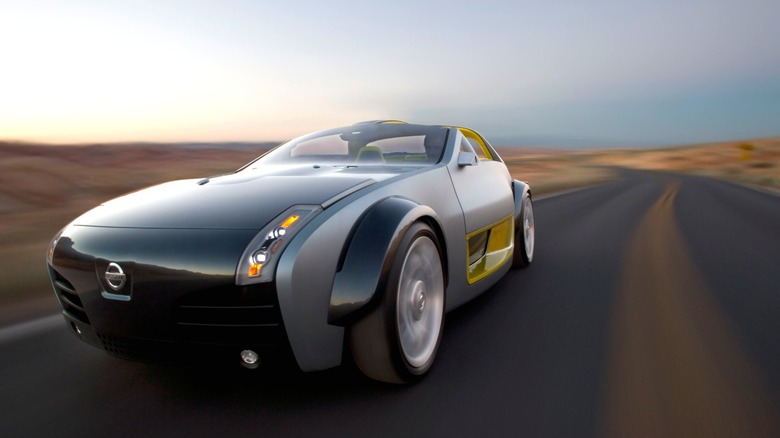
Tesla Arcade and its many innovations have made the concept of in-car gaming seem pretty conventional, but there was a time when being able to game in a car was pretty cutting edge. Case in point: the Nissan Urge, which let drivers boot up a game while they were parked.
Unveiled at the 2006 New York Auto Show, the Urge was a lightweight 2+1-seater targa top that would have slotted in below the 350Z of the time, with the automaker targeting agility and responsiveness over brute force. It shared the 350Z’s wheelbase, with a braking system also derived from Nissan’s mid-range sports car, but had a small, high-revving engine and a motorbike-style six-speed sequential ‘box.
The Urge’s design was informed by an online survey, with Nissan Design America vice president Bruce Campbell stating that respondents “want[ed] a small, fun-to-drive sports car that [could] incorporate the technology products that they use on a daily basis, such as … game consoles.” To that end, the Urge had an Xbox 360 built in, complete with a fold-down screen. The console ran a special build of “Project Gotham Racing 3,” and drivers controlled their virtual car using the real car’s steering wheel and pedals.
IDx Freeflow and Nismo
In 2013, Nissan showcased a pair of twin concepts, the IDx Freeflow and IDx Nismo, that could very well have been great alternatives to Toyota’s GT86. Sadly, neither came to fruition, but we can at least look back more than a decade on and think of what could have been.
The IDx coupes were a tasty mix of old- and new-school design. They drew inspiration from the brand’s back catalog — namely the Datsun 510 and Hakosuka Skyline — and paired them with forward-looking design touches and plenty of edgy lines. The result was two pretty exciting coupes that we have no doubt would have done well had Nissan put them into production.
The Nismo, especially, was the one that likely caught most gearheads’ eyes, with the fender flares, racy wheels, and a paint job not dissimilar to classic Datsun 510 race cars from years gone by. The Freeflow would have had a small sub-1.5-liter gas engine, while the Nismo’s racier looks would have been backed up by a turbocharged 1.6-liter motor, complete with a manual-capable six-speed CVT.
MID 4
The 1990s were a great time for JDM performance cars, with every big automaker offering one or more models that set gearheads’ hearts aflutter. One of the best was Honda’s NSX, which stood out from its peers with its sleek styling and mid-engine layout. Had Nissan’s MID 4 entered production, though, then the NSX may have had some competition.
Nissan unveiled the MID 4 Type I in 1985 — the same year Honda engineers began work on what would become the NSX — before showcasing the Type II a couple of years later. Like the NSX, both variants of the MID 4 were mid-engined. The Type I had a naturally aspirated engine and rear wheel steering, which made way for a 325-horsepower twin-turbo VG30DETT and all-wheel drive for the Type II.
While the Type I was certainly quite impressive for its day, the Type II is the one that we would have loved to see make it to production. From its sleek, Ferrari-esque lines to the capable powertrain and four-wheel propulsion, it would have offered stiff competition to the NSX and showed that Japan really was on top of the automotive world.
ESFLOW
Nissan’s Leaf might not be the vehicle most people think of as a desirable EV in the mid-2020s. Yet, the Leaf is arguably the car that pioneered the EV industry as we know it, with the compact EV’s tech showing that there was a viable alternative to traditional gasoline engines. The ESFLOW is what could have happened had Nissan been willing to said tech to slightly sportier ends.
Showcased in 2011, a year after the Leaf hit the mainstream, the Esflow used a modified version of the Leaf’s powertrain. Instead of the Leaf’s single front-mounted motor, the Esflow had two mid-mounted motors, each powering one wheel. Nissan also reused the Leaf’s battery tech, but relocated it to offer better weight distribution.
Nissan claimed that the Esflow would have a longer range than the Leaf at 240 kilometers, or around 150 miles. Performance was brisk, with Nissan suggesting a 0-62 mph time of less than five seconds. The automaker placed these rejigged Leaf components in an aluminum chassis and wrapped the whole package in a handsome two-seater body that drew heavily from its Z-car heritage, most evident in the long nose and hatchback rear.
Bevel
Concept cars are generally built to showcase the best of what an automaker can do, be it stylistically or technologically, and Nissan is no exception. However, the Bevel concept was something quite different. It wasn’t fast, nor was it loaded with cutting-edge tech. Instead, it showed what Nissan thought it could bring to the somewhat staid SUV concept.
This SUV was Nissan Design America’s take on the concept. It, to quote a press release of the time, was designed to appeal to “male empty-nesters actively engaged in hobbies, recreation and community service.” To that end, the Bevel had an asymmetric design: the driver’s side had an extra-large door and a panel-van-style rear, while the passenger side had two smaller suicide doors that offered ample room for loading equipment.
The Bevel’s rear hatch opened into a tailgate, with a 110-volt outlet present, offering this hypothetical empty-nester a place to work while on the road. It would have been pretty green, too: The Bevel’s electrical outlets drew power from roof-mounted solar panels, while a 2.5-liter hybrid V6 would offer relatively eco-friendly propulsion.
Gripz
Concept cars don’t have to have particularly classy names, and the Nissan Gripz is a perfect example of this, admirably riding the line between clever and silly. On the one hand, spelling it with a “z” was undeniably cringe, even for the mid-2010s; however, it was also strangely appropriate referencing its combination of crossover practicality with Nissan’s performance heritage.
More specifically, the Gripz took the high-riding, compact crossover archetype that was all the rage in 2015 and married it to design elements drawn from the Nissan 240Z — specifically, the red-and-black lifted version that won the 1971 Safari Rally. Thus, while Nissan never said as much, we’ll read the “z” in the name as being a reference to the concept’s Z-car heritage.
The callbacks didn’t stop there, as the Gripz had a red-orange body with a black hood, like the 1971 240Z. It also cribbed from the world of racing bicycles, with huge 22-inch wheels and an interior inspired by elements seen on high-end bikes competing in the Tour De France. The result was a combo that, even now, is surprisingly appealing.
Nails
Nissan’s Nails concept from 2001 is, for our money, one of Nissan’s most attractive concepts, and one that has gotten more likable with age. The Nails was something of a Datsun mini truck for the future, with compact dimensions and a low ride height that echoed the slammed mini-trucks popularized by auto mags such as “Mini Trucks” back in the day.
It paired these proportions with quirky touches like integrated tires and wheels, along with fabric rear doors on the cab that opened up onto the truck bed. The bed also had a black diamond plate and was surrounded by intensely chunky rails, with a tailgate that lifted up and to the left. All of this was finished in a handsome two-tone black-and-light-blue paint job that still looks great to this day.
Of course, this being a turn-of-the-millennium concept, the Nails was designed, to quote the automaker’s press kit, as “a tool for communicating with friends.” Thus, it featured integrated cell phones and other telecommunications tools; extremely quaint features to boast of now, admittedly, but quite something back in 2001.
BladeGlider
Despite its justifiable reluctance to go all-in on electrification, Nissan has a rich heritage of concept electric vehicles dating back to the early 2010s. One of many, and potentially one of the most interesting, was the BladeGlider, a sleek electric performance car that was first unveiled at the 2013 Tokyo Motor Show.
The BladeGlider was all about aerodynamics, with Nissan going so far as to opt for a McLaren F1-style 1+2 seating arrangement so that it could have as narrow a front track as possible. This, combined with a wider rear track, minimized drag and maximized downforce, allowing for what would have been good performance without the need for a lot of power. The name, then, reflected the idea that it would glide across the tarmac thanks to its zero-noise powertrain and sleek design.
Unlike most of Nissan’s concepts, the automaker built functional versions of the BladeGlider. The working prototype had two 130-kilowatt motors — one for each rear wheel — and was taken to the legendary Goodwood circuit in 2017, impressing with its great handling and stylish design.
Alpha-T
The now-discontinued Nissan Titan was not a particularly exciting pickup and failed to gain much traction in the market. Had Nissan stuck to its guns and released the Titan in a form that more closely resembled the Alpha-T concept, though, things may have been quite different.
Nissan showcased the V8-powered Alpha-T concept at the 2001 North American International Auto Show in Detroit, and the full-size pickup caught journalists’ attention thanks to its massive dimensions and unique, ahead-of-its-time styling. We don’t think it’d be an exaggeration to say that the Alpha-T was, aesthetically, a precursor to the Cybertruck, with its angular lines and plain silver finish echoing what Tesla would debut many decades later.
Sure, the Alpha-T had a slightly softer finish, with some rounded-off edges here and there, but the total effect is remarkably similar, down to the glass roof. Nissan’s concept pickup had utility, too, with a motorized truck bed that slid out when the tailgate was down and a toolbox built into the tailgate.
Hyper Tourer
Minivans, with the exception of models like the 2025 VW ID. Buzz we reviewed, are generally not known for being particularly stylish or cutting-edge. Nissan’s Hyper Tourer concept, however, was both.
The Hyper Tourer made its public debut at the 2023 Japan Mobility Show as a showcase of what Nissan’s designers imagined a minivan of the future could be. Thus, the Hyper Tourer was pitched as an all-electric minivan with vehicle-to-everything functionality and a cabin built entirely around fully autonomous driving, complete with front seats that swiveled 360 degrees. This, of course, would allow those in the front to turn their seats around and converse with those in the rear seats, safe in the knowledge that the Hyper Tourer will safely navigate to its destination.
While we’re not likely to see a fully autonomous minivan any time soon, some of the Hyper Tourer’s sharp design cues, especially that smart grille, have made their way into production vehicles. Nissan’s fourth-generation Elgrand minivan, unveiled in 2025, has a front fascia that’s not too dissimilar from that of the concept.
Extrem
The Nissan Extrem was a concept targeted at young Brazilian consumers. To that end, the Extrem was eye-catching and vibrant, with a two-door compact crossover body with chunky six-spoke alloy wheels, exaggerated arches, and a surprisingly sporty posture, all finished in a rich orange that Nissan called Solar Cortex.
Nissan showcased the 2+2 Extrem at the 2012 São Paulo Motor Show. Despite its name, it wasn’t particularly radical otherwise, with a proposed 1.6-liter turbo engine under the hood, but the idea seemed to be to reinvent the wheel here. Instead, the Extrem offered a characterful take on crossover principles with nice touches aesthetically and functionally. The latter included a two-tier luggage space with a removable cargo bin and a see-through A-pillar that both looked good and offered better visibility.
Designed by Nissan Design America, the Extrem was part of Nissan’s attempt to showcase its commitment to the then-nascent Brazilian market. This included a then-new manufacturing facility in the city of Resende, which was still a couple of years away from starting full production when Nissan first unveiled the Extrem.
Mixim
The Mixim was a strange hodge-podge of design characteristics and traits that is both hard to love yet also difficult to not find some strange admiration for. It probably would never have sold well, and we’re glad (for Nissan’s sake) that it never went beyond the concept phase, but it’s such a strange beast that we had to discuss it.
Let's get the mundane stuff out of the way first
The Mixim was supposed to be an EV hatchback that was lightweight and smaller — or, at least, shorter and lower — than the already-small Micra. It would run on two of Nissan’s Super Motors and allegedly offer great range, although Nissan did not offer any numbers for the latter.
What sets the Mixim apart, though, is the design. It had gullwing doors, a rear hatchback deck that looked not too dissimilar to what we’d see on the Honda CR-Z, funky futuristic angles and lines, and a nose that looked like a strange exaggeration of the design language seen on the facelifted 2004 Micra. On top of that, it had a 1+2 (or 1+3) seating layout complete with gamer-inspired controls. The mid-2000s were a strange time indeed.
Jikoo
There are plenty of ways to celebrate anniversaries, but the method Nissan chose to celebrate the 400th anniversary of the Edo Shogunate in 2003 was quite unique: it built a concept car. The idea was that the Jikoo’s construction and design would echo techniques handed down through the generations of craftspeople who had called Tokyo (formerly Edo) home.
It, of course, drew heavily on Nissan’s own heritage as well. The Jikoo was inspired by the original Datsun Roadster from 1935, at least in spirit; the rounded, flowing lines were a radical departure from its boxy predecessor, but the core concepts — an open-top design, long nose, and two-seater layout were present and accounted for. It also had jump seats, like the Datsun, and used its long nose to hide a two-tier storage system accessible from both sides of the car.
The Jikoo was likely only ever conceived of as a show car, evidenced by elements like how the cockpit display focused on showing historical maps and information. However, it’s not hard to imagine a version of the Jikoo taking to the streets and giving other compact Japanese roadsters of the time, like the Mazda Miata, a run for their money.
Related Stories