
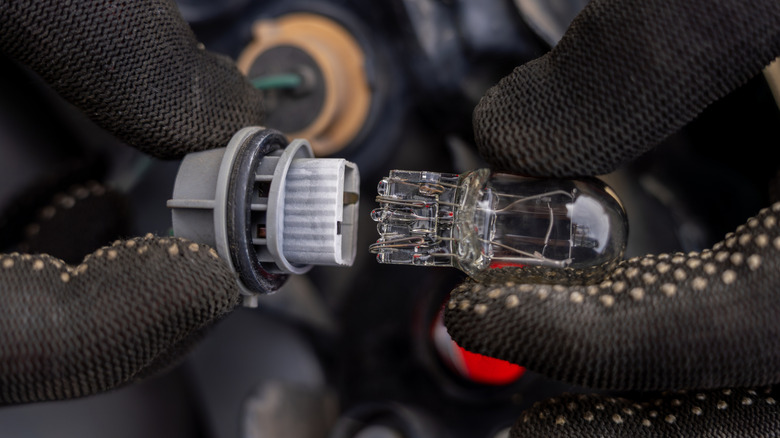
Why You Should Never Touch A Halogen Headlight Bulb With Your Bare Hands
Swapping out a dead halogen headlight bulb in a car is a pretty straightforward job that anyone can pull off. But in their haste, some forget the one important rule — not touching the glass with your bare hands. The reason behind this is actually way more nuanced than just possibly burning yourself on a hot bulb. Of course, a halogen running for long enough does get hot enough to scorch your finger in mere moments, so that’s another reason to keep your hands off. But that’s not what we’re talking about here.
The real reason is more chemistry-related. When you touch a bulb with your finger, it leaves behind a thin film of oil and salt. When the bulb fires up and starts heating, it then gets baked onto the glass. Temperatures climb even higher after that, and as that happens, the contaminated spot heats up too — except at a different pace. This creates a weak point right there. Over time, or sometimes within the first few hours of use, this can crack the glass. Worse, the whole thing can even shatter.
Even if the glass survives the mistreatment, there’s another problem. As Philips points out, Any grease left behind can evaporate and settle on the outside of the housing or the reflective mirror behind the bulb. Visually, it contributes to that less shiny, yellowed-out appearance in lights common in older cars.
Thankfully, there's a simple fix for all of this
All you need to do is grab the new bulb with something like a clean cloth, a tissue, or a pair of disposable nitrile gloves. If you do slip up, a quick wipe with a lint-free cloth with rubbing alcohol applied on it should help. Just let it dry fully before installing, though.
Why do halogen bulbs heat up so much in the first place?
If you’re curious why halogens heat up so much in the first place — the glass envelope can reach as high as 1300°F during normal operation — it’s because they’re basically souped-up versions of Edison’s original incandescent. Just like those, halogens feature a thin tungsten filament inside, and when current flows through, it heats up until it glows. The change here is the added halogen gas surrounding the filament. All that heat causes bits of tungsten to evaporate, but then the gas catches them and drops them back where they came from. It’s a little loop that significantly boosts longevity well past Edison’s bulbs, even though they run far hotter.
Heat also plays a role in how long car headlights last, and it’s part of the reason LED bulbs have so much more longevity in comparison. It’s also why LEDs are safer overall. The hottest part of an LED bulb, its heatsink, is only a fraction of that of a halogen — between 140°F and 212°F — and manufacturers frequently claim LEDs last between 30,000 to 50,000 hours. That’s basically the lifespan of the car itself for plenty of drivers. Halogens, on the other hand, only clock somewhere between 450 and 1,000 hours.
So it’s no surprise halogen sales have been winding down in cars. You can still find replacements for models already on the road, but most cars starting from 2015 come factory-fitted with LEDs. It’s part of why most cars you see on the road today have such bright headlights. Meanwhile for other uses, US federal regulations have already pushed them off shelves: A ban in 2023 specifically targeted the manufacturing and sale of general-service incandescent and halogen bulbs for household and commercial lighting.