
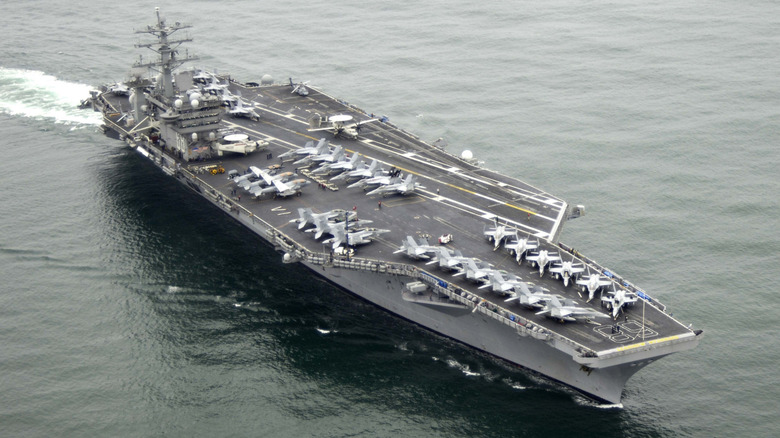
USS Nimitz Was Cruising To Retirement Until The Navy Changed Its Route
After a long career, the USS Nimitz was heading toward a well-earned retirement, at least so it seemed. The Nimitz was commissioned in 1975, making it the oldest in America’s carrier fleet. Notable points in the ship’s history include its involvement in the ill-fated Operation Eagle Claw mission to free American hostages held in Iran, Operation Desert Storm in 1991, and Operation Iraqi Freedom in 2003. The Nimitz has also seen its share of tragedy. During operations in 1981, an EA-6B Prowler crashed on landing, killing 14 crew members and injuring another 47. This highlights the danger that these ships and their crews face even during normal operations.
But there’s one enemy that no piece of military equipment can beat — time. For the USS Nimitz, time appeared to have been called <a href="https://jordangazette.com/what-happens-when-an-engine-derates-heres-what-you-should-know/”>when the U.S. Navy initially said it would be retired from active duty in May 2026. However, for the grand old lady of the U.S. carrier fleet, the retirement has now been delayed for around 10 months, with the ship now expected to remain in active service until March 2027.
This isn’t a random act of sentimentality on the Navy’s behalf. The extension to the ship’s service life is because Congress requires the Navy to operate a minimum of 11 carriers at any given time. If the Nimitz were retired immediately, this would leave the Navy with only 10 carriers. A situation that won’t be resolved until the USS John F. Kennedy joins the fleet, which is expected to happen in March 2027.
Why the Navy still needs the USS Nimitz U
S. Navy photo by Photographer’s Mate 3rd Class Kristi Earl/Wikimedia Commons As noted, Congress has mandated that the U.S. Navy keep 11 carriers operational. However, maintaining an effective carrier presence is more complicated than just counting how many ships are in the fleet. Carriers cycle through lengthy maintenance periods, with even the amount of time taken to refuel aircraft carriers counted in years.
This is important because although the Navy has a legal requirement to operate a fleet of this size, it doesn’t imply that the entire fleet is available at all times. A more typical situation is to have four carriers on active duty, another three or four docked but ready for duty at short notice, and the remaining carriers are dry-docked for maintenance or upgrades. Currently, geopolitical tensions are straining these resources. A point highlighted by the USS Gerald R. Ford’s ongoing deployment, which is now over 300 days, making it the longest deployment since the USS Midway completed a 322-day deployment in 1973.
Ultimately, it’s this pressure on existing carrier resources and ongoing tensions in areas like the Middle East that have delayed the Nimitz’s retirement. The good news for the Navy is that Nimitz’s replacement, the USS John F. Kennedy, recently took a big leap forward and, if it remains on schedule, should allow the Nimitz to finally get a well-earned retirement in March 2027.